
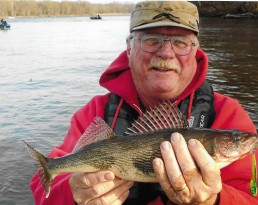
Sauger: The Walleye’s Smaller Cousin
We called them sand pike. I grew up in the 1950s and ‘60s near Lake Winnebago in east-central Wisconsin where I learned to fish. In Winnebago, there were white bass, yellow perch, the occasional smallmouth bass, and lots of walleyes and sand pike.
Everyone called them sand pike, and growing up, I thought that was their real name until some years later, when I realized that sand pike was just a common nickname for sauger. Looking back, it seemed everyone in Wisconsin in those days called sauger sand pike, and it seemed that many fishermen never had a lot of respect for sauger/sand pike, either.
Walleyes and sauger are members of the perch family and are basically cousins.
There are some significant differences between sauger and walleyes. Walleyes are a golden-brown color with no markings on their dorsal fin and a large white spot on the bottom of the tail. Saugers are gray in color and many times have darker gray, almost black blotches on their sides. They also have spots on their dorsal fin and no white on their tail.
Sauger are smaller than walleyes. That may have something to do with those fishermen in my youth never having much enthusiasm for sauger, preferring walleyes over sauger. In most places, walleyes and sauger share a combined limit. In the days of my youth, Lake Winnebago had a five-fish combined limit of walleyes and/or sauger in any mix. For example, you could have a limit of four walleyes and one sauger, or three and two, or four sauger and one walleye. Still today, waters with both sauger and walleye usually have a combined limit for both species.
As a young boy fishing with my grandfather, I recall him telling me that if were getting close to our limit of walleyes and sauger, and the walleyes were hitting, we would release the sauger to make room to keep more walleyes. I think that attitude might have come because sauger are smaller than walleyes. I have talked to other fishermen, growing up in the same time, and they as well remember that many fishermen then did not have a very high opinion of sauger or sand pike.
I do not share that attitude. I find nothing wrong with sauger. I enjoy catching and eating them. Because they are cousins to walleyes, they taste just as good as any walleye. If you have walleye and sauger fillets together, it is impossible to taste the difference.
Sauger have a little more restricted territory than walleyes. They are usually found in big rivers or lakes fed by rivers. The Lake Winnebago system, with the Fox and Wolf rivers and several other smaller lakes, is a prime example of sauger habitat. Growing up near Lake Winnebago, I remember catching a lot of sauger (sand pike).
You can be among the first to get the latest info on where to go, what to use and how to use it!
The sauger population in the Winnebago system has had its ups and downs over the years since I first fished it as a boy. There was a time in the 1990s when sauger numbers were so low that fishermen weren’t allowed to keep any sauger.
From 2002 to 2012, the Wisconsin DNR initiated a program to stock sauger in Winnebago. Today, the combined walleye/sauger limit in the Winnebago system is three, allowing only one sauger to be kept.
Last summer, I fished Lac Seul, a huge lake in Ontario. Our group found sauger there, usually in deep water over rocky bottoms. Most of the fish were small, especially in comparison to the large walleyes that we found there.
Lake of the Woods in northern Minnesota and southern Ontario is known for its walleyes but it also has a large population of sauger. Most of the sauger are in the 13- to 15-inch range. I ice fish there and we catch and keep far more sauger than we do walleyes.
I fish walleyes and sauger on the Mississippi River at the dam near Red Wing, Minn., in early spring and late fall. In the Mississippi, we find larger sauger than elsewhere. It is not uncommon in the Mississippi to see sauger from 16 to 17 inches and larger. I caught my personal best sauger, a 22-inch fish, one fall afternoon on a gold blade spoon. Many of these early- and late-season sauger come out of Lake Pepin. Lake Pepin also has a thriving summer sauger bite for those trolling crankbaits.
Most waters with sauger have no size limits for them although they may share a combined bag limit. On the Mississippi River, they have a four-fish limit for a combined catch of both walleyes and sauger, with a 15-inch minimum size for walleyes but no size limit on sauger.
As mentioned earlier, sauger are the smaller cousin to the walleye. In Wisconsin, the state record sauger is 6 pounds, 6.7 ounces. It was caught in the Mississippi River, Pierce County, on March 19, 2009. In Minnesota, the state record sauger is 6 pounds, 2 ounces, caught in the Mississippi River, Goodhue County. in 1988.
Despite being the little cousin to the walleye, sauger are good to catch and great to eat. Saugers are just a fun fish.

Did you enjoy this post?
You can be among the first to get the latest info on where to go, what to use and how to use it!