
Rise of the Panfish
As winter stretches on, community panfish spots begin to thin out, rivers slowly start to open, and the days grow noticeably longer. Brief warm-ups melt down the snowpack, allowing more sunlight to penetrate the aquatic environment. But don’t celebrate the end of winter just yet! Along with 30- to 50-degree temperatures, March has an alter ego. I have seen 70-degree, lamb-like days on the ice, but two days later, the lion comes out and it’s a blustery 10 degrees.
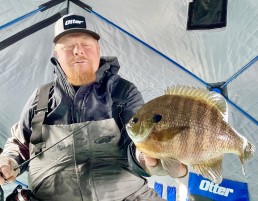
Despite unpredictable weather, longer and milder days create some of the best panfishing of the winter. Deep schools of crappies and bluegills begin to rise and move into shallower terrain. Most of the weed beds are dead and gone, resembling a freshly tilled farm field with only scattered corn stalks and stubble left behind. With limited structure, fish cling to what they can find. Scattered logs, shallow rock piles, and remaining dead weeds become prime holding areas thanks to the fresh influx of melt-off.
In addition to mid-range depths of 10 to 20 feet, panfish on some lakes move into shallow water, up to 3 to 8 feet, especially along shorelines connected to emergent vegetation. Cane grass, wild rice stalks, and deep bulrushes all become part of the panfish’s late-winter habitat.
Looking in
Cell phone technology allows the opportunity to study target lakes with LakeMaster maps directly through the One-Boat Network app. Highlight everything under 8 feet in red, and you instantly narrow hundreds, sometimes thousands, of acres of water into manageable areas. From there, mark spots that look good for crappies and bluegills. I use red icons for must-hit locations, green for good potential, and yellow for backup spots.
Most of my late-ice panfish hunting takes place on larger lakes that consistently produce both quality and numbers of panfish. Smaller lakes often have limited potential when it comes to size and population. Lakes that are 1,000 acres or larger are typically my starting points. Many of these lakes have established reputations among anglers, and DNR survey data is often available online. That information helps confirm whether a lake even holds panfish before you ever step onto the ice.
Let’s RAZR holes
When exploring new bodies of water, it’s better to space your holes 50 to 100 feet apart. On large-acreage lakes, this allows you to efficiently cover water and then fine-tune your search by drilling closer when you find something of interest. This approach works especially well with two anglers: One can RAZR holes while the other scans horizontally using a Humminbird XPLORE with MEGA Live 2, looking for open space or less weeds where you can spot groups of panfish.
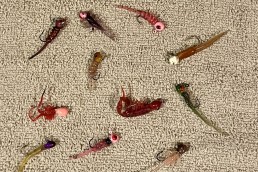
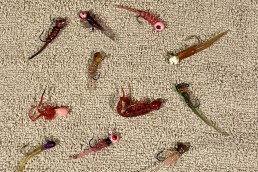
In thicker weeds, it can be better to fish your way through after letting the holes quiet down. A small underwater camera can also be helpful for peeking into weed pockets. Many times, in water less than 8 feet deep, I can actually see fish swimming in clear water while standing and looking down the ice hole at a brightly colored Northland Tungsten Gill Getter or Forage Spoon. I tie them on 3-pound Sunline Fluorocarbon Ice, paired with a St. Croix Pan Dancer rod and a SEVIIN GS 750 reel.
I add a Gamakatsu size 8 single Siwash hook to the spoon and thread on two waxworms. Waxworms are a good visual target as the lure drops toward the bottom. Sometimes, you don’t see the fish, but suddenly the waxworms disappear. When that happens, set the hook! In murky or tea-stained water, I switch to a 2D transducer on my Humminbird XPLORE instead of the down rod once we’ve located fish in shallow water.
Bro Pro Tip: Dress for the mission. When targeting late-winter panfish, sweating can be an angler’s downfall. I wear an AFTCO Reaper Hoodie with a pair of bibs for kneeling on the ice, along with Fish Monkey Wooly fingerless gloves. And don’t forget cleats, which are essential when walking on ice and patches of hard, slippery snow.
You can be among the first to get the latest info on where to go, what to use and how to use it!
No two lakes are the same
I’ve been on lakes where panfish seemed to be everywhere with emergent vegetation and fantastic fishing. However, I try different lakes instead of repeatedly hammering the same schools of fish. I’ve also encountered lakes with similar characteristics—perfect weeds and water of the same clarity—yet no shallow fish to be found. The lake was known for high-quality panfish, but where were they?
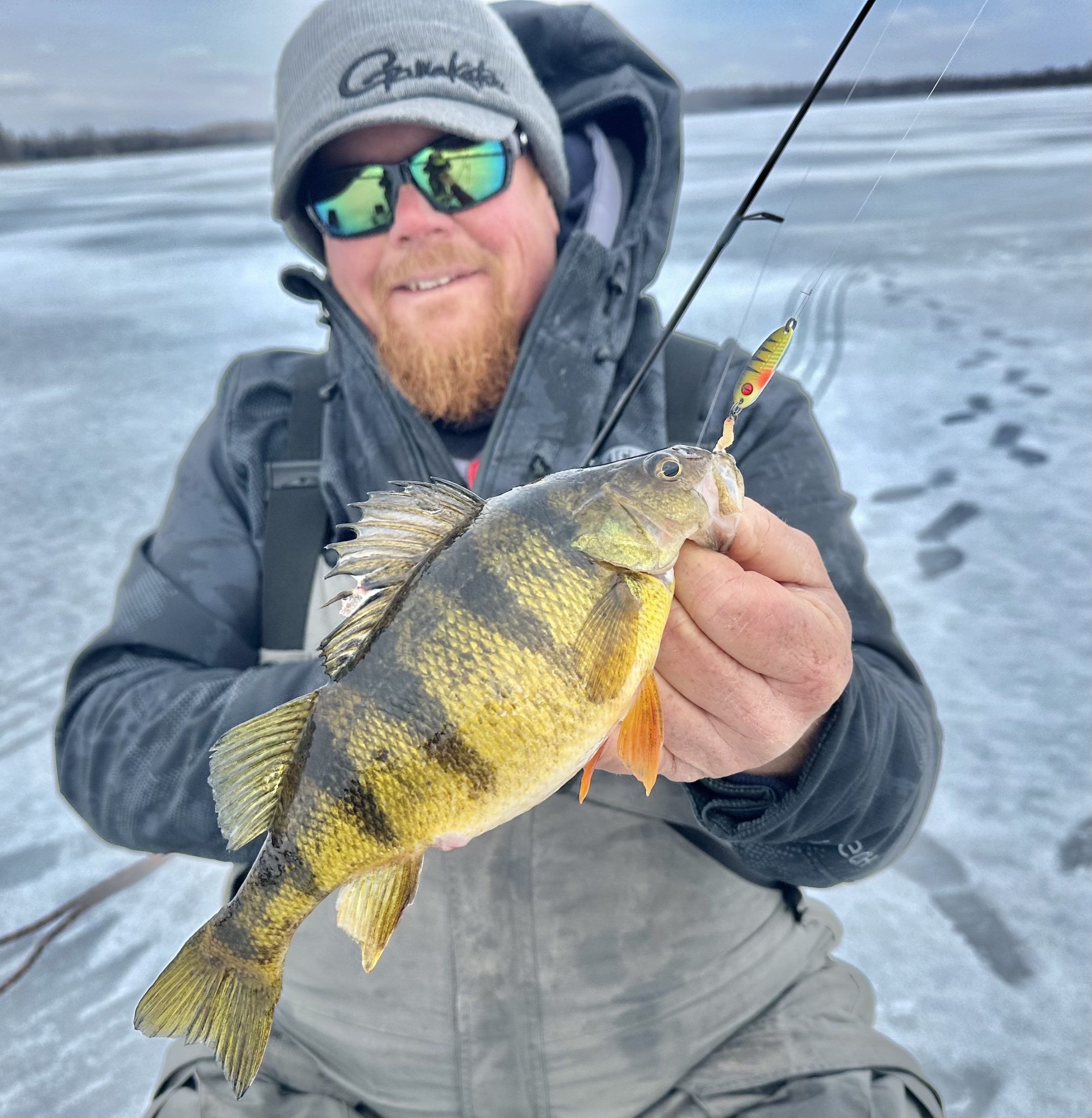
I checked the shallows and the deeper community spots. I was just about ready to give up. Out of stubbornness, I drilled across the flats and along the gradual break between deep and shallow water, which is what I like to call “No Man’s Land.” I was ready to quit with tiny perch stealing my waxworms and maggots, when I suddenly caught a slab crappie. Then another crappie. Then a plate-sized bluegill.
There was no structure at all—just a bottom as flat as a pancake. I kept RAZRing holes to determine where the school started and ended, and discovered that the fish were scattered across the flats, belly tight to the bottom. Not every hole produced fish, but the active ones saw crappies and bluegills making their rounds every five to ten minutes. And the bite became epic! As evening approached and the sun hit the treetops during the hour of power, big panfish cruised the mid-depth muddy flats, grazing on bloodworms and zooplankton.
This lake wasn’t known as a popular late-ice panfish destination, but we had cracked the code and it climbed to the top of my favorites list.
Some lakes allow you to chase suspended panfish. Other lakes are completely different, with panfish buried in shoreline-connected emergent vegetation. And some have fish roaming mid-depth flats feeding on insect life.
Bro Pro Tip: Pack light. I use a Fish Armor Pro Lite Shuttle and down rod to carry my 9-inch Humminbird XPLORE with MEGA Live 2. To keep the weight down, I power with an Amped Outdoors 12-volt, 15-amp battery. The entire setup weighs in at under 19 pounds.
Turn off the spotlights
When RAZRing holes and searching for panfish, I use an 8-inch bit for easier use with a down rod transducer. When fishing heavy vegetation, I switch to a 6-inch Synthetic Ultra Lite RAZR auger. When using 2D sonar in shallow water, larger holes can act like spotlights on bright days, sending too much light through the ice. Smaller holes tend to spook big crappies and bluegills less. To reduce light penetration even further, leave ice shavings in the hole to darken it. Pull the jig up to the rod tip, push it through the slush, and let go of the line—what I call the “Jousting Technique.” I rarely use an ice skimmer unless I’m sight fishing.
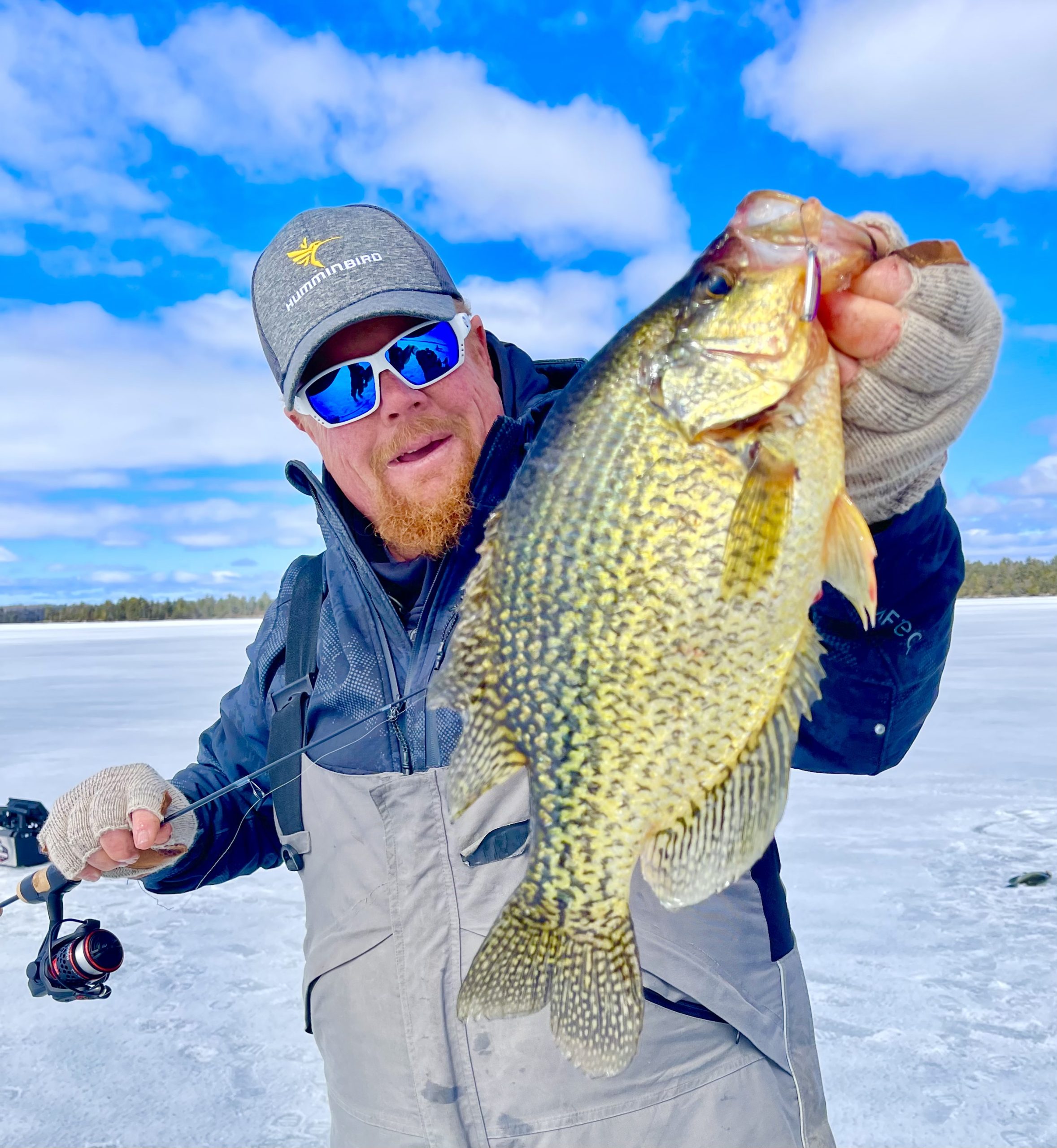
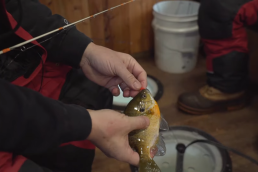
I’ve pulled crappies over 2 pounds through a 6-inch hole, along with plenty of plate-sized bluegills. That said, if you hook a truly big largemouth bass, you may lose your lure to the hole dimensions. A few lost lures may be the least expensive part of an ice-fishing trip.
Good luck, and have fun chasing “rising panfish.”
Did you enjoy this post?
You can be among the first to get the latest info on where to go, what to use and how to use it!