
On The Bank
The title sounds quite positive—maybe even a bit on the cheery side— and possibly a touch euphoric for the month we are in. THE title probably should have read Angling Simplicity out of necessity or frustration due to unpredictable weather such as winds, sleet, snow, freezing rain, intense cold fronts and still-almost-frozen water temps. But that’s an extremely long title—one you might choose to pass on by! So, I’ll stick with the original title—the warmer, fuzzier one. It gives you the feeling that you might be joined on the bank by frolicking unicorns—or something more bearable than a miserable northwest gale!
I must say, March is normally the very birth of the open-water season in most areas of the Midwest; open water, yes, but favorable fishing conditions, well, not usually. While my lack of interest in avoiding hand-numbing weather gets stronger with every season, my desire for open-water angling is what drags my bundled-up backside to the water’s edge!
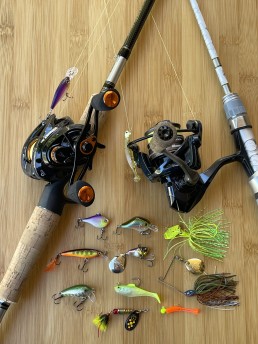
In many ways, my approach to angling at this time of the year is vastly different than during the warmer months. But for the sake of this article, the main focus will be on targeting multiple species. Being a multi-species angler, during the warmer months of the year, I generally pick my target species, gear up appropriately, then head to the banks. Now, the predictability of those target species can be very uncertain, and tough to carry and prep all the gear I normally haul along. Which brings me back to my title, Simplicity.
The simplicity aspect and concept narrows downs one or two approaches to the species that swim in the icy cold waters that you are about to explore. Most of you can probably do this on a regular basis anyway, of which I’m envious; I’m getting better through therapy, but if I have a more than two target species in the waters that I’m fishing, the use of a wheelbarrow would be necessary to carry all my possibility choices, That’s just the way I am.
As I admitted, I’m getting better. Over the last couple of seasons, I narrowed down some very basic techniques and tactics with a multi-species approach in mind, and have enjoyed success during this late-winter period. So, let’s dive into my one lonely, sparse tackle bag. Okay, it’s not that sparse or empty, but it is only one bag!
For the sake of this article, we’ll look at some of the normal characters in most waters around the area. There are certainly more species; feel free to adapt to fit your pursuits. Here we will be focusing on panfish, bass, walleyes, and pike/muskies; the waters are pretty limited for the last two, but we’ll still look at each species.
One tip before planning and outing, try to find: If you’re not familiar, determine the main species in the waters of your destination. In most Illinois waters, it’s a pretty safe bet that most of the species named above can be found in those locations. But investigating before you go makes helps make a more accurate decision on what type of tackle to bring along.
So, let’s get started with probably everyone’s favorite, both on the ice and early in the open-water season: panfish. Bluegills, crappies, and perch, if you have them. Perch seem to be very limited outside the “The Big Lake,” but a few small waters contain a few for the frying pan.
Bluegills: I fish for a whole lot of larger gamefish, but getting into a mess a bluegills still lights a fire under me. A favorite through the ice, they should also be a target species after ice-out. Here’s the concept that changed my bluegill fishing many years back.
During this early part of the season, fish the same approach that you would if you were pursuing ‘gills under the ice, as normally their location and patterns haven’t changed a whole lot, even with open water. If you’re not an ice fishing angler, search for schools of bluegills further off the bank than you would during the warm-water month, as at the end of winter, these fish should be in their deeper water hangouts.
Bluegills can be found anywhere on a lake or pond, but outside edges of existing weed lines are great places to start, not only for bluegills but crappies and perch as well. On some waters, the weeds die off during the winter months, or at least are at a minimum. So edges of drop-offs are targets as well, if you can find them. Wood in the water attracts panfish, too.
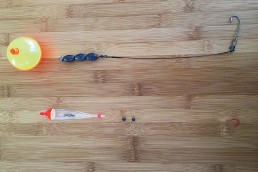
It’s very simple fishing for me, using an adjustable float and jig. It’s probably the simplest approach to all panfish, for that matter, reminiscent of an ice fishing approach using ice jigs; especially when bluegills are the main target at this time of year. All my jigs during this cold-water period are tipped with some type of “meat”—spikes, bee moths, pieces of worms—the one time of the season when I always add a little live bait to enhance my success. Gulp makes a few panfish products which are better than plain jigs, but you still can’t beat live offerings.
Crappies: My next favorite fish at this time of the year, and I target them the same way I do bluegills, in same areas as ‘gills. Though to me, crappies seem to be little more nomadic, even in cold water; you might find them one day and then they’re gone the next. Just keep searching.
You can be among the first to get the latest info on where to go, what to use and how to use it!
Rigs are the same as the bluegill setup, but I “up” the size of my jigs. If I can find them, Imight add minnows to my search baits, but trust me, crappie jigs with spikes will bring them in.
Perch: I rarely target perch in the smaller waters, but the above approaches will get you on them. Based on my little success with them, I’ve found perch to be a little more on the bottom, so keep your bait near their bottom-hovering locations.
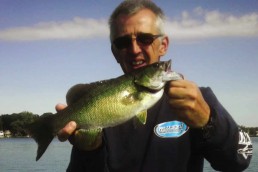
Bass: While tougher to locate at this time of year, you often find them in small packs, primarily in similar locations to panfish. Deeper water, weed line edges, around bottom cover if it exists, they’re drawn to underwater wood and brush if your water has it.
I could tell you that large minnows and ‘crawlers, presented below floats, will produce well. But most bassers want an artificial approach. Here again, think simplicity. My number one bass-producing artificial bait at this time of year is a slow-sinking plastic bait, rigged Wacky style. Smaller Senko type baits—3- to 4-inch, and 4- to 5-inch, straight-tail worms, are my regular choices. I prefer an unweighted rig, opting for the slow-sinking presentation. That not only appeals to the bass’s metabolism at this time of year, but also counting down the drop rate of the sinking bait allows me to target in on the bass’s active depth range. Once determined, I target that depth range around the lake.
The Shakey-head rig is another bait with pretty favorable results at this time of year. It’s basically a jig and 6-inch, straight-tailed worm worked painfully slow along the bottom, mostly holding the jig in place while gently shaking the bait. It works really well if bass are not suspended higher in the water column.
Walleyes: These fish were made for cold water. A few lakes in my local area do contain walleyes. But for my pursuit of Illinois walleyes, I usually stick with river systems for my best chances to hook into these early season ‘eyes. Walleye fishing is kind of synonymous with jigs. While certainly not the only approach, for early season, jigs are all I use. Plain jigheads—no skirt—with live bait is an exceptional technique; ‘crawlers and minnows are the typical jig toppers. I like a mix of live bait and some skirt material; bucktail, an old standard, is still is one of my top choices. But don’t hesitate to mix live bait with plastic tails as well.
I have landed many walleyes—especially on the Kankakee River—with a 3-inch Twister-style tail tipped with a minnow or -crawler. Twister-tail grubs and soft swimbaits take their share of late-winter walleyes as well, and are exceptional choices if you don’t have live bait, or would rather not mess with live offerings.
In river locations, it’s search time once again. But deeper hole areas seem to produce, especially for larger walleyes. Honestly, slack areas off the main flow of water seem to produce multiple species, so never pass those areas by.
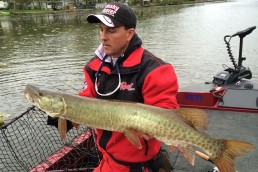
Pike/Muskies: I’m mainly addressing pike here; muskies are generally very limited in this part of the Midwest, although they will primarily bite the same techniques used for pike. I’ve addressed musky in several articles, so let’s throw a little spotlight on pike during this cold-water period. They’re another species that’s bred for cold water; you’ll find pike very willing to pursue most baits during these near-frozen water temps.
As opposed to most of the species above, I prefer to target pike with artificial presentations. While pike are happy to take live bait offerings, I can cover much more water with artificials. Awhile back, I discovered that I can carry one bait for these fish with remarkable success: a soft, paddle tail swimbait. It began when all I had was a couple of white, 3.8-inch Keitech swimbaits. Fishing the Kankakee River during an early season outing, I slammed them until they devoured my soft plastic tails. Now, it’s all I carry: a white or very-light-colored, 3.8- or 4.3-inch Keitech or similar style bait version rigged on a swimbait head. Other baits will work, but in keeping with simplicity, it doesn’t get much easier!
Just a reminder: At this time of year, fishing for all species is a big-time search game. Dropping your gear in one spot—unless you know the area produces—will leave you nothing more than cold and frustrated, so pack light and keep on the move.
Well, that’s a wrap. There’s lots more running through my brain, but limited space to throw it all out here! March is the unofficial start of the open-water season here in Illinois; at least I hope it is! So don’t pack away those winter clothes yet. Bundle on up, focus on this simplicity approach, and early-season success awaits!
Did you enjoy this post?
You can be among the first to get the latest info on where to go, what to use and how to use it!