Old Timers’ Simple Walleye Techniques Still Produce
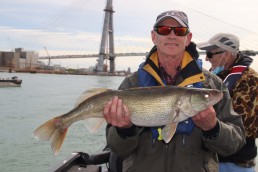
A mixture of light snow flurries and a drizzle of rain, coupled with a cold breeze blowing down the river, made our first outing on the Detroit River memorable.
Add to this fun, we were losing a jig or two on every drift. The Trenton Channel was putting a hurtin’ on our walleye jig supply. We couldn’t tell when a walleye had hit until our rod started bouncing. The fish had to hit hard, because we were using the stiffest broomstick rods that we could afford.
We returned to our lodging, and a guide we knew was there. We explained our dilemma, and he volunteered to check over our tackle.
First problem: Using a cue-stick-stiff rod. A medium or medium-light rod with a fast or extra-fast action is perfect.
Second, we were using heavy line. Today we use a braid in the 6/2, 8/3, or 10/4 range. And the line is a high-vis color that we can easily see jump or move when a fish sucks our lure in. The braid also expeditiously transmits the faintest of bites.
The last Saturday of April is the traditional opener in our area. However, the Detroit and St. Clair Rivers are open year-round. If you’ve never fished these two rivers, you need to.
Most anglers will vertically jig the big rivers on the east side of the state. Two tips are equally important when vertical jigging. First, the trolling motor must be pointed into the wind. No exceptions. This is the only way that you will be able to stay vertical and match the speed of the current at the bottom of the river.
Second, please use a stinger hook. We use a size eight or ten treble hook and have not noticed one being better than the other overall. You can buy your stinger hooks or make your own. My favorite length is four inches. Homemade or store-bought, make sure that the leader is stiff and that the hook hangs behind your plastic or hair jig. If the stinger hangs straight back, it’s much easier for a walleye to suck it in. We use a 3-inch stinger when using a hair jig or a 3-inch plastic bait.
Drop your jig down, hit bottom, and then lift up 3 to 6 inches. Anytime that you don’t feel the bottom, set the hook. When lifting up, if you sense deadness, set the hook. You always need to know where the bottom is. This means either letting more line out or reeling in.
And another tip to remember: Keep your rod tip close to the water so you can set the hook with more authority. Nearly all the jig anglers I know today use braided line.
Some anglers and charter captains that I know tie on a fluorocarbon leader. They tie a snap to their main line and a barrel swivel onto their leader. Some believe that fluorocarbon is harder to spot, and others do so in case they snag up, quickly grabbing another pre-tied rig and snapping it on. It saves time re-tying, especially in cold weather.
Another great technique that rarely gets a second look on the big rivers is jigging, or fishing vertically, with a Mack’s Smyle Blade and a slow-death hook. When using a slow-death hook thread, a ‘crawler up to your knot. Leave one inch of ‘crawler daggling and pinch off the balance.
We like adding a glow bead before the hook. I use glow color blades. Early in the season, we use the size .8, and as things heat up, we move to 1.1-size Smyle Blades. My friend ties this rig to a 2-ounce bottom bouncer. I tie mine to a three-way rig with a 2-ounce bell sinker.
On the west side of the state’s shallower rivers, I suggest drifting this rig using a three-way rig. I lean towards the 3-way rig. If rarely snagged up, will you lose more than the sinker? ‘Crawler rigs work excellently trolling downstream.
Deep holes and deep runs are best, along with any bridge that you can find. Walleyes are often found just behind a current-deflecting pillar. Also, check your graph for a washed-out depression downstream of the bridge.
A bucktail or hair jig is a killer, and a forgotten jig. Marabou, hair, or bucktail jigs tipped with a minnow are often hands-down best choicea in cold, frigid rivers in spring.
A hair jig falls differently than a plastic tail. A hair jig produces better when the bite is slower. My hair jigs are in the same color pattern as my plastics. Something along the lines of the Black Ice, Blue Ice, and Pimp Daddy.
Maybe a decade back, we were fishing near Wyandotte for a late afternoon outing. We started chatting with a boat near us and these two guys only used hair jigs. After some conversation, they gave us two purple-colored hair jigs.
You can be among the first to get the latest info on where to go, what to use and how to use it!
Hair jigs are an old-school lure that most anglers never heard of or have not used within the past few decades. A few old-timers that I know tip their hair jigs with a minnow. One old fishing buddy of mine tips his with a one- inch piece of ‘crawler. I rarely tip my hair jig with anything.


The Clouser fly is similar, except it is weightless. We fish this bucktail fly on Wolf River/3-way rigs. This is a dead-rod technique where the rod is placed into a rod holder.
Another forgotten lure I love to fish is the Whistler Jig head. On big, deep rivers, we vertically jig with the 1-ounce models. Recently, the 1-ounce size was discontinued. Another old river rat shared the Whistler with me maybe 5 to 6 years ago.
On the shallower rivers on the west side of the state, we either cast and hop our lure in, or we throw it out twenty feet, lift the jig up and let it flutter down. The propeller blade draws the fish in.
Whistler Jigs can be fished both vertically and by casting. In weed beds, use the smaller size, starting with the 1/8-ounce. The Whistler really shines in deep water, midday fishing, and muddy waters.
On inland lakes, we cast them around the weeds. You can make your own Whistler in twenty seconds. Buy small-size propeller blades. Add a bead or two and a quarter inch of tubing. Then add your favorite plastic tail.
I picked up this technique from a charter captain while fishing the St. Clair River. We were vertically jigging a mudline and doing very well. Toward the end of our drift, we ended up parallel to another boat. What first caught my eye was that it was a tiller.
I have a tiller, and those things stick out. I also noticed that they were traveling just a tad faster than us and were not using jigs. These folks were running a different line than us. We were in Canadian waters; they were in Michigan waters, and the ends of both drifts brought us together.
After three meetings, I pulled up the boat and introduced myself. It turns out that this guide used a willow-leaf blade with a few beads and two hooks tied 1 inch apart.
He threaded on a ‘crawler, nipped the tail with 1 inch of it hanging, and hooked it up to a 2-ounce bottom bouncer. His spinner rig was 18 inches long. He instructed his clients to drop down, hit the bottom, lift up, or pull forward a few inches and repeat.
This technique really works well, and if you have trouble vertically jigging with a jig, this setup is for you. Keep the speed .1 mph faster than the current. He moves at a snail’s pace, faster than us when we were vertical jigging, but slower than the bottom bouncer guys. His clients love this rig because it’s close to dummy-proof.
We use a slip bobber for many species on our inland lakes. Slip floats work great on suspended fish, wood, rocks, and any weeds that can be found.
Floating jig heads with 3-way rigs and bottom bouncers, or a three-way rig, work great, slow-trolled or drifted with the wind. The floating jig head keeps your bait just above the bottom debris.
On smaller local rivers, we might jig with one rod and drift a split-shot rig in a rod holder. A split shot rig can be along the lines of a slow-death hook or a floating jighead. Add a Mack’s Smyle blade in front of the floating jig head or the slow-death hook. Place a few beads between the hook and the spinner.
Two old time friends use Tube Jigs for walleye. They cast tubes along the weeds and vertically jig tubes on the Detroit and St Clair Rivers. My goal for 2026 is to give them an honest shot. We keep our walleye fishing basic and straightforward.


Did you enjoy this post?
You can be among the first to get the latest info on where to go, what to use and how to use it!