
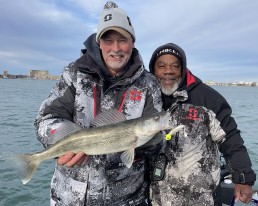
November Walleyes in ‘The D’
When it comes to river walleye fisheries, all fingers point to the Detroit River in southeast Michigan. Known locally simply as “The D,” this Great Lakes waterway connects Lake St. Clair to Lake Erie. While the mighty Detroit is barely 30 miles in length, it attracts walleyes from as far away as Saginaw Bay!
Excitement over the Detroit River reached a peak in recent years. A huge number of walleyes from Lake Erie head to the Detroit River in early spring to spawn. Likewise, walleyes from Lake St. Clair, southern Lake Huron and even Saginaw Bay perform their spawning in “The “D.”
The river attracts anglers from all across the Midwest and Upper Great Lakes regions. Boat launches typically fill to capacity by early morning. Even on weekdays, the river is a busy place in late March, throughout April, and early May.
When the walleye spawning run starts to wrap up in late May, walleyes head back to their summer haunts, and the masses of fishermen also disappear. Most anglers figure the fun is over for another year, but they would be dead wrong. A little-known fall run of walleye sets up in the Detroit River in late October and peaks in early to mid-November.
At this time of year, many anglers have set down their fishing rods in favor of shotguns and bows. Avid anglers who are still actively fishing tend to spend their time on Lake Erie, where they can compete in the Fall Brawl and The Walleye Derby fishing contests.
“The fall walleye run on the Detroit River is not a new phenomenon,” says Captain Rob Jones, who runs trips on “The D” in both spring and fall. “Fall walleye fishing on the Detroit River rivals that in the spring. The biggest difference is that the fall run doesn’t attract the crowds of anglers.”
Vertical jigging
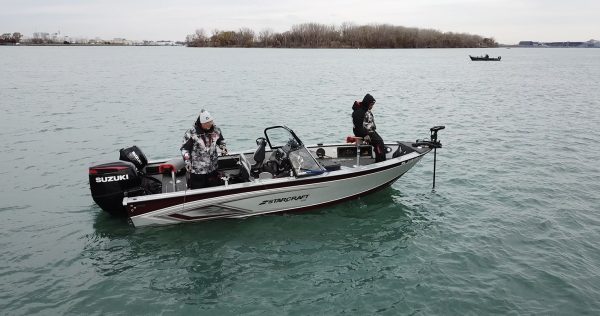
Overwhelmingly, vertical jigging is the most popular fishing method on the Detroit River. This highly-effective fishing presentation is deceivingly simple, yet complicated. Drifting with the current while bouncing a jig along bottom, directly below the boat, is the simple part. The more complex aspect of vertical jigging involves mastering the very precise boat control chores required to vertically jig effectively.
Wind is the nemesis vertical jig fishing. On calm water, the boat drifts downstream at the same speed as the current. When the wind picks up, the boat either drifts faster or slower than the current, depending on which direction the wind might be coming from.
If the wind is blowing the same direction as the current, your boat will act like a sail and drift faster than the current. Conversely, if the wind is blowing upstream, the boat will drift much slower than the current speed.
Anglers must understand and compensate for this dynamic while vertical jigging. An electric motor is the best tool for matching the boat’s drifting speed with current speed.
This is accomplished by lowering the jig to bottom and then watching the line closely as the boat drifts. If the line starts angling upstream, the boat is drifting faster than the current, and you must push the boat slightly upstream with the electric motor. If the line starts angling downstream, the boat is drifting slower than the current, and you must use the electric motor to push the boat downstream.
The boat control required in vertical jigging is best achieved with short bursts of power from the electric motor. It helps to use fluorescent fishing line that is easy to see against the water’s surface.
The goal is to keep the boat, current, and jig all moving downstream at the same speed. Every few seconds, it’s necessary to use the electric motor to make small corrections as the boat drifts.
You can be among the first to get the latest info on where to go, what to use and how to use it!
This style of river jig fishing can be very daunting for beginners. Once you get the hang of vertical jigging, it becomes second nature to drift with the current while making periodic corrections. When this delicate balance is achieved, keeping the jig directly below the boat and just off bottom becomes easy.
Jigs for vertical jigging
Jigs suitable for vertical jigging in the swift Detroit River feature a 90-degree eye tie so the jig hangs horizontally in the water. Jigs must also be heavy enough to easily maintain contact with bottom. Important jig sizes include 1/2-, 5/8-, 3/4- and even 1-ounce models. The heavier models are needed for fishing in deeper water and also for fishing on windy days. The smaller jig sizes are important when working shallow water or on those rare days when it’s dead calm on the water.
The head shape of the jig is not critical to vertical jigging success. Simple round-head jigs are the standard for vertical jigging, but bullet, guppy, stand-up and pancake -tyle jigs are also effective.
More important than the shape of the jighead is the hook used for vertical jigging. A thin-wire hook with a wide hook gap is needed to stick walleyes and keep them stuck. The Eagle Claw Lazer Sharp L570VP Pro-V Jig Hook is the jig hook all others are compared to. While more expensive, the Trokar TK570P Aberdeen Jig Hook is considered to be the ultimate hook for vertical jigging. Machine sharpened to produce a wickedly sharp hook, Trokar jig hooks are popular with anglers who pour their own custom jigs.
The Eagle Claw River Jig is a good example of a walleye jig made especially with the Detroit River in mind. These jigs come in the proper sizes and feature hooks that are ideal for walleye jigging. Sold at retailers everywhere, the River Jig come three-in-a-package for the 5/8 – and 3/4-ounce sizes, and two per package for the 1-ounce models.
Stinger hooks
Adding a stinger hook is important when vertical jigging. Light bites and short hits are so common that anglers who don’t use stinger hooks could be missing as much as 40 percent of the fish that bite!
The Eagle Claw Cinch Stinger Hook is ideal for vertical jigging in river situations. The unique cinch connection makes it easy to put the stinger hook on, and also to remove it when changing soft plastics or adding live bait.
Soft plastics
Anglers targeting walleyes in the Detroit River will need three different soft plastic bait styles, including split-tail minnows, paddle-tail grubs and finesse worms. These three profiles in 3- and 4-inch models get the job done, day-in and day-out, on the Detroit River.
Natural-color soft plastics are important when the river runs clear. When fishing in murky-water conditions, brighter fluorescent oranges, yellows and greens are necessary to maximize bites. If the river flows dirty, dark shades including brown and black produce the best action.
Adding scent products
Natural scent products can also help anglers enjoy more bites and more aggressively hooked fish. Pro-Cure Bait Scents is a leader in the natural scent business. The Super Gel series of scents are offered in a number of natural forage formulas, including emerald shiner, gizzard shad, alewife and smelt. Because these scents are an oily and sticky gel, they generate an effective scent stream in the water for 30 to 40 minutes. Water-soluble scents tend to wash off all most as quickly as they are applied.
Summing up
Just about everyone who enjoys walleye fishing has heard of the Detroit River. Famous for delivering world-class spring river walleye action, very few anglers have discovered that “The D” is also a great fall walleye fishing destination. A visit to the Detroit River in fall offers up all the fishing action you could hope for, with none of the crowds.

Did you enjoy this post?
You can be among the first to get the latest info on where to go, what to use and how to use it!
