
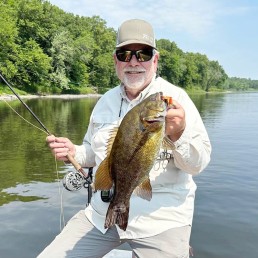
No-Nonsense Flyfishing for Shallow-River Smallmouths
Few things in fishing are more exciting and enjoyable than tangling with big, powerful fish in shallow water. Especially if you use a long, limber fly rod. Flyfishing is stealthy, up-close-and-personal with your quarry, and a throwback to simpler times—the way fishing should be.
It also has its drawbacks, like trying to cover lots of water, strong winds that prevent you from casting effectively, and the notion that it’s only effective for trout, as well as hard to do. Nonsense.
Let’s put these perceptions where they belong: out with the trash. If you’re not at least trying it, you’re missing out on some of the finest fishing experiences you can image. Especially for smallmouth bass in rivers.
Let’s look at some fundamentals, and fine-tuned tactics, that make flyfishing extra special, beginning with basic tackle, and then moving on to put powerful fish on the line.
Equipment
To get started, you need is a 9-foot, 6- or 7-weight fly rod. You could go lighter, but risk having to fight smallmouths to the point of exhaustion to land them, making them more difficult to release. A 6- or 7-weight rod does the job nicely.
Spool your reel with a # 6 or #7 weight-forward, floating line matched to the rod. This excels for fishing any type of fly on or just below the surface. Then tie a monofilament, tapered leader to the end.
My good buddy and flyfishing guide Mickey Johnson recommends using a 9-foot, 8-pound test tapered leader, which is plenty stealthy enough for catching smallies in stained rivers. He then ties about 16 inches of 20-pound-test fluorocarbon to the end of the tapered leader (Fly guys would call that a tippet, rather than a leader tied to a leader.) to prevent bite-offs from pike and muskies. I’d probably go a little lighter, like 12- to 14-pound test, but that’s personal preference. In either case, fluorocarbon is invisible in the water. Using a lighter, more flexible leader just unfurls a little smoother and quieter at the end of the cast. To each his own.
And by the way, fly leaders are often sold in “X” designations, like 3X, 5x, etc., depending on how heavy they are. Forget about that nonsense. The pound-test is also printed on the package for those of us who don’t know how to speak X.
Fly types
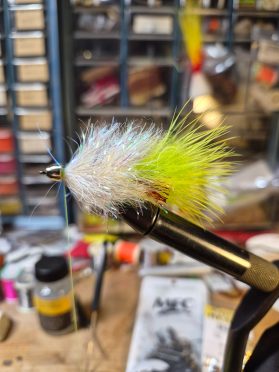 There are many flies and fly patterns on the market. Trout anglers famously try to “match the hatch” by using tiny flies to mimic insects hatching, rising or floating on the surface. The microscopic vision of wily trout in ultra-clear water demands such nonsense.
But not smallmouths! This isn’t trout fishing with tiny size 22 flies and 2-pound test leaders. For smallies, keep it simple. Three-inch-long flies fit the bill. Mickey likes midsized poppers—not large ones that are difficult for smallmouths to suck under and grab—tied with #1, wide-gap, hooks. And streamers tied with #2 streamer hooks. You can buy them in outdoor stores catering to fly fishing, or purchase component parts and assemble your own. Just avoid those with hooks too small to grab and hold onto a feisty smallmouth.
“Think in terms of using something that’s lifelike and gets their attention, rather than trying to match natural forage, Mickey says. “A floating fly like a popper; a submergible fly like a Dahlberg Diver that dives downward with a bubble trail when surged, then floats back up when paused; or some type of streamer fly will do the trick in most circumstances. You could experiment with an insect imitation like a woolly bugger, perhaps with a tiny, metal bead head to make it run a hint deeper. But truthfully, I seldom need to do that. Don’t overcomplicate things!”
“Smallmouths are notorious for chasing down and chomping brightly-colored flies, as well as lures. Poppers look like frogs. Streamers exhibit the profile of a minnow, but their hair or feathers add extra motion. It doesn’t have to be a beautiful tie. Just something that looks good enough to eat.
“Beadhead or conehead flies are basically tied with a tiny bit of weight at the head of the fly, with beadheads obviously being lighter; coneheads, which look much like they have a bass angler’s bullet sinker up front, are obviously heavier. Cone shapes come through the water well. You’re moving the fly enough to swim it. When you strip your line, the body collapses. When the fly is paused, all the little hairs flair out, like the fly is breathing. It’s deadly.
“I really like a gold conehead, yellow cactus chenille body, with chartreuse tail feathers, laid forward with a little Krystal Flash palmered in to add some sparkle. It’s easy to tie, somewhat similar to a woolly bugger, but you don’t have to lay on a layer of chenille. All the little fingers are constantly moving. Fish come up to look at it, are convinced it’s the real deal, and bite.
“If you prefer using a lightly-weighted fly, wrapping a little lead thread on the middle third of the hook makes the fly sink more level, rather than head-down. But once again, it’s probably not necessary.
“I like flies that are quick, easy and cheap to tie. If I snag up, I’m not afraid of losing them. Once a fly becomes a piece of artwork too precious to lose, you waste a lot of time and effort trying to get it back. Instead, just break it off and tie on another one.
“I’ve seldom noticed a major difference with colors, but occasionally, it can happen. Mostly, I use bright, visible colors because smallies respond to them so well, but a plain, white streamer works much of the time as well.
“I used to tie in weedguards, but they act like a bit of a rudder that makes the fly run differently. Instead, I just clean weeds off and put up with the occasional snag. If weedguards are too stiff, they prevent fish from compressing them and getting a good hookset. So, I go with bare hooks unless snags are extremely bad.
“Most anglers probably have 7 to 9 fly patterns that they have confidence in, at least in certain circumstances. For instance, at the end of June and into July, I might try a crayfish pattern fly when crayfish are molting and vulnerable. But again, don’t overcomplicate things!”
Where do you need to fish?
The following bit is likely to challenge your perception of how and where to catch river smallmouths in summer. Remember, you were warned.
Most of the time, you’re fishing for smallmouths in as little as a foot of water, down to 3 or 4 feet deep. You can certainly draw deeper fish up toward the surface by floating, twitching or slithering flies above their heads, like from the depths of a pool. But a lot of the time, you don’t need to do that.
You can be among the first to get the latest info on where to go, what to use and how to use it!
“A 3-pound smallmouth can sit in 8 inches of water, no problem,” says Mickey. “They can be tight along shore, in the shade, even if it’s not a cut bank. Or inside a tangle of submerged brush or a fallen tree. They can lie in divots between shallow weeds, with the weed tops dancing above their heads in the current. Don’t be surprised if they’re shallower than you’d think.”
In the rare instance that you need to fish deeper than 3 or 4 feet, you can mess with sinking or sink tip lines if you’re a flyfishing purist. But many of us aren’t, and will instead go with the flow as needed. I always figure that switching tactics to a jig, crankbait, or other lure, worked on a spinning or casting rod, is simply easier and more effective for deeper presentations. Pick your poison.
And here’s the mind blower. Anglers have become programmed to think that smallmouths can be shallow, but must have deep water to escape to nearby. Like a 6-foot hole, or some form of swift current break supplying overhead protection from predators like hawks and eagles. But guess what? During summer, smallies can and do inhabit long river sections with water no deeper than 3 feet in the center of the channel. There may even be no discernible channel; just a few hundred yards of river with shallow sand flats extending shore to shore.
Not supposed to happen, right? But during periods when the water is warm and relatively stable, smallies can spread out along shore for long distances, a few here, a few there, in pockets of shade and/or cover. When the sun moves from the east during morning to the west after noon, switch to fishing the other side of the river, because chances are that smallies have changed sides to take advantage of the shade. They may shift up-or downriver a bit to find shoreline cover and shade, but likely not that far.
In fact, sometimes, they’ll lay out in little depressions in otherwise consistent sand flats, a foot or two deep, where they can tuck out of the current. Right out in the middle of nothing! Sacrilege! But surprisingly true! In spring, sand flats adjacent to current become spawning areas, and fish may spread out across them to build nests. Look behind islands or prominent points along shore, and you’ll discover spawning flats loaded with fish. Invest in a good pair of polarized sunglasses to see them. It makes the difference.
The upshot is, during summer, pods of smallmouths can move around, shore to shore and along both banks, to wherever they feel safe and are able to feed successfully. You may have to cover a lot of water to find pockets of fish, and then figure out if they’re tight along shore, in wood cover, out across flats, or relating to current flowing over and around classic midriver shoals, boulder fields, the ends of pools, the points (upriver and downriver) of islands, bridge pilings, rock and rubble shorelines, submerged weeds, and even pockets along the outer edges of emergent weeds like cane or bulrushes. Chances are, they’ll use some of each. And to make things more challenging, patterns can shift during the course of the day.
Just when you thought you had shallow-river smallies all figured out… you didn’t! Instead, you have to go look for them. You may go down hundreds of yards of shoreline that all looks pretty much the same, and then suddenly run into a 50-yard stretch that holds fish. That’s just the way it is. Good stretches tend to be good, repeatable spots, but sometimes, you just don’t know.
Tactics
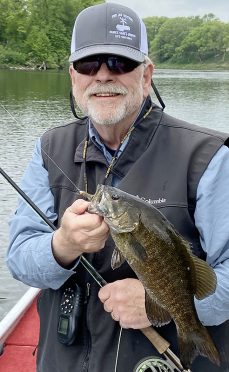 When smallies are tucked tight to shore, you can drift downstream along a riverbank, maintaining the same boat distance from shore, making the same length cast every time with a fly rod. There’s no need to retrieve line; just lift the line off the water, flick it behind you, and when the rod loads, propel it forward, releasing your grip on the line as your fly nears the target. The line, leader and fly automatically lays out the same distance every time, with the leader unfurling at the end of each cast, and the fly silently landing on the water. What could be easier, stealthier and more efficient than that?
When they’re a bit farther out from the bank, or when they’re willing to follow and chase, work your fly all the way back to the boat. They’ll surprise you, suddenly charging and taking your fly just as you’re ready to lift it out of the water for another cast. It’s like they think it’s getting away.
Smallies are very competitive, so it’s common for more than one to chase your fly. If you hook one, another angler should cast right back toward the hooked fish. Chances are that another fish, which is excited and perhaps waiting for the hooked fish to cough up a crayfish or baitfish, will immediately smash the second fly or lure.
“When you sense that fish are tight to shore or cover, get your flies right in there, in the shade, and work them along the upstream sides of logs or submerged trees, Mickey says. “Sometimes, fish seem like they’re watching and almost catching your fly, even just before it lands on the water. But when you notice that fish are roaming about more, like on a cloudy day, be sure to also work the intermediate area between the bank and the boat. It’s just something you notice if you pay attention.
“If you see a prominent rock, fish both sides of it, not just the upstream side. You just never know. Miss a fish? Get your next cast right back in there. If a fish is excited, it will likely bite again.
“Experiment with how you work your fly. With poppers, try a really hard pop at first, followed by a long pause. Or a series of subtler pops, again followed by a pause. Fish will stare at your paused fly and get mad at it. On the next twitch, boom!
“With a Dahlberg Diver, really give it a sharp tug to create a bubble trail. It looks alive, and bass respond to all of the vibration.
“With streamers, strip line a few times, then pause. Give the fly time to suspend and let all the little hairs flair out and breathe, so it looks alive.”
Tips
“Lately, it seems like there are scenarios where fish come out and just bump something, but turn away,” Mickey adds. “I’ve seen it more and more. I’ve had to school people on how to set their hooks. Many people set hooks by just raising their rods up into the air. Either set hooks to the side or strip-set it like when fishing in saltwater. With a lift-set, the hook may slip right out the sides of their mouths.
“Also, don’t be in a rush to set the hook. Take a breath. Give the fish a beat to turn sideways before you set. If you feel a fish, you think it’s hooked. Not necessarily. Set twice.
“I’ve had many people watch me and do incredibly well. They remember how Grandpa used to catch fish. Go back and use some of that old stuff that used to produce years ago. It still works!
In closing
So, chances are that everything we said about pods of smallmouths spreading out along shallow river sections in summer may be a bit of a surprise to you. Sections you once though were too shallow to hold fish may in fact be holding a few here, a few here, very catchable using a fly to stealthily fish in shallow water.
Once fall rolls around and the water temperature begins cooling, smallies sense the seasonal change and begin migrating upriver to deeper pools where they can spend the winter, or downriver to the top ends of reservoirs where the water is deeper and current is reduced. During this migration, flyfishing still works, although you may wish to cover water more quickly with a spinnerbait or crankbait to locate packs of migrating fish. Once they reach deeper wintering areas, you can pretty much put away your fly rod until next spring. But the good news is, the bite remains hot and heavy if you’re versatile and switch to other methods better suited to fishing deeper water.
Did you enjoy this post?
You can be among the first to get the latest info on where to go, what to use and how to use it!