
Minnesota DNR Updates
Fish highlight: burbot
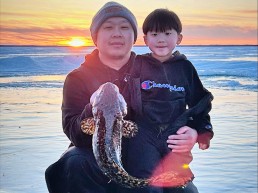
An ice fishing target that talks back: the burbot! Also known as an eelpout, poor man’s lobster, and many more common names, the burbot is an unusual fish shaped like an eel. Burbot are found in most northern lakes and rivers, including Lake Superior. These fish love frigid, deep waters. We have telemetry records of burbot going as deep as 900 feet in Lake Superior!
In comparison to other fish species, they spawn very early. In late February to March, they can be seen grouping up in massive spawning balls beneath the ice.
Despite their slimy exterior, burbot are delicious when prepared properly. They’re the only freshwater cod and have a consistency similar to a lobster (hence the common name poor man’s lobster).
When caught, a burbot may bark at you. Anglers can keep up to four burbot with Minnesota’s inland waters possession limit. On Mille Lacs Lake, all burbot must be immediately released.
Learn more about this unique fish on the DNR website, dnr.state.mn.us/species profile burbot.com.
Minnesota DNR requesting feedback on hunting, fishing regulations books
Anglers, hunters and trappers are invited to share their thoughts with the Minnesota Department of Natural Resources about the regulations books published annually to inform people about how they can legally hunt, trap and fish in the state.
“We are interested in understanding how people access, understand and use the information in these regulations books,” said Sarah Middleton, DNR wildlife rules and regulations coordinator. “To continuously improve how we inform the public about the regulations relevant to their activities, we want to hear from people willing to share their thoughts and experiences with us.”
You can be among the first to get the latest info on where to go, what to use and how to use it!
The DNR produces three regulations books each year for fishing, hunting and trapping, and waterfowl hunting. The regulations books consolidate complex legal requirements into a comprehensive format for public use.
The DNR encourages people to share their thoughts using an online questionnaire on the DNR website (mndnr.gov/qr/rt-regs-book) through Monday, March 16. People can also submit feedback by email to Sarah.Middleton@state.mn.us or to the DNR Section of Wildlife, 500 Lafayette Road, St. Paul, MN 55155.
The DNR will analyze feedback this spring and plans to continue engagement efforts throughout 2026. Copies of the regulations books are on the Minnesota DNR fishing regulations webpage (mndnr.gov/regulations/fishing) and hunting regulations webpage (mndnr.gov/regulations/hunting). Printed copies are also available wherever DNR licenses are sold.
Presence of zebra mussels in Washington and Chicago counties
The Minnesota Department of Natural Resources has confirmed the presence of zebra mussel larvae in Tanners Lake, abutting the town of Landfall in Washington County.
Recent DNR analysis of Tanners Lake water samples showed 12 zebra mussel larvae, called veligers. While the DNR has not found adult zebra mussels in Tanners Lake, the presence of veligers suggests reproducing zebra mussel populations. Tanners Lake will be listed as infested with zebra mussels.
The Minnesota Department of Natural Resources has also confirmed the presence of a zebra mussel larva in Goose Lake, near Stark in Chisago County.
Water samples taken in Goose Lake by the Wild River Conservancy and analyzed by the St. Croix Watershed Research Station, part of the Science Museum of Minnesota, included a zebra mussel larva, called a veliger.
The DNR has not found adult zebra mussels in Goose Lake. The presence of a veliger, however, suggests reproducing zebra mussel populations. Goose Lake will be listed as infested with zebra mussels, and the Wild River Conservancy will monitor zebra mussel populations in the lake.

Did you enjoy this post?
You can be among the first to get the latest info on where to go, what to use and how to use it!
