Maintaining Healthy Fisheries Requires Adapting to Modern Times
Not long ago, I was an eager-to-learn student of the fishing world. Let’s dial the time machine back to the mid-to-late1980s. It was easy to gather fishing information through countless Saturday morning fishing shows, books, magazines, VHS videos, radio shows etc. And the fishing was good. The fishing pressure was good, too—meaning, angler hours on the water, in my opinion, were minimal compared to now. The use of technology (sonar, navigation) was minimal as well. And frankly, top-quality anglers who could put many a fish in the boat at any given moment were also hard to find.
Even with old, outdated, liberal fishing limits—no slots, no special regulations, and simple possession limits—fish populations seemed to be kept in check and doing just fine—and the fishing was good! Wow, how easily I can reflect on the “easy days” of walleye fishing on some of Minnesota’s top walleye-producing waters. That was then. Times are a-changin’, and in order to help maintain quality fishing for generations to come, we all need to make some adjustments—especially when it comes down to harvest, catch-and-release, and management.
As a fishing guide, I’ve been through three phases (so far) throughout my 34-year career (only 16 years and one phase left?). The first phase began when I was just getting started back in 1989 (I was roughly 18 years old). In order to build a guide business back then, it was all about numbers of fish caught and the stories that my clients (walking, talking advertisers) would tell their friends in hopes of steering them my way. Word of mouth, written articles, free seminars, agreements with resort owners, and pictures of a ton of fish caught was the business model. There was no Internet, cell phones, or you tube videos. So, to say the least, that phase lasted the longest.
And yes, I look back at those days and know now that it was a great plan to grow my business, but probably not the best for certain lakes—or the fish. Remember that many of these clients only went on one fishing trip per year—so in theory, the damage was minimal. Compare this to groups that fish 22 weekends a year, and indulge too much by taking limits of whatever species, each time creates a much different outcome in relation to fish populations. Even at that, as I evolved as an angler and paying attention to the science, I began to enter the second phase of my career: management.
The management phase of my guiding career began out of necessity as my business grew into a seven-day-a-week operation back around the mid-to-late 1990s. I started to realize that if I didn’t manage the harvest levels (fish kept) on “my spots,” I would literally fish them out. It might take a week or two, but it could be done—all by myself. It didn’t matter if it was walleyes, crappies, or bluegills—the effects were the same. Bass and pike were excluded back then, since nobody wanted to keep either one. (Today, people love to keep a few pike; they are some of the best table fare that swims; how things have changed!).
You can be among the first to get the latest info on where to go, what to use and how to use it!
These were spots I had found where I literally had no competition from other anglers—because angling pressure was minimal 20 to 25 years ago. Of course, I had hundreds of spots spread throughout dozens and dozens of lakes, But the bottom line was, in order to make my job easier on myself, I had to manage the fish populations on a variety of spots—especially throughout the summer months when many species are heavily schooled and can be homebodies, to some extent. Even though I am not a fisheries biologist, I can simply tell you that one person can manage isolated catchable fish populations single-handed.
The basic idea was to visit more numerous spots less often, and only harvest a couple of “keepers” off each spot at any given moment. That way, I could slowly “milk” the spots of fish in some cases for an entire season, versus for only two weeks. Another couple of benefits of rotating multiple spots, and only fishing each one for a very short amount of time was that I never really “spooked” the fish off of the areas—so they hung around longer.
Another helpful side effect was that other anglers (through observation) could never pattern me or the areas I fished. This also equates to helping manage the fish population(s) on any given spot or lake. In other words, we all know what happens when a hot bite hits social media; it gets destroyed by overfishing. I still use my simple spot management techniques today, but it has also helped to create a third phase.
The third phase that I have been into for quite some time is related to the second phase to some degree. It also involves management of the numbers of fish I/we harvest in the boat. I have decided on my own personal limits for each species. In my opinion, the DNR is 20 years behind the times. It’s clear that thanks to sonar technology breakthrough(s) (Livescope/GPS/Spot-Lock), social media abuse (instant info on a hot bite), outdated fish limits, effects of invasive species, tournament abuse (too many anglers on the same lake, increasing lake exposure) etc., that the quality of fishing for most species on numerous bodies of water is declining. The decline is everywhere—not just limited to the metro areas; it has spread much further north than it ever was before.
Being that I fish all of the popular tourist/fishing destinations throughout the state, I can safely say, without a shadow of a doubt, that it’s a statewide decline in quality fishing. Like I said before, I’m not a fisheries biologist, but the information and observations that I gather are quality, real-time data (just like my other guide friends) that really shouldn’t be ignored. Test net data can be extremely misleading—good or bad. But an avid angler’s intel through actual observation and experience is always valuable. So, I figured one day long ago that, if the DNR isn’t going to adapt fast enough, I will.
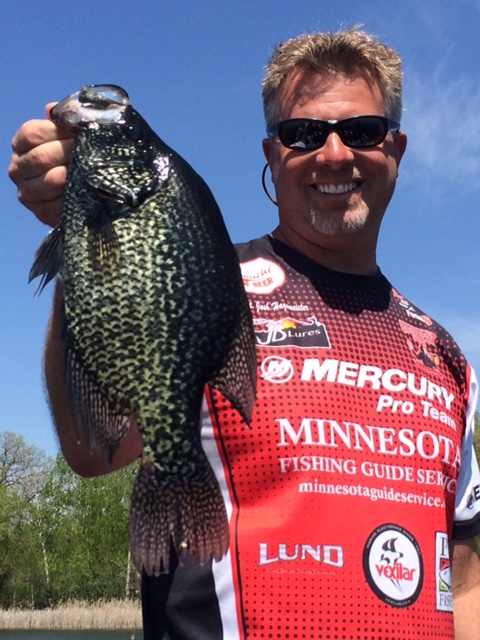
So, long story short, a bunch of us guides out there have more or less made a pact that we are not going to follow the state-set limits; we will set our own—which are far less than the state legal limits—along with some slot limits, especially on highly-pressured bodies of water or regions. A few limit examples would be 5 crappies, 10 bluegills, 4 walleyes, or 10 perch. And in some instances, no possession limits of any kind. And guess what? The clients love the concept, no matter what state they are from—which basically blows out of the water the theory/concerns that if the state lowers limits or increases slots, tourists will stop coming. Has anybody ever asked them? Where are they going to go? That’s right, nowhere. It’s simply false. Do I lose some trips because of my personal rules? Yes, but it’s because I purposely do not take parties fishing who start the conversation by asking how many limits they can take home. Sorry, I’m not that guy anymore. I’m guessing phase four is around the corner.
I’m not really sure what phase four will entail—if there is one? I hope that there will be a phase four, because to me, that means I’m still learning and adapting, which can only help my success, and the successes of others!
Did you enjoy this post?
You can be among the first to get the latest info on where to go, what to use and how to use it!