Late-Fall Bassin’ with ROF Baits
I am not a fan of using acronyms! It started back before I retired; it seemed we couldn’t communicate or explain details of our job without loading up on the acronym dump on everything from conversations to emails. So, what do I do? Use a despised acronym in the title of this month’s article!
ROF—rate-of-fall baits
So, you were probably unaware of this new category of baits? Officially, it’s just a category that rolls around in my brain; so no, you didn’t miss anything in a new breakthrough system!
It’s funny: The more years you spend with rod and reel in hand, the fewer true “breakthrough” baits, techniques—anything fishing-related—seem to come forth. You find yourself in that, “When I was a kid… or when I first started fishing, there used to be _____ (fill in the blank) state of mind. Your anticipated excitement waiting for the newest bait offering, technique, or creative design seems to fall a bit short in the wonderment department. Realistically, much of what we’re introduced to today is often just a little more than a tweak, or at most, the “building of a better mousetrap” concept.
So, where does this month’s bank-approved technique fall, category-wise: old, or new/reinventing the wheel? Actually, this system is more of an observation reached after many few years on the water and relentless trial-and-error.
I started fishing this concept of keying in on the rate of fall of certain baits many years ago as we departed from the last warm waters of fall, heading into the coldest water time of year. Late fall is an awesome time of the season to be on the water, but you need to make some adjustments in your approach to trigger colder, yet still active bass. Bass can be unpredictable in their location and depth, so finding a bait that covers top-to-bottom is essential to locating active fish.
I originally began my cold-water searches for bass using a wacky-rigged Senko. This setup is certainly more than just a late-fall rig, as wacky-rigged Senkos or other types of stick bats are popular and effective for much of the open-water season. During much of my open-water season with wacky-rigged stick baits or worms, I prefer using a wacky jig of some type. But during this cold-water period, I wanted to offer the bass a bait with a much slower descent, so I went with an unweighted hook. This slow-descending bait, working its way from the surface to the bottom, proved deadly on cold-water bass.
There are few little tweaks and exceptions, and we’ll get into those in a minute. But once I started using this technique, certain ROF baits became the center focus of all my fishing up until my waters froze over.
Before we get further into the technique itself, here’s a little more explanation on why the concept works so well for bank bass anglers. First, wacky-rigged “anythings” just flat-out catch fish. The system does not need to be tested to see if it works; the rig just does, so you can push that trial-and-error testing aside. The questions you’ll have to figure are more of the physical attributes of the bait itself, as to whether it will appeal to the bass in your particular body of water.
Senkos or stick baits are always good starting-off baits, but be open minded; various types of worms or other types of underwater “creature type” offerings work as well. Experiment to determine your local bass’s preference. Focus on presentation and technique as being much more critical than variations of your plastic offerings.
The technique is to drop your bait through the water column rather slowly, as opposed to just cranking a bait through at just one particular depth. A slow-falling bait is often way too much for a bass to pass up as they are packing on the pounds prior to a few months under the ice; or at the very least, a winter period of very cold water.
You can be among the first to get the latest info on where to go, what to use and how to use it!
Some experts claim that because of the cold water, bass are way too lethargic to chase down a bait; there’s some truth to that, but from what I’ve experienced, bass are more tightly schooled in various depths due to water conditions. I’ve had them devour a fast-moving crankbait within their proximity, so thinking that they can’t catch a bait due to their lethargic mood, I don’t find to be true; they just don’t seem to be on the prowl as much as during warmer-water situations.
We tend to think of baits as means of enticing bass to bite, hooking them, and reeling them in, which it is. But also imagine these ROF baits as a type of fish-locating device as well. When I’m fishing during the cold-water period, I’m trying to piece the puzzle of where active bass are located at the moment. Rather just catching a random bass, I’m looking to develop a pattern. Using bait that can cover water from the surface down to the bottom has become my fish locator; my manual and less expensive FFS, so to speak!
Since we’re kind of in technique mode at the moment, here’s a quick and simple explanation. I try to find the deepest water in whatever body of water I have chosen. Wacky rigs are not my favorites when weeds abound, so I’m generally fishing more open water areas or on weed line edges. In general, weeds are not usually a big issue by this time of late fall, so most fishing areas are open to fish the rig.
I simply cast the bait of choice out and let the bait make its way down through the water column. Don’t get carried away with adding action to this rig; the subtle fall is the attracting action of this bait, so let it settle on a semi-taut line. This is a cast-and-drop method for me. The action is created by the fall. I don’t crawl the bait back along the bottom; rather, once the bait reaches bottom, if there’s no reaction, I simply retrieve for another cast.
Learn to do the countdown method as the bait drops—counting one thousand, two thousand, etc.—which will allow you to determine the depths of active bass. Once you figure out that active depth, you’ll often find bass active at that level around the lake, so your pattern begins to develop.
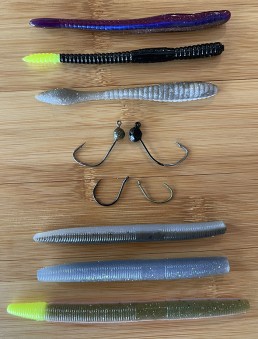
Now for the bait and rig itself. If I can, I usually try to work with just a plain, unweighted hook. Choose your favorite wacky-style hook. I prefer the true wacky hooks with the short shank, looking similar to a circle hook. Senko-type baits normally have a good fall rate, but if you have baits that are very buoyant, you might have to use a light wacky jig or weight ofno more than 1/16- to 1/8-ounce to get a decent ROF.
As stated, stick baits are probably my first choice for ROF baits. I prefer 4-inch over the standard 5-inch Senko-style baits during this part of the season. Choose for your waters, but my numbers are normally up with the smaller size. In addition, I’ve had success with smaller finesse worms as well, I keep these worms under the 6-inch range; 4.5-inch worms rule supreme. It’s hard to beat the smaller Roboworm’s 4.5-inch Fat Straight Tail Worm, or one of my old favorites, Charlie Brewer’s 4-inch Slider Worm. If you feel that scent gives you an edge, try Berkley’s MaxScent Flat Worms in the 4.25-inch size; all are productive finesse worms. Use what you like. Finesse worms are plentiful, but keep them on the shorter side.
Everyone asks me about color. I don’t want to start an in-depth conversation or argument, but to me, color variations in most baits, especially plastics, are way too overrated. During this time of the year, I’ve purposely experimented with all the usual, must-have bait color options, but have also tied on some rather flamboyant hues as well—with incredible success. It’s not a copout here, but we have an incredible infatuation with colors and baits. Just choose your favorites. But here’s just a little morsel of info from last season: For me, any of the “morning dawn” hues were killer!
Gear-wise, it’s normally lighter spinning gear for my ROF angling. Choose a rod and reel combo that can cast very light baits and rigs, yet is sensitive as well. I primarily use 15-pound braid, and not always tied to a leader. But if you prefer a clear leader, a mono or fluorocarbon leader in the 6-to 10-pound range gets the job done.
As the cooling winds of late fall make their way in, don’t head for a place by the fire—yet! There’s a whole lot of open-water season ahead, and bass willing to be enticed with your ROF approach!

Did you enjoy this post?
You can be among the first to get the latest info on where to go, what to use and how to use it!