
High-Visibility or Low-Visibility Fishing Lines?
Most fishing lines on the market these days are offered in both high-visibility and low-visibility colors. The question is, when should you use high-visibility lines, and when should you opt for low-visibility lines? It seems that for every rule in fishing, there is an exception to the rule. But this short tutorial should help shed a little light on the advantages and disadvantages of high-visibility fishing lines.
For the record
For the record, we don’t know for sure if fish can or can’t see the various types of fishing line in the water. Assuming that fish can see fishing line, do they always associate fishing line with something to be afraid of or concerned about? Who knows the answer to this question?
For my entire fishing career, I’ve stuck to one way of thinking when it comes to fishing line. It’s always better to assume that fish can see fishing line, than to assume that they can’t. When a fishing presentation is enhanced by using high-visibility fishing lines, I’ve always opted for adding a clear fluorocarbon leader at the business end. While many may argue it’s not necessary to add a clear leader, I’ve always adhered to this standard and have never felt handicapped by the decision.
 Knots for adding fluoro leader material
The most seamless way of adding a fluorocarbon leader to any main line are knots designed for the task, including the double uni-knot, the Albright knot and the FG knot. Each of these knots are strong and small enough to easily slide through the rod guides and onto your reel. You can easily learn how to tie these knots at the internet site www.animatedknots.com, a site designed to help anglers master new and complicated fishing knots.
Some anglers prefer to attach main line to leader line using small swivels. While this practice is easy to master from a knot tying perspective, swivels can and will do a lot of damage to rod tip top guides over time. It’s simply best to invest a little time into mastering a few of the knots that work well at joining different line types.
Vertical jigging
Vertical jigging cries out for using a high-visibility superline as the main line. The ability to see the line while jigging makes it much easier to facilitate boat control chores needed to keep the line vertical and maintain the lure directly below the boat.
Pitching jigs
Jig pitching is another common fishing presentation that screams out for the use of high-visibility super lines. The ability to make long casts, the sensitivity to detect even subtle strikes when the jig is at maximum distance from the boat, and the ability to see the line twitch or move from a strike, add up to three very important reasons that everyone who pitches jigs is best equipped with a high-visibility superline.
Longline trolling
Longline trolling is the art of trolling bait or lures straight out the back of the boat. This presentation is often teamed with multiple rods of varying lengths to help spread out the lures and cover more water. In this situation, using a high-visibility monofilament or superline is very important in terms of steering hooked fish away from other lines.
Monofilament is a good choice when fishing in open-water areas that are largely free from structure or cover. Switching to an ultra-thin-diameter super line is a good idea when fishing in and around cover such as emerging aquatic weeds or submerged wood.
Trolling diving planers
Trolling with diving planers is one of those presentations where using a high-visibility line isn’t always critical. Many might argue that using a low-visibility line makes fishing divers a stealthier presentation. In the same token, many anglers use only black or clear divers to further enhance the stealth trolling characteristics of using diving planers.
The exception to this rule would be when small diving planers are used in combination with planer boards to spread out gear and cover the maximum amount of water. Switching to a high-visibility superline in this situation makes it easier to see lines, avoid tangles, and to fish shorter overall leads, which also helps to land fish more quickly.
You can be among the first to get the latest info on where to go, what to use and how to use it!
 Planer board trolling
Planer board trolling is one of those presentations where anglers commonly use all the different line types and both high-visibility and low-visibility lines. For example, if a high-visibility superline is used as the main line, a low-visibility leader of monofilament or fluorocarbon is required. If a low-visibility monofilament or co-polymer line is used as the main line, no leader material is required.
Downrigger trolling
Downrigger trolling is best approached using low-visibility lines including monofilament, co-polymer lines and also fluorocarbon line. These line types work best with the pinch-pad-style releases and stackers commonly used in downrigger trolling. A 20- to 25-pound-test line works best for trolling downriggers for trout, salmon and steelhead. For targeting smaller fish like walleyea, coho or brown trout, using a 15- to 17-pound-test, low-visibility line is the best option.
Flippin’ heavy cover
Bass anglers who flip jigs into heavy weed or wood cover are best equipped with a low-visibility braided line. Braids in the 50- to 65-pound-test range are ideal for flippin’. Some anglers prefer to flip using a high-vis braid, then use a permanent marker to black-out about 10 feet of the line near the lure.
Bottom bouncer trolling
Slow-trolling bottom bouncers and spinner rigs is commonly done with both monofilament and super lines. While bottom bouncer rigging is not exactly a finesse style of fishing, it does function best as a stealthy presentation that favors low-visibility lines. For shallow-water situations down to about 30 feet of water, a clear or other low-visibility monofilament line works nicely. In deeper-water conditions, ultra-thin and low-stretch superlines are far better options for fishing bottom bouncers. The ultra-thin nature of superlines makes it much easier to maintain contact with the bottom when fishing in deep water.
Forward-facing sonar
Some fishing lines on the market touted as being superior for fishing with forward-facing sonar. These lines claim to provide longer casts, faster sink rates and more sensitivity. In reality, these lines are nothing more than thermally-fused products such as Fireline, marketed as forward-facing sonar fishing lines. A high-visibility line with an invisible fluorocarbon leader is the best option for fishing most forward-facing sonar presentations.
 Spider rigging
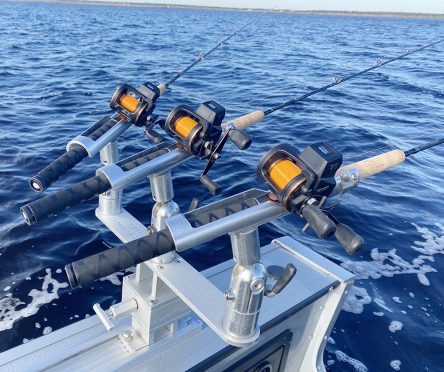
Spider rigging is commonly used to catch crappies on southern waters. Thin superlines are the best option for spider rigging. Because spider rigging involves fishing several rods in close proximity to one another, and this rigging method requires a leader at the terminal end, using a high-visibility superline with a monofilament or fluorocarbon leader is the best option.
Casting crankbaits, spinnerbaits and bladed jigs
Bass anglers who commonly cast crankbaits, spinnerbaits, and bladed jigs are best served with a low-visibility line such as fluorocarbon. Not only is fluorocarbon nearly invisible in the water, it has less stretch than monofilament line, making it more sensitive.
Slip sinker rigging
Slip sinker rigging is all about maintaining contact with the bottom. A low-visibility, thin- and low-stretch superline makes for the perfect choice for fishing slip-sinker Texas rigs and also Carolina rigs. At the terminal end, a low-visibility fluorocarbon leader is the best option.
Float fishing
Most of the bobber-stops designed for fishing slip-floats work best when used on monofilament, co-polymer or fluorocarbon lines. String-style bobber-stops can be used on superlines, but the tag ends of the knot need to be cinched up extra tight to prevent the bobber stop from easily sliding on the slick surfaces of superlines.
Because a bobber is already a visual strike indicator, low-visibility lines are the best options for most float fishing situations.
Summing it up
All the common types of modern fishing lines are produced in both high-visibility and low-visibility color options. Which one is the best choice depends on the presentation at hand.
Did you enjoy this post?
You can be among the first to get the latest info on where to go, what to use and how to use it!
