
Grubbin’ It!
I’m not certain how to react when a “new” bait or technique suddenly becomes the center of attention in the angling world. I’m also not crazy about being reintroduced to “new” product concepts or techniques that I used way back in 19??—whatever—that have gone full circle back to the spotlight!
Part of me naturally leans a bit to being that grumpy old fisherman who claims that nothing is new anymore. You know, “I was catching smallmouths as long as your arm while your mom and dad were still chasing each other around the monkey bars on the playground!” Yet the other side of me is learning to embrace these “new” things. I’ve been blessed with enough years on this earth to experience a resurgence in both products and techniques, something way too many family and friends who are no longer here are unable to do. For that reason alone, bring on those 50-year-old baits! I can’t promise you won’t hear a story, though.
In my first article this year, I mentioned spending a lot of time last season experimenting with baits and techniques, and that my successes would make it to print this season. so here we go.
First up to bat—conveniently tied in with the opening of baseball—is “the grub!”
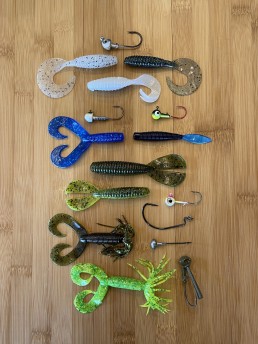
In the world of soft plastic baits used for bass angling, most baits can be categorized into worms, craws, swimbaits, creatures, lizards, frogs, etc. The grub is kind of the “mutt” of plastic baits. Body-wise and tail-wise, they seem to be an offspring of various bait designs. There are no actual parameters that designate a grub as a grub; look them up on tackle websites and you’ll see a multitude of characters under that category. For the sake of testing last season, I narrowed down my grub selection to just a few.
The grubs getting the spotlight in today’s article are baits in the 3- to 5-inch size range—soft plastic, of course—with various tail actions. They are small and compact offerings that draw attention from both numbers of average-sized bass, to hawgs hiding in the depths.
Single/curly-tail grubs
This bait that goes way back for me, especially in the smaller size; honestly, back to the days when my dad tied on the Mister Twister Curly Tail and turned me loose! I not only slayed the bass, but practically all the species that lurked below the surface in our favorite waters. There are a few more sizes, scents, and colors today, but a bait that has remained virtually the same over many decades.
I’ve always had a supply of them, yet over the past years, the soft, paddle-tail swimbait has pushed the curly tail from one of my go-to baits, and I’m not alone. I like to go off the trends, however. A couple years back, I picked up some 5-inch curly tail grubs on a whim, rigged them up for some river angling. and smallies annihilated them. I put them back in rotation after that, but with a wider range of use last season, it just blew my mind on how effective these baits were on all bass in all waters, from ice-out till first-ice as winter approaches.
The curly tail is not a seasonal bait; that’s why I wanted to kick off the open-water season with them. If you’re not familiar with the curly tailed grub, the head and mid-section are rather worm-like; some companies use a fish-like shaped body. It doesn’t really matter, because fish attention is drawn to their tail action.
Curl tails can vary in length and thickness; size-wise, you can find curly tails ranging from 1 on up to 9 inches. But for most bass angling, my choice is the 3- to 5-inch range. Tail action is determined by design and plastic thickness; the thinner the material, the slower you can retrieve the bait and still have an enticing action. I prefer thinner plastic, especially in colder-water conditions.
Jigheads are the normal rigging setup, using round head jigs, weedless jigs, small swimbait heads, darter heads, etc. They can be also be fished weedless by Texas-rigging them with a worm hook, with or without a weight.
You can be among the first to get the latest info on where to go, what to use and how to use it!
The multitude of potential retrieves makes this bait—and all grubs—versatile throughout the season. You can use them as search baits, using just a steady retrieve; crawl them along the bottom; and rigged weedless. You can work grubs through vegetation, and actually on the surface like you would a soft toad bait. The bigger the tail, the better the surface action; they’re a surprisingly good topwater bait.
Twin tail grubs
For the sake of this article, I will focus on two types of twin tailed grubs; one being the curly tail, and the other more of a flat or split, beaver-tailed design. The twin, curly tail grub is basically the same curly tailed bait described above, but rather than having just one tail, it has two. It gives off a bit more visual action. Often, the plastic is thinner than the single tailed grub; both work well.
The other twin tail is generally used more as a trailer for jigs and bladed jig baits. Don’t confuse these with craw tails, similar to but not usually featuring as much flapping action. The Strike King Menace bait got me using this style of twin paddle tail. The split tail on the back seems like they could have little action. But on the retrieve, these small paddles have a subtle, swimming action; sometimes, especially in clear-water conditions, bass are often attracted to their subtlety.
Rigged in multiple ways, much like the curly tailed grub above, these baits are quickly becoming a favorite of mine when I feel hat tbass are reluctant to chase the wilder action of curly tailed baits. It’s a sleeper of a bait on a plain jig; get ahead of the crowd this season by giving them a shot.
Spider jigs
This is another bait that has been around for many years; why it’s not used more, I don’t know. This is definitely a “mutt” jig bait. The rear is simply a double, curly tailed grub. The body the same, but the head section looks like spreading, tube bait tentacles. While other grubs can be used alone or as a trailer, the spider jig needs nothing, as the tentacles look like a skirted jig. I began using these when they came out as Gary Yamamoto’s Hula Grub.
The Hula Grub, or spider grub by most manufacturers, has been relegated to being a bottom-style bait; indeed, it’s an incredible bait for working bottom cover. But don’t overlook it as a swimbait or swim jig as well. If you want to swim them, use a swimbait head; or if you want to keep them relatively weedless, a swimbait head with a brush guard. For the bottom approach, I use a weedless football head jig or a stand-up bottom jig. This is a very underrated bait for sure; if bass are picking at forage such as crawfish on the bottom, this should be your go-to bait.
My rod and reel setup for grubs is as simple as the bait itself. In open water, and generally for swimming these baits, I use 10- to 15-pound braid on my spinning reel. Typical jigging rod size and action are perfect. When I’m working the depths with heavy weeds, then I jump on up to 30-pound braid. Now mono works as well, but I prefer the sensitivity of braid for its ability to cut through vegetation.
When to break out grubs? Simple: Anytime you’re standing on the edge of the water! You can manipulate a grub to fit water conditions from top to bottom, and adjust the speeds to fit the season. And, you can walk the banks with minimal tackle; with just a few extra grub bodies and jigs or hooks stashed away in your pockets, you are more mobile without the weight of bags dangling off your shoulders.
This season, break out the “mutt baits” of the bass world, use grubs to bring a few more bass to the bank!
Did you enjoy this post?
You can be among the first to get the latest info on where to go, what to use and how to use it!