
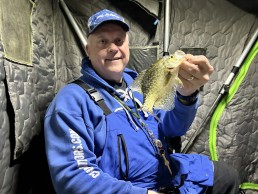
Go Deep and Dark for Midwinter, Thick-Ice Crappies
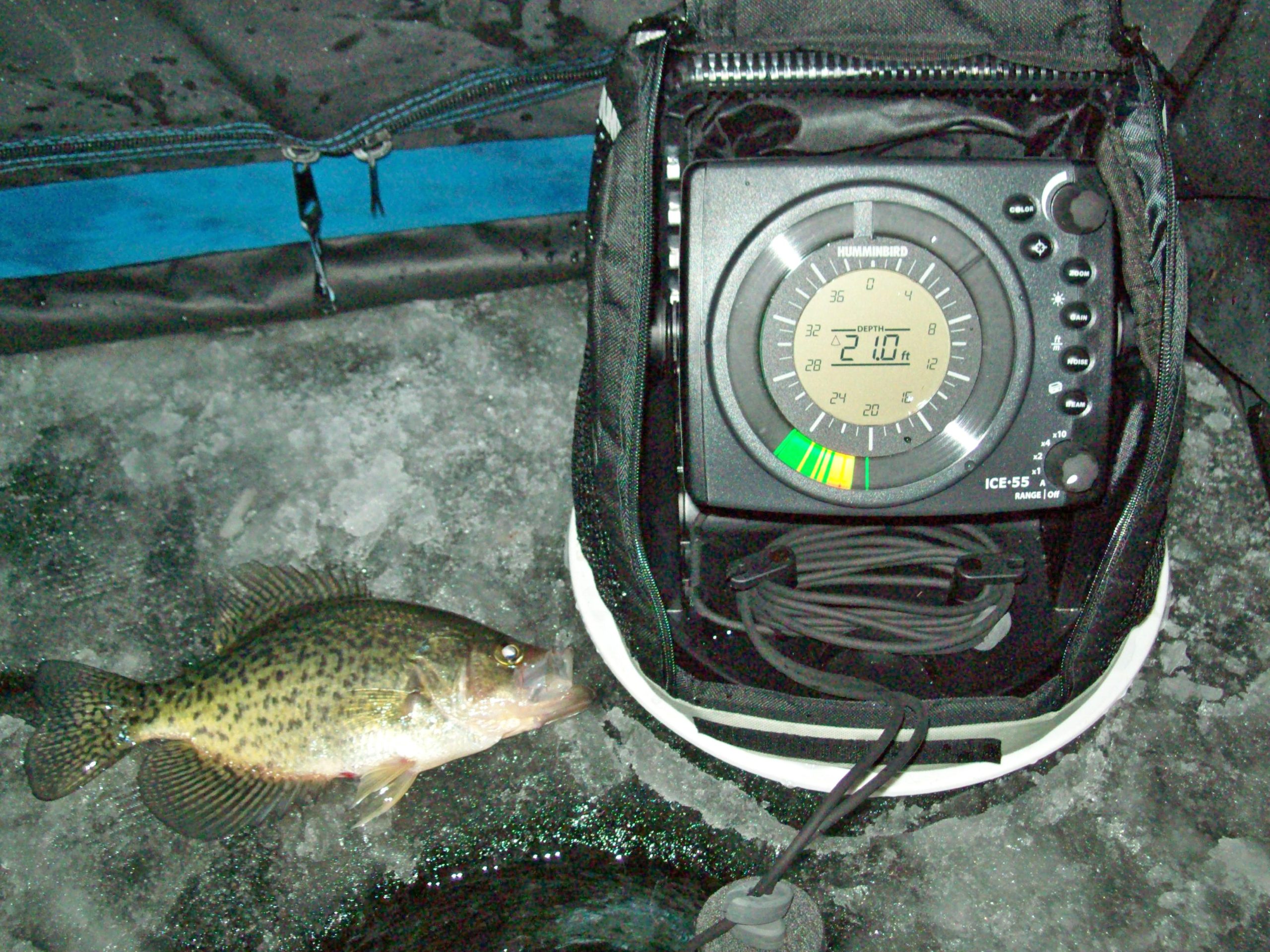
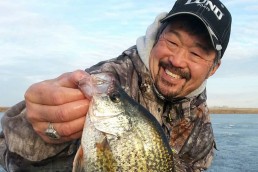
“I am seeing fish already,” my son said as I entered our Clam hub shelter with the last of our equipment. “Got one,” he said a few seconds later, before I could even get my jig down to the fish lighting up my Humminbird. By the time I finally got my jig 22 feet down to the soft bottom, Parker was tossing a 10-inch crappie into a bucket. “Fresh crappie for dinner tomorrow,” I smiled.
January and February can be downright cold in the Midwest. The lakes have enough ice to drive vehicles on, and fish-house villages mark many of the offshore reefs and humps on lakes. During this time, panfish leave the shallow bays and the dying, decaying weeds for deep-water basin areas. During the cold-weather, mid-winter period, these deep, soft-bottom basin areas have abundant insect larvae activity, and therefore are teaming with schools of panfish. Fishing these basin areas near shallower reefs and humps dotted with shelters can produce good mid-winter action for bluegills, crappies, and/or perch, depending on the species available in the lake. Fishing for crappies can be especially good at and after dark.
Modern ice fishing electronics make you a better fisherman all winter, but they can be outright critical to success during the mid-winter, deep-water night bite. A GPS mapping unit can greatly shorten the time required to find basin areas near offshore reefs and humps. A good flasher is invaluable in finding the water depth you are looking for, and for spotting fish. Turning up the gain can also show panfish food (bloodworms, midges, etc.) rising up from the soft bottom in basin areas. This especially happens after dark, and crappies will be in these areas, taking advantage of the easy meal.
I will not head out on the ice without my Humminbird Helix Ice 7s which give me GPS and ice flasher capability. These units are reliable and user-friendly, and are critical for the thick-ice, night crappie bite. Crappies are often moving around basin areas near shallower reefs and points at night, and a good flasher will help you know when they are swimming through, as well as at what depth. Crappies feeding at night on larvae rising up from the bottom can be found at all depths, from right near the bottom to just a few feet below the ice, twenty feet above the bottom. My Helix Ice 7 keeps me in the know for where to set my bait to get bit.
For this type of fishing, I use an ultralight rod with a strike indicator (spring bobber) for my jigging to feel and see strikes. This setup allows fish to inhale a bait before the rod loads up. I like to use a 24- to 28-inch St. Croix Legend Black Ice rod spooled with a Fish 13 Descent inline ice reel for finicky, night crappies. This combo, spooled with 2-pound-test Berkley Vanish Fluorocarbon, is super sensitive, allowing you to feel the most subtle bites. The inline reel allows me to use the fluorocarbon, which is nearly invisible in the water, tied directly to the jig, with no spinning from line twist that you get with a spinning reel.

There is no magic jig or color; you have to experiment each day. I always have a couple of different-colored horizontal jigs and vertical jigs rigged up on rods when I go mid-winter crappie fishing. For horizontal presentations, I like a VMC Tungsten Tubby, a VMC Roach Jig, and a Custom Jigs & Spins Gill Pill. The Lindy Frostee Jig is a good vertical presentation, as is a tiny Lindy Frostee Spoon. I tip these with a waxworm or two to three red spikes most of the time, although if you find the fish to be super-aggressive, you could substitute a 1- to 2-inch soft plastic. Experiment until you find the combination the fish will hit.
You can be among the first to get the latest info on where to go, what to use and how to use it!
It is usually best to move the jig to attract fish, and then stop moving the bait when a fish approaches. If this causes the fish to move in and take the bait, keep doing the same thing. If the fish turns and swims away when you stop moving your bait, then keep moving it and see if that makes the fish bite.
Watch your flasher and move your jig to just above where you see a fish. If the fish is reluctant to bite, try moving the jig up a bit. If the fish follows it up but doesn’t bite, move it up some more. As long as the fish follows your bait, you can keep moving it up until the fish bites… or disappears.
In addition to the rods that my partner(s) and I are holding and jigging with, I always put down a second line for each angler—we can use two lines per person ice fishing in Minnesota—with a crappie minnow hooked on a small, vertical jig under a slip-float. I use an ultralight or light-action rod for this, again paired with an inline reel and spooled with either 2- or 4-pound test fluorocarbon.
I start out with this set three feet above bottom. As crappies start showing up, I try to observe what depth seems to have the most frequent appearances of fish, and move the minnow under a float to that depth. The action that a struggling crappie minnow imparts often attracts fish to your area, even if finicky fish won’t bite it. If there are crappies around, and they are somewhat active, you will catch some on this second line.
You will pop an occasional walleye or northern on this rig as well. We have had periods at night where a large school of active crappies swims through and we have bobbers going down the hole while we are bringing up fish on our jigging rods. This is one of the most fun fishing experiences of the season.
I would be remiss if I didn’t address jig and plastic color. For fishing in the dark, I like bright colors like chartreuse and orange, but my favorite to start with is glow white, I have a charging tazer light on my lanyard and recharge the glow on my jig every time I bring it up with a fish or to check the bait. This can really help improve a night bite. As far as soft plastics color, I like to match my live bait and use white or red most of the time. A 1-inch Berkley Gulp Fish Fry is my favorite soft plastic to jig with through the ice,
For cold, February evenings, I like to set up my Clam hub shelter or Fish Trap and get a propane heater or two going to keep things comfortable. A headlight for each angler is a good idea, especially for unhooking fish, baiting up, or retying jigs with super-thin and transparent fluorocarbon line. I add on a hub shelter light to the top hub of my Clam and a light bar on the center bar of my Fish Trap. These LED lights give off amazing light, connect to any regular or lithium-ion electronics battery, and draw a ridiculously low amount from those batteries. Check out Clam Outdoors website for these essential accessories for night fishing.
Equipment is rounded off by my StrikeMaster Lithium Ion 40V auger. I can drill an amazing number of holes with this auger on a single battery charge, and can drill them quietly. I can also set up the shelter in cold conditions and go inside to drill the holes without filling the hub up with gas and oil fumes.
Get out on the ice during the cold temps of February. Use your vehicle if there is enough ice, or your ATV to get your shelter out to GPS coordinates you have fished previously, or use the GPS map to find deep basin areas adjacent to a shallower reef or point. Set up a comfortable chair, fire up the propane heater, and watch your electronics for when and where the crappies swim through. Most of all, enjoy the peace of a cold, quiet night out on the middle of your favorite lake. Give it a try this February; you won’t regret it.
Troy Smutka is a central Minnesota fishing guide (Great Day on the Water Guide Service) and a walleye tournament angler. Troy is also a member of the Lund Boats and Mercury Outboards Pro Teams, as well as the Clam Outdoors, St. Croix Rods, Pure Fishing, Rapala, Amped Outdoors, and Dakota Decoys Guide Teams. Troy also posts fishing and hunting reports at FishingMN.com and hosts and produces “Fishing and Hunting the North Country” on You Tube.
Did you enjoy this post?
You can be among the first to get the latest info on where to go, what to use and how to use it!