
Fishing Iowa Farm Ponds
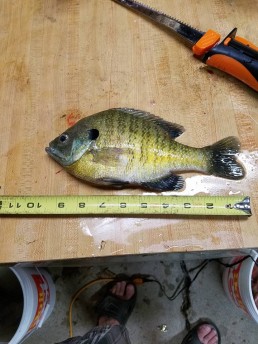
Iowa fishermen enjoy a fishing paradise in Iowa farm ponds. A few years back, most Iowa farm ponds were stocked by the Iowa Department of Natural Resources. After study and experimentation, the DNR came up with the proper mix of fish species to make good fishing ponds. Their ratio was 1,000 fingerling bluegills, 70 largemouth bass, and 100 channel cat per acre. The pond owner was cautioned not to allow any fishing for at least three years.
Their plan worked like gangbusters! Catches of 25, 6- to 8-inch bluegills were common. The ponds were pressured until Rathbun and an improved Lake Miami entered into the picture. Throngs of fishermen headed to the bigger lakes, and farm pond fishing was largely abandoned. But the fish in these unfished ponds continued to grow.
My fishing buddy Buck and I started pond fishing for ‘gills by first purchasing a county plat book of the county we wished to fish. We then drove the rock roads, looking for likely ponds. The ponds we wanted had to have certain criteria. They had to be close to the road, with easy access. We selected ponds with sloping banks because ‘gills spawn best in shallow water that is warmed by the sun.
We wanted older ponds that were fringed with cattails or had dead limbs in the water. We marked those ponds and included which side of the pond had cattails and wood. Your best bet is ponds where the cattails and dead limbs are on the west or south side of the pond. The reason for this is that, in Iowa, the warming winds are from the south and west. Winds will blow plankton across the water to the waiting mouths of fish. (Phytoplankton are a vital link in the food chain.) After locating a dozen or so of these promising ponds, we called landowners to get permission to fish.
After the spawn is past, we plan our fishing trip. We like to get on the water several days before a cold front. We select several ponds where the soft breeze blows over the plankton’s basin and across the pond’s surface.
We generally want the wind to be out of the south. The wind pushes plankton, insect eggs, larvae, and weak-swimming microbes across the water’s surface, into the open mouths of bluegills. It’s like giving free beer and pizza to college students. The appearance and concentration of plankton activates the food chain.
The food chain perhaps is described as bigger fish gobbling down littler ones. Tiny fish eat the plankton. Inch-long minnows and fingerling bluegills eat the tiny fish. The minnows are gobbled down by an assortment of aquatic mammals such as most gamefish, frogs, salamanders, and other inhabitants of the farm pond. Obviously, this is the best time to fish for ‘gills.
We like to get onto a pond before sunrise and fish into the wind, from the bank opposite the sunken wood and cattails. You can see the ‘gills feeding, making dime-sized circles on the surface. Buck and I like to fly fish with #8 poppers that have a topping of white so we can see our lure. The action is fast and furious.
You can be among the first to get the latest info on where to go, what to use and how to use it!
When the sun hits the water, the ‘gills retreat to deeper depths. We switch to a #8, wet black gnat. The gnat is a real fish-getter for me. I think that’s because fish are used to seeing black bugs falling down the water column.
We use spinning tackle our outfits: 6-foot, light-action spinning rods, open-face reels, and 4-pound test monofilament line. I use a 1/64- or 1/32-ounce black Little Nipper baited with a corn meal worm. This small jig nails ‘gills! A bluegill’s mouth is about the size of a dime. Buck tried a small fishing lure called a Wee Craw made by Rebel. The lure is less than two inches long. It’s a great fishing tool! Little ‘gills leave it alone, but the keepers jump right on it! It catches bass and channel cats, too.
Standing on the bank, we make longish casts into deeper water around the 6-foot depth. Deeper water is the home of the larger-sized ‘gills that we wish to harvest. Mature bluegills from 7 inches long on up feed on minnows, immature crayfish, and smaller creatures that live in deeper waters. Smaller ‘gills typically inhabit shallow water and moss cover.
We stop fishing any pond once we have caught 30 ‘gills between us. Buck and I never keep a ‘gill under 7 inches. We only fish a “good” pond once a week. When the ‘gills start running small in size, we quit the pond for the season. We often give the landowner a mess of fresh, filleted ‘gills and always send them thank you cards at Christmas. Buck and I always have a pond to fish.
Bluegill Patties Recipe
The first thing I do is thoroughly wash my hands and clean my fingernails. Then I gently boil a bunch of fillets until they can be flaked with a fork.
I place the fish in a large mixing bowl and add two eggs, some minced onions, and a half a sleeve of crackers. Using my newly washed hands, I squeeze and work the mixture together. If the mixture is too runny, add more crackers. The idea is to make the patties firm enough that they won’t be runny in the skillet.
I form my mixture into patties about 5 inches in diameter and half-an-thick. I spread mayonnaise on the patties and fry them in a medium skillet until brown. I’ll try one to see if they are done, and share part of it with my lab.
Did you enjoy this post?
You can be among the first to get the latest info on where to go, what to use and how to use it!
