

Fishing Ice-Out!
Well, the lake did freeze, and I hear some people have been ice fishing. The whole lake is frozen as I’m writing this. We’re supposed to start getting some warmer weather, so hopefully, by the time this comes out, it will be thawed out. It used to just about always thaw out by the middle of February, but I think it was the first week of March before it thawed out last year.
As soon as it opens up (thaws), people will be hitting the lake; it’s been a long winter! Today’s warmer clothing makes it possible to handle the cold. We don’t usually go out anymore unless it’s supposed to get close to or in the 50s. I can’t handle the cold like I used to.
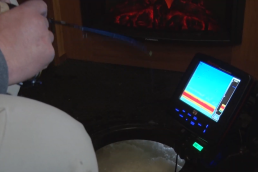
Right after it thaws, the water will still be pretty cold, and the fish sluggish. Most people will be fishing for crappies. We tend to start by fishing standing timber in pretty deep water. We put a jig below a bobber so we can control the depth of the jig; then we throw just past a tree, work it back to the tree, and slowly around the tree, catch a fish, and then move to the next tree. We sometimes have to experiment with the depth to find the active fish. Sometimes you can determine this with electronics, and sometimes not. Granted, the newer equipment makes this easier.
Some people prefer to use a slip-bobber for this kind of fishing; we prefer to use a stationary bobber, because then, you know your jig is at the set depth. With a slip-bobber, as you’re working it around the cover, the line can slip back through the bobber and raise your jig. Even just the wind blowing, causing a bow in your line, will raise the jig. If the fish are holding below—say 8 or 10 feet—then we’ll remove the bobber and just vertically jig.
There have been years where we have found them around shallow stumps and only needed the jig set 1 to 2 feet below the bobber. We’ll still use a bobber so we can work the jig slowly around the stumps, giving the fish more reaction time.
You can be among the first to get the latest info on where to go, what to use and how to use it!
Every year is different, and every day can be; there’s always some trial and error involved to find them. Sometimes, it just depends on what area of the lake you’re fishing, and what type of cover is in that area. This time of year, what’s going on at the north end of the lake can be completely different than on the south end. For one thing, the average depth of the water is deeper on the south end, and it takes it longer to warm up.
Some people start looking for largemouth bass in March, but until the water warms up a little more, it’s a pretty slow bite. They’ll be holding pretty tight to cover. Usually, you have to use baits that you can get into the cover and work slowly in and around it. Bass jigs, craw-worms, and lizards are good choices. Bass might also hit slow-moving crankbaits. Towards the end of the month and into April, they will get a little more active, depending on the water temperatures.
It’s still a little early for white bass unless you’re up one of the rivers. And unless the water level comes up, it’d be tricky getting up there in a bass boat. Some people go up to one of the small boat ramps and launch a smaller boat, or just fish from the bank. Whites should be active up there, and you might luck into a walleye or two.
Remember, if you’re going up the Kaskaskia River from the lake, when you get past the Whitley Creek ramp, be aware of the dredging project going on; there are going to be pipes in the water to transport the material to the holding area south of the Sullivan Beach.
March can also be pretty good below the dam for about any of the species that are in the lake. It’s time to get out!
Did you enjoy this post?
You can be among the first to get the latest info on where to go, what to use and how to use it!