
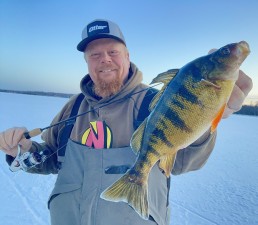
Find Busy Bottoms for Midwinter Jumbo Perch
Northern Minnesota offers ice fishing opportunities for a wide variety of species: walleyes, pike, crappies, bluegills, eelpout, whitefish, and even trout. One species that doesn’t always get mentioned, but has grown in popularity, is jumbo perch.
As a kid, I remember lakes filled with large perch, mostly targeted by locals but also attracting visitors who discovered untouched schools of these fish. I even recall out-of-state anglers asking why locals would throw perch back when they were so good to eat. Fast forward to today: Perch have earned their place as a Minnesota favorite and a sought-after target species.
Grubs: much ado about nothing
Over the years, I’ve often heard anglers say that they don’t keep perch because they’re “full of grubs.” They’re talking about yellow grubs, a common parasite passed from birds to snails and then to fish. Not all perch eat the same diet, but shallow-water perch on lakes with lots of waterfowl can have a few—or many—grubs. Deeper basin perch, on the other hand, tend to have fewer.
Grubs are easy to spot. Right after the catch, check the fish tail or gills under the chin for yellow egg-shaped lumps. If you see them, release the perch. Don’t harvest fish only to throw them away during filleting. Yellow grubs don’t stay in the perch permanently; the next time you catch that same fish, it might be completely grub-free.
Many perch seekers know that grubs can be poked or knifed out of the fillet and are completely harmless to human consumption. If they were harmful, I wouldn’t have survived decades of eating perch! Some even jokingly call them “extra protein.” No worries!
The perch low
Perch populations crashed to low levels on many lakes about 15 to 18 years ago. During that time, I had to abandon large lakes like Winnie and Leech and start searching for perch on smaller waters ranging from 2,000 to 10,000 acres. Each year, I saw more anglers targeting perch, and we all waited for legendary perch lakes like Winnie, Leech, and Mille Lacs to rebound and once again produce jumbo perch.
Back when the limit was 100 perch, large groups of anglers regularly caught limits, and it seemed like massive schools of 9- to 12-inch perch were unaffected by harvest pressure. Eventually, the lakes crashed to lower perch levels, and the phone rang more often for guide service. That pushed me to keep hunting for jumbo perch, but most lakes could not sustain the angling pressure.
That reality brings me back to the true perch factories: Winnie, Leech, Mille Lacs, and Cass Lake. Not all Minnesota lakes produce jumbo perch. They exist in places like Big Stone Lake and Mississippi River backwaters, but the greatest concentration is in what I call the upside-down triangle of Mille Lacs, Leech, Winnie, and Cass.
As the fishing in smaller lakes changed, the idea of a reliable jumbo perch bite began to fade. Anglers started to wonder if walleye slot limits were playing a role by increasing the number of large walleyes, along with a surge of hammer-handle northern pike. Bigger fish in these waters eat bigger perch.
Large predators can consume large quantities, and from there, the system gets complicated. Years ago, when we caught very few big walleyes, perch populations were massive and resilient. Today, we catch-and-release more big walleyes than small ones—but nature always finds a way.
Successful year classes
I spend winter days targeting a fish that bites during daylight hours on clear glacial lakes. Jumbo perch are an action fish—they think with their stomachs—and they keep the phones ringing. Just when I thought I may have to switch my guide focus to crappies and bluegills, I realized that they are even more fragile fleeting species. I stick with perch.
There isn’t a hierarchy of big panfish producing more panfish, but perch replenish themselves through strong year-class recruitment. As I’ve said for years, perch are the farmer’s corn crop of ice fishing.
About ten years ago, while guiding for walleyes in summer, I noticed something important. Perch hatches were everywhere on the lake. It didn’t matter if I was in 10 feet of water or 30; on my Humminbird, the perch hatch showed up as a 5- to 10-foot-thick layer wherever I stopped. They were so dense that they often registered as bottom. I knew then that winter perch were making a comeback, but that amount of bait doesn’t help walleye fishing.
Thanks to several successful year classes, we now have an incredible lineup of perch from multiple age groups. Some large lakes that are known perch factories are producing good numbers, though they don’t have the big jumbos we saw 16 to 18 years ago. One reason is the higher number of big walleyes, which limit how many perch reach that size.
That said, the perch population is as strong as it has been in the last 16 years. An influx of rusty crayfish helped after cabbage weeds disappeared about nine years ago. I believe those crayfish proliferated from Cass Lake. Upriver perch were spawning at just 7 to 8 inches, stunted in size and spawning at an early age. Rusty crayfish accelerated growth rates, and combined with massive numbers of young-of-the-year perch, true jumbo perch returned.
You can be among the first to get the latest info on where to go, what to use and how to use it!
Since then, perch have hatched successfully, rebuilding good ol’ day populations on Minnesota lakes that historically held perch. Even with more—and larger—walleyes in the system, late springs, fast warmups, and warm summers have boosted perch populations. Today, big jumbos are better than they’ve been in over a decade.
The main difference now is that many of Minnesota’s best jumbo perch lakes are infested with zebra mussels. The ultra-clear water makes perch more efficient foragers, but it also makes them spookier and harder to catch, especially in shallow water. Perch don’t have exceptional vision, and while clear water helps them feed, it makes them a hardwater challenge.
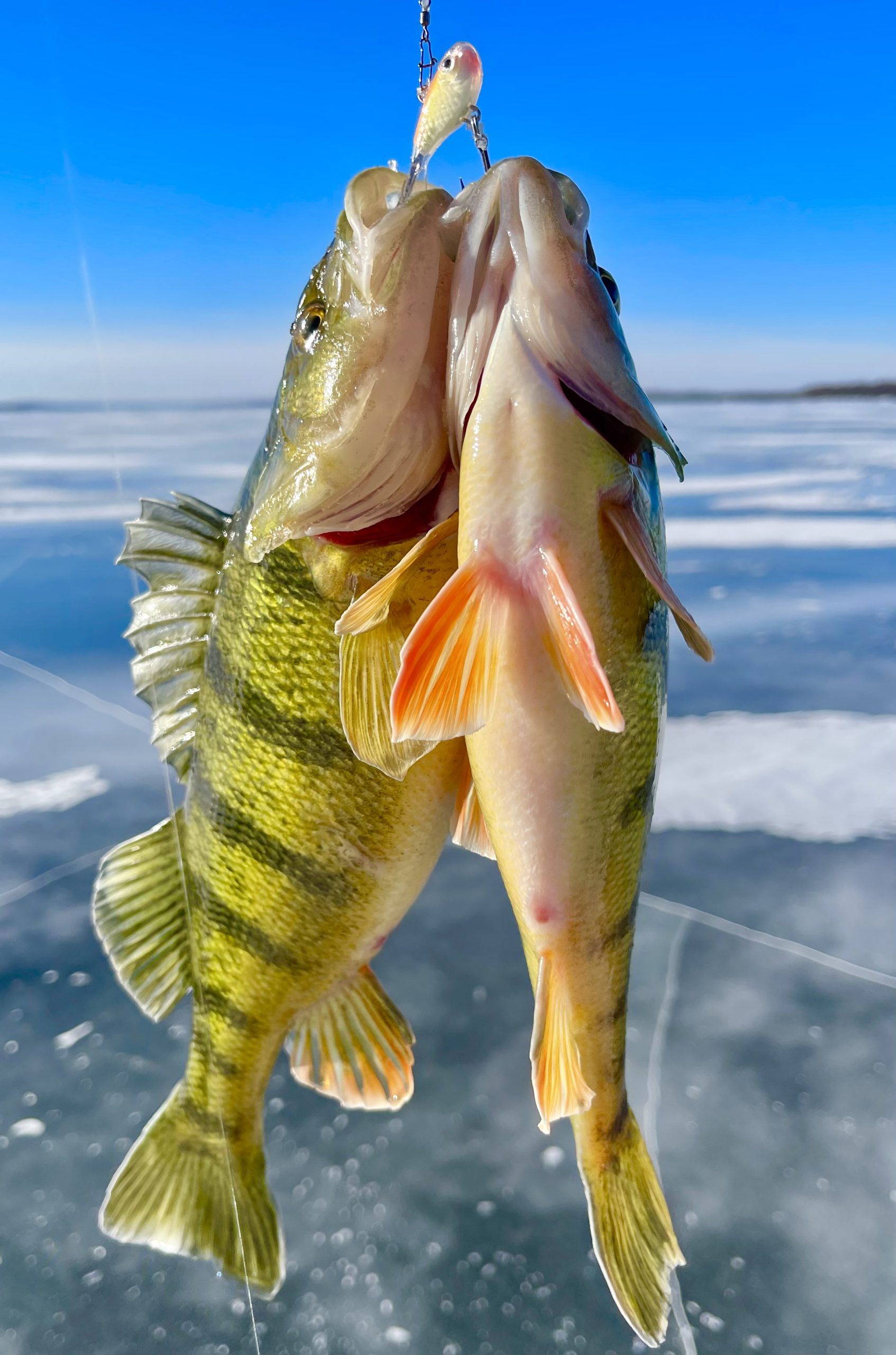
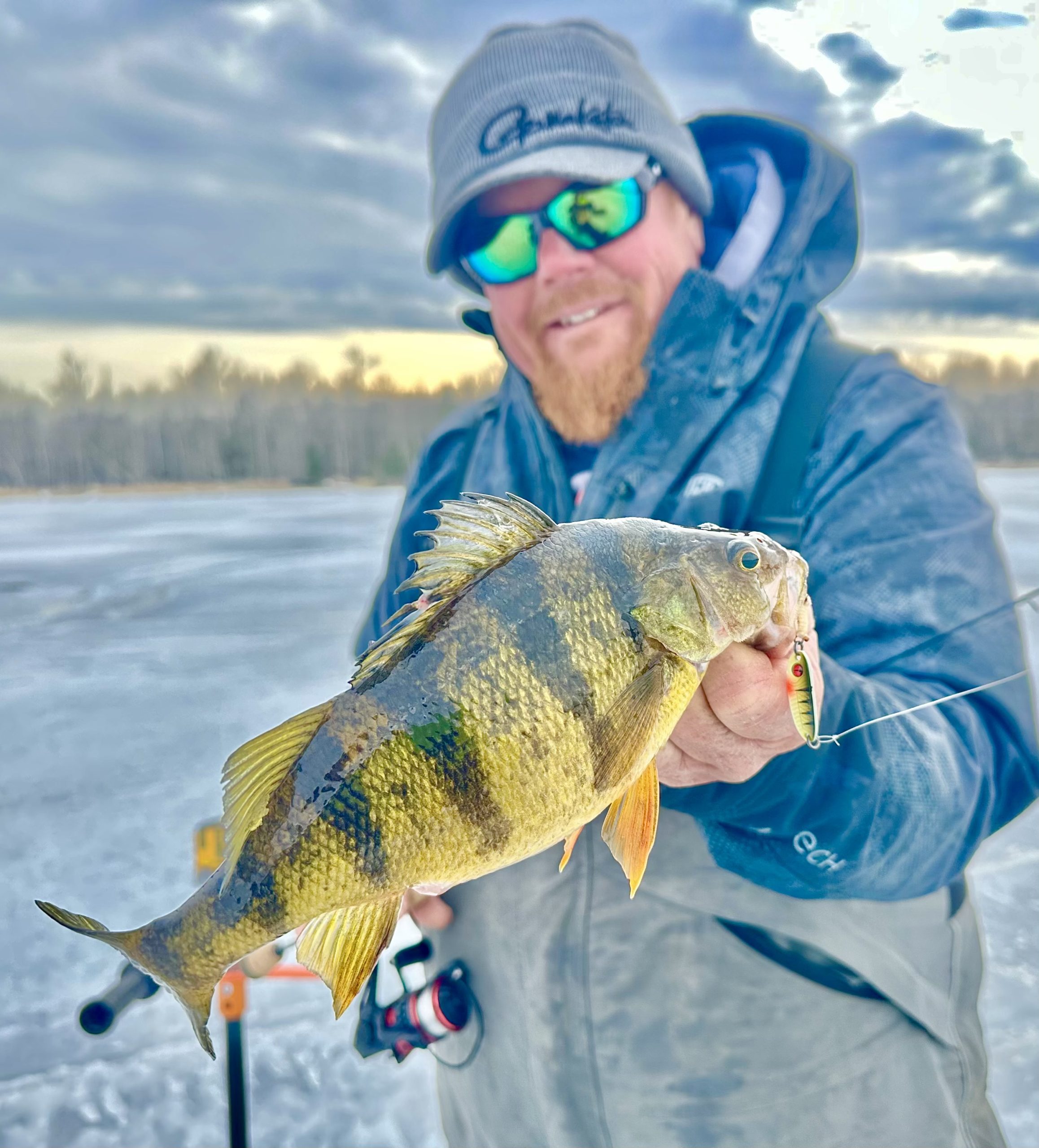
Targeting jumbos in clear water
Two winters ago, I found jumbo perch in shallow water, buried in weeds and along the weed line. Last winter was the complete opposite. On most lakes, perch were deep—much deeper than I would normally fish them in 18 to 28 feet. I found perch hanging in 32 to 38 feet of water, and even beyond 40 feet.
Using my Humminbird Xplore with LakeMaster maps, I highlighted all the deep water and RAZR’d holes about 100 feet apart across the basin. At each hole, I dropped my MEGA Live 2 forward-facing sonar and looked for what I call “busy bottoms.” If I found soft mud with baitfish balls and insect life darting around, I fine-tuned my hole placement—and found schools of jumbo perch nearby.
Bro Pro Tip: For run-and-gun drilling, I wear an AFTCO Reaper hoodie, bibs, and Fish Monkey Yeti gloves. The key is staying warm without sweating.
In deep water, perch typically hold one to three feet off bottom. When they’re slightly suspended, they often race up to smash a Northland Twitchin’ Puppet in a perch pattern or glow. If the bite slows after locating fish, unpack, settle in and fish for a while.
At that point, drop a live fathead on a dropshot rig set 18 inches off the bottom. Hook the minnow on a red or glow-white Gamakatsu Octopus-style #6 hook, paired with a 1/4- to 3/8-ounce tungsten cylinder sinker. Use lighter, thinner line like Sunline 5-pound fluorocarbon ice line. It sinks faster and still gives you a fighting chance if you hook a big walleye or an eelpout.
My rod setup is a St. Croix Dead Eye paired with a SEVIIN GS 750 reel. The soft rod tip gives you time to grab the rod and set the hook. Place that combo in an I-Fish Pro tip-up, spacing them about 50 feet out, and jig nearby. The jigged lines bring fish in toward the tip-ups, creating a strong one-two punch.
I’ve also had excellent success in these depths with Northland Tungsten Buck-Shots and Slim Spoons. Perch patterns, Wonderbread, and gold colors all work well—and they sink fast.
Bro Pro Tip: Go Light! I use my Humminbird Xplore graphs off my boat while on the ice, mounting the MEGA Live 2 transducer on a Fish Armor Pro Pole attached to a Fish Armor Pro Light Shuttle.
I power the shuttle with an Amped Outdoors 12-volt, 15-amp-hour battery, keeping the setup lightweight and easy to carry for light hole-hopping and running and gunning. For longer trips that stretch from day into the night, I switch to a second shuttle with a 12-volt, 32-amp-hour battery for extended run time without sacrificing mobility.
The good ol’ days are now
Every winter on the ice is different when it comes to targeting jumbo perch. Several factors influence where perch will hold—sometimes changing even within the same season. The biggest factor is food: Baitfish balls made up of young-of-the-year perch, insects, and crayfish. All of these critters dump down to the basin, including crayfish, in midwinter. Crayfish are why it’s important to keep your minnow off the bottom: They’ll nibble pieces off your bait if it’s too close to them.
Anglers must determine if jumbo perch are located in three main areas: food shelf weeds, primary break shelfs and humps, or deep, busy-bottom basins.
Make sure you have a RAZR auger and extra batteries for your power tools; you just might hit a jumbo perch jackpot.

Did you enjoy this post?
You can be among the first to get the latest info on where to go, what to use and how to use it!