
Fancasting the Flats is Where it’s at in June
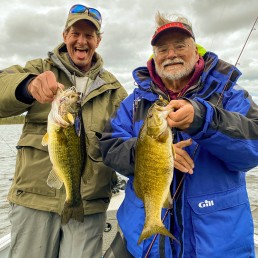
It used to bug me that we could catch all sorts of big smallmouths (or other species!) during pre-spawn, but right after spawning was complete, they just sort of disappeared. I wasted a lot of time searching for “secret spots” that held numbers of big, post-spawn fish. Never found them. Instead, the shoulda-been-obvious solution finally became apparent: You never found any post-spawn schools of smallmouths (or most other species) because they weren’t schooled at all—yet! At least until the leading edge of summer.
Post-spawn dispersal is just that: Females dispersing away from nesting sites, across the adjacent sand and rock flats, as individuals, or perhaps as small groups of a few fish. As they did, they’d encounter rock humps, depressions, and perhaps a few clumps of emerging weeds that would attract and hold them for short periods. But never for long. As the water warmed, the fish were on the move, inching ever deeper toward drop-offs into the main basin where they would begin to school in earnest on classic structure. During the “in between time,” it was more like hunting for lone wolves rather than packs.
 Multi-species patterns
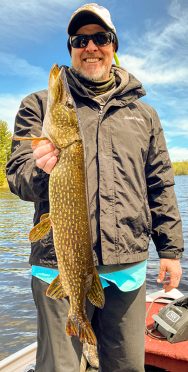
Other species display similar behavior. Largemouths and northern pike begin relating to emerging weed clumps and beds atop flats, with pike already dispersing toward the main lake even as bass remain in and near spawning sites. Week by week, as weed beds rise and thicken, fish adjust location, here today, gone tomorrow.
Walleyes, too. Where perch are available as forage, shallow weeds adjacent to walleye spawning areas become good areas for post-spawn walleyes to dine on perch. Where perch and weeds are lacking, walleyes may be feeding on shiners or shad roaming shallow flats. In Northwoods flowages, shallow wood cover atop flats may hold minnows and gamefish as well.
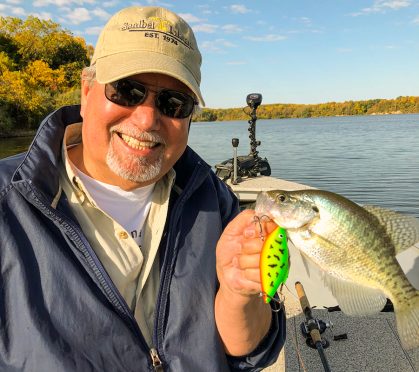
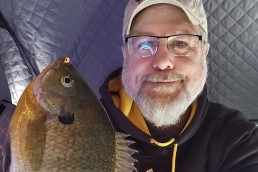
Even panfish display similar behavior, although it is somewhat delayed because they are typically the last major species to finish spawning. Bluegills and crappies weave in and out of emerging weeds, moving ever closer to the main drop-off as weeds thicken. They relate to pockets and lanes within the weeds where beds are lush, or to weed clumps where weeds are sparser. Eventually, pods of panfish begin gathering along the developing deep weed edge as summer peak arrives, forming actual schools, indicating the arrival of classic summer fish patterns.
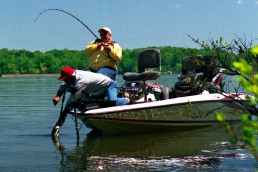
The universal lesson is, during post-spawn transitions and the beginnings of pre-summer regrouping, flats are where it’s at. You need to do lots of fancasting, longline trolling, drifting or using other tactics that cover lots of water to locate pods of fish.
The good news is, they’re probably not aimlessly wandering. More likely, they’re relating to subtle features atop flats that gather at least a few fish; and in some cases, something resembling the beginning of schools, although perhaps aggregations is a better word to describe their behavior at this time. Meaning that fish aren’t yet operating as coordinated schools, but rather just loosely gathered in temporary areas offering good cover and feeding opportunities.
Subsurface tactics
It’s not quite topwater time yet, even for bass. The water is simply too cool to promote insect hatches and trigger much surface activity, and bass may remain reluctant to rise all the way to the top. Instead, subsurface techniques tend to excel. You typically need to run lures just over the tops of emerging weed cover, or slightly above wood or rocks. If there isn’t much cover available, simply swimming lures halfway down between the surface and the bottom may suffice. In all cases, match lures size and tactics to fish species, location, types and depths of cover, and fish activity.
Old-time classics
• Tandem spinnerbaits are obvious choices. Cast ‘em out and reel ‘em in. Try audacious, double-Colorado-bladed models for largemouths, and flashier Colorado-willow leaf combos for smallmouths. They’re great for casting around flooded shoreline timber and brush a well as across shallow flats.
• Cast shallow-running crankbaits, probably on the subtler side at first, like Shad Raps. More aggressive wobblers come into play toward the end of this period as the water warms toward 70 degrees.
• Everything bites straight-shaft spinners like Mepps, Panther Martins and Blue Foxes, but they’re especially good on smallmouths, pike and muskies.
• Midsized wobbling spoons like Dardevles catch more Canadian pike than any other lure. They work in the U. S., too.
You can be among the first to get the latest info on where to go, what to use and how to use it!
• Vibrating crankbaits like Storm Thin Fins and Rat-L-Traps cast a mile and cause a ruckus. They’re ideal for fishing flats.
• Swimming jigs dressed with 3- to 4-inch twister-tail grubs really nail smallmouths but work on other species as well.
• Jig spinners like Beetle Spins excel, especially for panfish. Use mostly straight retrieves until you can stop your retrieve and helicopter them down into visible holes in the weeds.
 Modern classics
• Swim jigs dressed with paddle tails are horizontal versions of classic bass jigs. Weed guards minimize snagging. Subtler than crankbaits, they are remarkably good for catching largemouth bass just above weeds.
• Jig and paddletail combos are multi-species killers, just about everywhere. They’re subtle. Cast out and swim them back to the boat.
• Chatterbaits are known mostly for catching bass and pike, but everything bites them. They’re like subtler versions of spinnerbaits featuring a high-pitched whine rather than a throbbing wobble.
• A new wave of rattlebaits like Rapala Rippin’ Raps are available in a wide range of sizes suitable for larger-mouthed gamefish on down to smaller-mouthed panfish. They create a racket. You can flutter them into holes and vertically jig them, too.
• Neutrally buoyant minnows like X-Raps catch all species, from bass and pike down to panfish if you use the right size lures. This time of year, they’re still best worked at modes speeds with extended pauses, so you can’t cover as much water as with some other lures. Once the water warms in summer, however, work them with a series of quick, sharp jerks, followed by a pause, to trigger strikes.
Note the general absence of even twitch baits like Texas-rigged jerk shads, although they may work on occasion; they just don’t cover water effectively. Ditto for fly-fishing, because it’s a slow process, although deadly for extracting bites once you’re on fish. Or on bottom-oriented tactics like bass jigs and Texas-rigged soft plastics, geared to fishing small, key spots rather than straining large areas. Instead, you need to use lures with a whole lot of horizontal movement, presented at or above the fishes’ level, as opposed to lures that are dropped vertically to the bottom and then typically hopped, crawled or jiggled in place.
Old versus new
In effect, fishing flats for fish in transitions isn’t brain science. But typically, you can’t just drive to obvious spots and begin hauling fish in. Rather, you need to cover water to contact pods of fish making use of temporarily attractive areas. In many cases, these areas have subtle features, rather than being readily apparent.
On weedy lakes, look into the water with polarized sunglasses to evaluate weed types, thicknesses, types and depths. Casting, feeling and interpreting the best fish-holding weed areas puts you on fish.
In lakes lacking weeds, you may need to rely more on electronics unless the water is clear enough to see bottom in, say, 8 feet of water or less. Sidescan and FFS technology allow you to view out to the sides and ahead of the boat to potentially locate both cover and fish. Even so, there’s no substitute for casting, feeling and interpreting what lies around you. Heck, you have to reach out to catch fish anyway. You might as well use the casts where they don’t bite to evaluate your surroundings. New school is nice, but old school never goes out of style.
Did you enjoy this post?
You can be among the first to get the latest info on where to go, what to use and how to use it!