
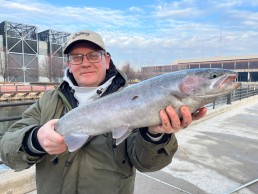
Drop-Shot Fishing Great Lakes Harbors for Steelhead
Last year, I did an article on a discovery I had fishing crawfish lures for Lake Michigan smallmouths, and catching a substantial number of nice browns. I didn’t set out to try to catch browns or steelhead on a crawfish jig… it just happened.
After about the 10th nice brown eating a crawfish, I recall saying to my fishing buddy, “This is no accident; this is a real deal!”
Well, I think I have another discovery that developed last fall and went straight through the winter. Once again, I had to say to my buddy, “Once again, this article is writing itself; this technique is legit.”
When these oddities happen, you get the first one, and go, “Huh.” The second one, you think, “Okay, is this something?” By about the tenth time it’s worked, and nothing else is getting bit, you know you have something.
Once again, I give the credit to smallmouth bass, and my obsession to continue to fish for them through the winter on Lake Michigan. I could be fishing for one bite in December, January, and February. But when I can get that one bite and land a smallmouth in January in 35-degree water, it’s stealing a victory out of the jaws of defeat. It’s finding a needle in the haystack and learning a little piece of the puzzle of where these smallmouths go in winter.
Fishing for harbor, winter smallmouths is like brain surgery. Moving baits inches, with long pauses. Shaking lures in-place. It’s painful, but it works.
But this piece isn’t about smallmouths. This is about Lake Michigan browns and rainbows, but another newfound bass tactic for winter trout… Drop-shotting!
The drop-shotting tactic originated in Japan but grew in popularity after its mid-1990’s exposure to the country by the late, great Aaron Martens. The tactic excelled in deep, clear water and for-pressured bass. I’m starting to think that’s why some of these ultra finesse bass tactics have been working so well for near-shore, Lake Michigan trout anglers.
Like everything, Lake Michigan is also constantly evolving. When I started shore fishing in 1974, on a good day, the water had a visibility of maybe a foot. We were all chucking big spoons in gawdy colors just to get the fish to find the lure. We even added rattles to spoons to help them home in on it. Well, that has sure changed.
Now, on a good day, we can see the bottom in 15 and even 20 feet of water. These are the exact conditions that forced bass anglers change to finesse tactics, and the same is true here on Lake Michigan.
What I really fell upon was the effectiveness of the drop-shot on winter and spring steelhead. My success was not in streams or rivers, but in open-water harbors. I was working seawalls, riprap edges, and harbor channels, and instead of smallmouths, catching steelhead! Pesky, 8- to 12-pound steelhead. What a problem to have!
You can be among the first to get the latest info on where to go, what to use and how to use it!
I love fishing hair jigs for smallmouth. Casting a 1/16-ounce hair jig almost free-floating to a cold-water smallie. It works great in 6 or 8 feet of water. These harbors are different. We are talking 15 feet or more and a lot of wind. A normal hair jig wouldn’t cut it, so I started tying my standard marabou on a stout hook and fishing it on a drop-shot rig. Success was instant.
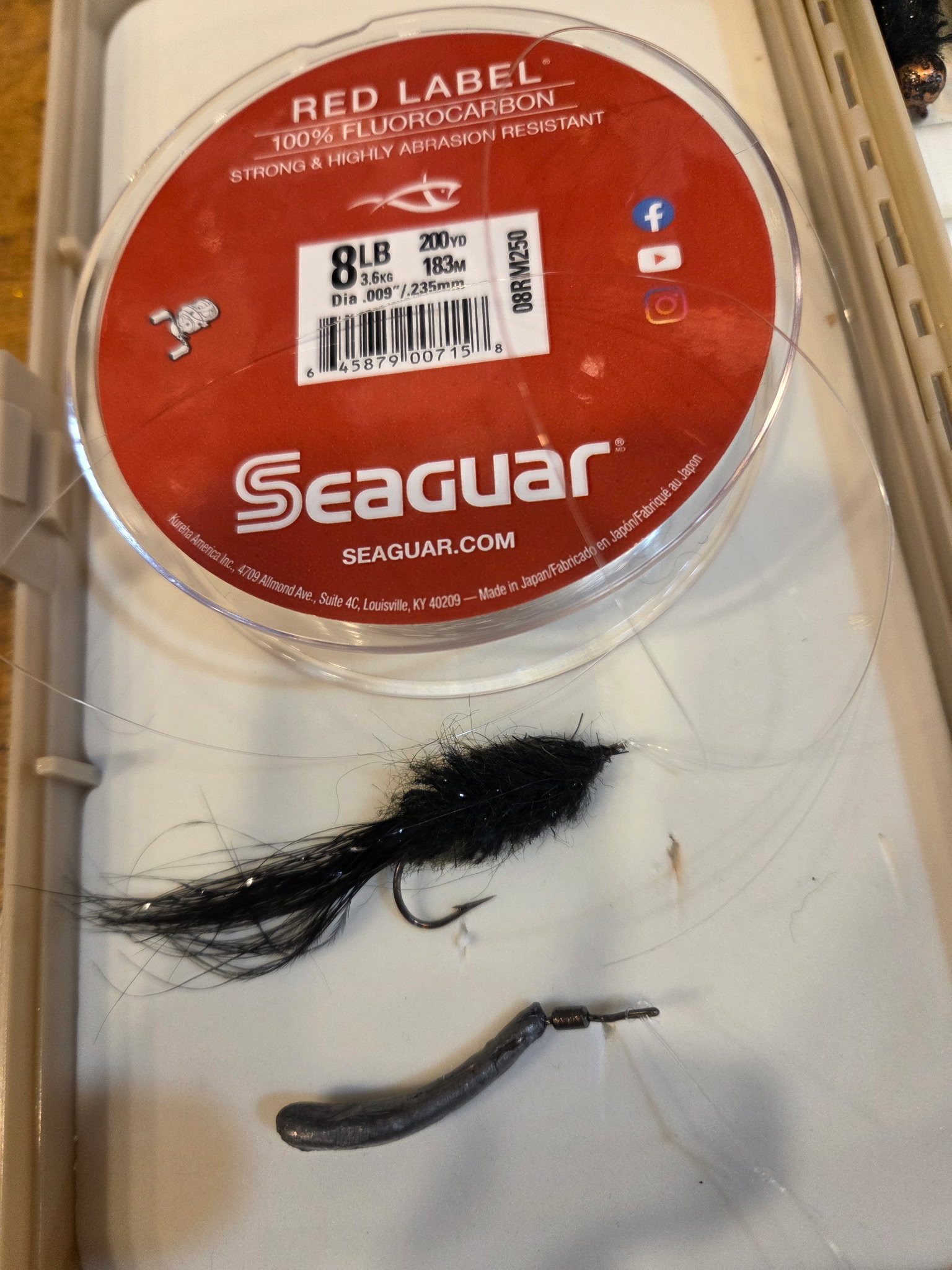
It was the best of both worlds. The deep-water contact of a drop-shot rig with the subtle free-flowing action of a hair jig.
Smallmouths loved it, but then the steelhead action started. Steelhead started loving it more than the smallmouths! Eight-, 10-, 12-pound steelies on my medium-light bass drop-shot rod!
The rig is simple, using standard drop-shot weights in 1/4-ounce. I prefer either a walking one or a long, slim one over a bell or ball shape. I try to keep it moving ever-so-slowly while making bottom contact.
If you don’t tie your own flies, don’t worry. Any leech imitation fly available in your local fly shop will work. A few good ones are the Balanced Leech, The Egg Sucking Leech, and the good old Wooly Bugger. Any color works as long as its black, LOL! Olive has worked too, but black has been the best. The fly you tie or buy should be about 2.5 inches long.
I like the drop from the fly to the weight to be about 18 to 20 inches.
Cast it out and let it get to the bottom. Then do a lift-and-drop of the weight about 6 to 12 inches at a time. I’m not pausing too long; just enough to take up the line. With cold-water smallies, the bite with just feel heavy. Steelhead slam it. They absolutely eat it!
I have gone to a medium, 7-foot rod with 8-pound mono or fluorocarbon. It’s too tough to fish braid in below -freezing temps, so it’s the one time of the year I have to go back to mono. It’s hard to beat good, old Trilene XL for a soft winter line. For fluorocarbon, I really like Seaguar Red Label. It’s tough and very affordable.
This spring or next winter, take a tip from finesse bass fishermen and try drop-shotting for steelhead in your local harbor. I fell upon it by accident, but I love finding a new tactic to use on Great Lakes trout!
Did you enjoy this post?
You can be among the first to get the latest info on where to go, what to use and how to use it!