Crappies: What’s My Line?
Experts agree that having the correct fishing line is important for good performance and more bites-per-hour. However, choosing the right line isn’t easy, because there are so many options. Here are some guidelines and tips for selecting the right line for enticing bites and landing crappies.
Monofilament and copolymer lines are very similar and constructed from nylon. Monofilament is one strand while copolymer is two strands. A copolymer has the advantage of combining characteristics of two lines into one.
Monofilaments are the simplest and remove much of the confusion of line selection. Their advantages include low cost, availability, stretch, great handling, good casting, limpness, and a range of clear to high-visibility colors. Their disadvantages include shorter lifespan and weaker hooksets due to line stretch. The same basic advantages/disadvantages apply to copolymers.
These lines excel at being extremely limp. This makes them easy to use for both novice and expert fishermen. The stretch gives them a shock absorption to aid when fighting a fish, and the limpness allows great bait action.
It doesn’t matter which line type you choose; it’s important to choose the right pound-test for the type fishing you do. For example, in stained water with wood cover, a 10-pound-test line is appropriate on a long pole. In clear water, a 6-pound-test line, or maybe lighter 4-pound in ultra-clear water, is a good choice because crappies can see the line and they can spook.
A good rule-of-thumb is to pick 8-pound-test for all-around fishing in stained and dingy waters. Select 6-pound-test for clear to slightly stained water. It’s possible that a smaller line might result in a few more breakoffs, but it’s worth it when you are getting more bites and having more fun.
It’s time to go to heavier lines when pulling crankbaits, and when power trolling heavy jigs or crankbaits. The strain of a big bait, weight and the strike on a moving bait requires strength. A 15-pound-test line is a popular choice.
Fluorocarbon line sinks, so it isn’t for many crappie presentations, but it’s good for single-pole pitching and jigging. Forward-facing sonar (FFS) with a long pole spooled with fluorocarbon is good because the line has little stretch and is nearly invisible in the water. The line sinks, so it helps get baits down quickly. No stretch provides a stronger hookset and the ability to swing a fish into the boat.
Fluorocarbon advantages include a quickly sinking line for deeper presentations; extremely low visibility for fewer spooked fish; low stretch for sensitivity and good hooksets; and abrasion resistance. Disadvantages include cost, but it last longer; knots must be tied with care; fast fall rate isn’t good for slow presentations or shallow water; and line can become stiff/brittle in cold weather and water.
Braided line has limpness, sensitivity and power. Crankbait trollers sometimes choose it because its tiny diameter allows baits to go deeper. So, advantages include limpness to allow good bait movement that is good for jigging or casting; no-stretch sensitivity to feel more bites; the line has no memory; it’s long-lasting; and offers maximum strength per diameter. Line like 10/2 braid is 10-pound test with the diameter of 2-pound-test monofilament. It sounds like the perfect line, but fishermen dislike a few things. For example, knots can be difficult to tie; the line has no shock absorption so fish can rip off; and the line is expensive.
Method vs. line
In general, monofilament and copolymer lines are the easiest to handle and are affordable. This is the most popular line used in fishing.
You can be among the first to get the latest info on where to go, what to use and how to use it!
For casting a free-fall jig, pick mono or fluoro line.
For casting with a slip-float, choose mono because the line doesn’t sink between the rod and float.
Choose monofilament for long-line jig trolling because it is a shock absorber for sudden strikes. Fluorocarbon line is good, too, and provides an advantage in clear water.
Crankbait trollers use all three types of line, but monofilament is the most popular.
Power trolling (long poles out the front, using fast speeds) uses heavy 15- to 20-pound test monofilament or fluoro.
Slow trolling or spider rigging can be done with any type of line, with mono being the easiest to handle.
Tips
• Lighter line results in more bites and more fish.
• High-vis line is good when watching the line for light bites. Experts disagree if the color spooks fish in clear water.
• Does heavier pound-test line result in fewer breakoffs when fighting a big fish or when hung-up in cover? Yes, it does, but if you catch 50-percent fewer fish, is it worth it? No. Stick with the lightest line that’s practical for your fishing. Most experts recommend 6-pound-test because it handles great and draws more strikes than heavier line.
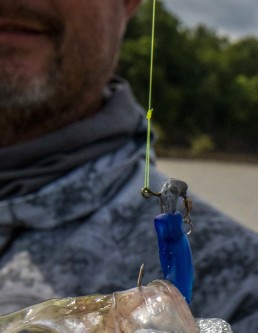
• Two things are important when using light monofilament line: First, wet the line before tying a knot for less line friction when cinching a knot. Friction can create heat causing a week spot at the knot. Two, retie line often, especially when catching fish that rub against cover or rocks, or after catching a rough-mouth fish like a catfish.
Did you enjoy this post?
You can be among the first to get the latest info on where to go, what to use and how to use it!