
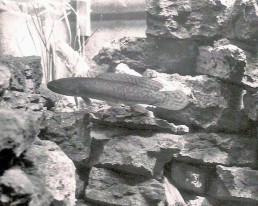
Bowfishing Clear-Water Creeks
A light, spring rain begins to fall, it muddies up the creek at my feet. The wind rustles through the trees. That tight, quiet air before a storm breaks.
In my roughly 50 years of bowfishing, I have concluded that a trend is in the making when it comes to clear-water creeks. It is not to say there is not some room for improvement. Water in our creeks and rivers is improving in quality and clarity. No longer are we seeing “sewer bass,” as was once the case. Time was when cities dumped their raw sewage directly into our waterways and thought nothing of it.
Although this trend is good for the environs, it is a new challenge to anglers. We need to become wary of our quarry spotting us. We must hone our stalking skills in pursuit of species such as carp, gar, bowfin, and suckers in cleaner creeks.
Seldom do we find gin-clear water, but it is getting clearer. Turbid water seriously affects visibility. The murkiness comes from larger suspended particles of silt and plankton.
A fish sees three-quarters of its world from below. Three-quarters of its field of vision is above the surface, and one-fourth below. The deeper it is in the water, the wider its vision of the surface.
A fish in shallow water has a more restricted view of the surface, and is easier to approach, because it is secure, holding in tight cover. The fish’s world is grey in color, as sunlight from above filters the water.
A fish’s eye can receive five times the light of a human eye. It allows it to distinguish shapes, sizes, movement, and color patterns not visible to humans. A fish adjusts to a variety of light conditions by changing the roundness of the eyeball, thereby altering the amount of light entering. Eyesight continues to improve with age.
You can be among the first to get the latest info on where to go, what to use and how to use it!
The worst time for fish’s vision is at dawn and dusk. The eye of the fish is changing to adjust to brightness and darkness. Transition can take as long as a couple of hours. Fish appear sluggish and are prime targets for fishing archers at this time. Often, bowfishermen attribute this sluggishness to change in temperature, which may also be a factor. Whatever the reason, bowfishing is at its best during these hours.
When bowfishing clearwater creeks, it is important for archers to stay out of the water. There are several reasons for this, only one of which is the fish’s increased ability to spot the approach of man.
Sound is a factor. Sound carries five times faster in the water than out of it. A fish has two systems for reception and interpretation of sound. It hears high frequency sounds through its inner ear. It can hear a sound from as far away as thirty feet, but must search to locate the source of the sound.
For low frequency sound, it relies upon the lateral line along the side of its body. This allows the fish to identify sounds that are 5 to 10 feet away, which most often spell immediate danger. The lateral line is a system of nerve endings near the surface of the skin that connect directly to the brain.
Sight and sound are the fish’s early warning system alerting them to danger. Bowfishermen outwit their quarry by taking a few precautions such as walking silently and slowly when approaching an area that may produce fish. It helps to not walk in the water, turning over of stones and brush. Such activity emits sound that is a danger signal. Walking upstream rather than downstream reduces the chance of sounds carrying to the fish.
Another technique is to work in semi-circles, away from the creek, approaching only to look for fish and to shoot quickly if one is present. By moving away from the stream, you’re out of the sight of the fish. It’s a good idea to wear camouflage or at least dark clothing, and to moving slowly. Bright clothing spooks fish, as do sudden movements.
The cleaner streams that we are seeing today present another set of problems to fishing archers. But they are a good kind of challenge, as they signal a brighter future for the resource and the archer. They are challenges that make bowfishermen better hunters.

Did you enjoy this post?
You can be among the first to get the latest info on where to go, what to use and how to use it!