
Avoid Bad Habits to Catch Big Trout
A few years ago, I had a run-in with a really large trout. It was early season, and the world was still quite brown. Trout hunters remember having run-ins with large trout and it is seared into their memories.
I, for one, don’t go back the next day after I’ve danced with a big one and lost. Most living creatures have short-term memories, and if you go after them right away, you are lowering your odds of catching that elusive big trout. Being aggressive like that typically results in the big, hook-jawed monster moving on.
I equate trout hunting with deer hunting. You must think about what you’re going to do. You just don’t blindly go down the same path and expect different results. If you spooked a giant deer from your treestand and you’re not sure why, a good hunter evaluates afterwards. It could have been scent control or wind. Or maybe you were fidgeting or playing with your phone when you should have been sitting silently and motionless in your treestand.
Trout do not have the same senses as whitetails, but there has to be a reason. A cause and effect. You must learn from your mistakes, or you will repeat them.
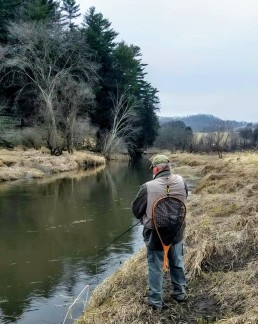
I gave that big trout two weeks before I went back after him. I was up on a higher bank and about to go into stealth mode to sneak up on the trout’s lay.
The battleground from the last failure was about 60 yards away. There were no trees or brush to conceal my attempt to fool that big trout. I stepped out into the open bank, and I saw a huge swell exactly where I had lost that big trout two weeks prior. I was flabbergasted and couldn’t imagine that a trout could see me from that far away.
I sat down on the bank and evaluated my repeat failure. How in the heck did it seem me from so far away? I had forgotten the one superpower that trout have.
You can be among the first to get the latest info on where to go, what to use and how to use it!
They detect movement. Me stepping out into the open, even that far away, was like I was entering its backyard. I did not belong there. A figure and movement, even far away, was out of the ordinary for that trout. I was in its domain and doing something unusual.
I dug back into my lessons from my father to see if I could remember anything that might apply as to why that trout would spook from such a distance. Dad used to preach to not always approach your hole from the same direction.
There are also lots of little trout in a typical stretch, and they will see you. It will be a chain reaction, and you will indirectly spook your big trout from quite a way away. If you’ve located a big one, maybe you need to approach from a different direction.
Loop around the area that you were going to stroll down to where he lives. Don’t be lazy; come at it from a different direction. Plan your attack like you are chasing a wily 12-point buck. Don’t walk into his bedding area. If you spooked him on the way in, you need a different plan of attack.
I can remember my father crawling for 20 yards through prickly ash to get a better angle at a spooky trout. I remember one time when he spooked it with a spinner, casting upstream. The next time we returned, he crawled from quite a ways above the hole, floated a worm downstream through the hole, and bingo, he caught it.
Bad habits are hard to break. Trial-and-error is usually what works. Wearing dark clothing against light brown, dried weeds typically is a no-go. Dark clothing on snow is also a no-go. Your movement is accentuated against your background. If you spooked a big trout once from 60 yards away, a new approach is needed.
Did you enjoy this post?
You can be among the first to get the latest info on where to go, what to use and how to use it!