Are Minnows Still King for Catching Crappies?
A cane pole, big cork, crimp-on sinker, large Aberdeen hook and a live minnow was the top setup for catching crappie in the early years. Line was heavy, and a cork had to be used for detecting bites because the cane poles used were not sensitive. However, it caught fish.
Fast forward to today. Fishermen have the best and most sensitive poles imaginable. Tiny “tic” light bites are easily felt. Small-diameter line enhances stealth approaches and allow baits to have better action. Jigs are more popular now, so are minnows still king?
Forward-facing sonar has stepped up the popularity of jig fishing. Jigs have always been good when crappies are active because jigs are quicker to use than replacing minnows after every bite or caught fish. Jigs can be put in places where it’s difficult to put a minnow rig.
Minnows still have their own advantages, like being added to a jig when fish prefer some live bait. They can be used alone when conditions are tough, because nothing beats the smell, flash and natural appeal of a minnow. Minnows are still the best bait when casting a slip-float. And they can be used without a float to drop straight down into cover with a long pole.
Using minnows
Minnows can be expensive, and bait shops are not located close to all waters. Planning ahead is important if you use minnows.
Have a good minnow bucket. A plastic insulated bucket with a lid and small, battery-operated aerator is ideal. Keeping minnows alive has always been a problem when live bait fishing during the hot months.
It’s important to use active minnows. A dead or almost-dead minnow will not catch fish in most situations. With few exceptions, lively minnows are critical for getting bites and catching fish. Check minnows after a bite, and after a period of time without a bite.
If minnows die immediately when fishing them in summer, try fishing them higher in the water column. Fishing below the thermocline in summer puts the minnow into a zone with less oxygen, guaranteeing a short life.
Try the following rigs for minnow fishing.
Single minnow rigs
Spider rigging, also called slow trolling, is still a good way to fish with multiple poles. Place long, 12- to 16-foot-long poles in holders in the front of the boat while the boat slowly moves along at about 0.2 mph. It works great along drop-offs and in areas with stumps or other cover. Rigs can include a 1/2-ounce sinker a foot above a #1 minnow hook with a lively minnow hooked through the lips. Using one hook and bait instead of two reduces hangups and simplifies fishing.
Another long pole option is a single minnow on a 1/16- or 1/8-ounce jighead. This simple rig allows you to pitch to a bridge piling, rock, stump or other cover. Slack line allows the jig to fall to the desired depth. At that point, the jig will either pendulum back to you, or you can gradually lift the rod tip to keep the jig at the right depth. Use this tactic with or without forward-facing sonar.
You can be among the first to get the latest info on where to go, what to use and how to use it!
Casting a minnow under slip-float rig may be the best option for a single rig, because it allows any depth to be fished. The float remains motionless when fishing still water. With a little current or wind, cast to where the float will be carried to the crappies. The natural presentation is deadly.
Double-hook minnow rig
Double-hook rigs can be vertically fished with short or long poles, fishing straight down into deep cover in summer or winter. A 3/8- to 3/4-ounce sinker on the bottom takes the rig down, allowing it to be bounced on/off bottom; or it can be dropped to a specific depth to keep it above a brushpile or other cover. The sinker transmits a bump up the line when it touches bottom or cover.
Spider rigging or slow trolling is the most popular way to fish double-hook rigs. The rig varies, but it’s usually a minnow hook on bottom, a 1/2- or 3/4-ounce sinker up 12 to 16 inches above the hook, and a leader 12 to 16 inches above the sinker. The rigs can be pre-tied, or purchased pre-tied, like the ones offered by B‘n’M Pole Company.
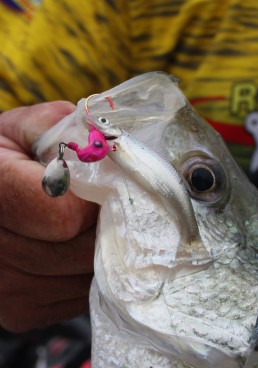
A double-hook tactic option uses an underbody spin jighead. The blade on the jighead provides flash to draw attention to the bait while the natural look and smell of the minnow entices the strike.
Going ultra-light
Wade Mansfield, Grizzly Jig Company owner and fisherman, says going ultralight is good when the water warms and fish become more active. Use a 12-foot jigging pole and light line for dipping a minnow around stumps, trees and other cover. It’s a fun way to enjoy old-style fishing.
“Casting is a fad right now,” says Mansfield. “It can be done-free style with the fisherman controlling the depth and speed. Or, add a slip-float when fish are deep.
Ultra-light casting is simple. Use a good, light spinning outfit spooled with 4- or 6-pound-test line. A small minnow, hook and split-shot is a natural way to present a bait. If you enjoy seeing a float disappear—and who doesn’t—adding a small float is a good, simple way to catch crappies, along with a lot of other species.”
Additional tips
Correctly hooking a minnow is important. The minnow should be hooked enough so it won’t easily be knocked off, but shallow enough so the hook won’t injure the minnow too much. Lip-hooking is popular for slow trolling, casting and other situations. The minnow will follow with minimal rolling when the bait is pulled through the water. Dorsal fin hooking is best when using a minnow under a float and left still. There are other ways to hook a minnow, but these two are the most popular.
Minnow size is critical. One way to learn the best size is to cut a crappie open to see which size minnows it’s eating. Other times, simply testing different size minnows will reveal which is best. In general, large is good in summer, medium or large in the spring, and medium or small in fall and winter. When tipping a jig, it’s often best to use a small minnow.
Final comment
Are minnows still king? Jigs are popular, but minnows still have a time and place, and will always be a part of crappie fishing.
Did you enjoy this post?
You can be among the first to get the latest info on where to go, what to use and how to use it!