All-Terrain Walleyes
By this time of the ice season, foot travel has turned into ATV travel, and soon it will be truck travel. We turn this big corner from early ice to midwinter, heading down the long road of late winter. This time of year also brings more accessibility to offshore structures and basins. While the hot, early ice bite is still holding on, the midwinter ice walleye race is on!
Avid anglers are the first to fish isolated rock piles, saddles and structures with steep breaks facing the main basin. The first anglers on a spot will have incredible walleye fishing. The second time it is fished, there may be bites. The homebody walleyes that made that piece of structure their home for early winter have been caught and kept, or stung and released, by the first anglers on the scene. Some fishing spots will reload every day, but most don’t.
Many structures may take a week or longer to reload. It all depends on food, which is number one priority for walleyes. If there are clouds of young-of-the-year perch, spottail shiners or emerald minnows, walleyes will definitely hunt this area. This is true as long as the massive bait balls remain.
When I find unique structure like this, it’s usually “game on” for my clients. Guides, resorts and local anglers are toe-to-heel in the race, with good reason. A great school of fish keeps rental houses going, guide clients on fish, and local and visiting anglers excited to set the hook on both big and eater-sized walleyes.
Most large lakes in the Ice Belt have this walleye gold race. While it’s not always large numbers of people, every good lake has anglers RAZRing holes on the hunt. There are legendary spots that tend to be good year after year, but everything changes—so it’s good to take the time to look.
Characteristics of a hot walleye spot
As a whole, big, hard-bottom structures hold more fish because of their massive acreage. But most of the time, the fish will hold to one small area. Points on a hump that have a steep side are great. Points with rocks are better. A hump with vegetation on top, with scattered rocks down the break, make a point “nuclear.” A featureless sandbar is just another of many plateaus. Baitfish complement any structure, so when you find complex structure with baitfish, you have the white elephant of a spot.
Some structures can be hundreds of acres, while others may be only a couple hundred feet across. Some lakes hold over 300 structures. Others, very few. The task of finding the right spot can be overwhelming—not to mention, who in this hyper-fast, busy world has the time?
Fortunately, you are able to eliminate 90 percent of your search before you leave home. I study contour maps on my cell phone using a simple phone app called One-Boat Network. Using this app, I am able to study structures by zooming in, and anglers are able to drop waypoints on juicy-looking spots that should hold a lot of walleyes. Highlighting colors and various shades help give the map extreme definition before you head to the lake. Use Bluetooth to download your GPS spots onto your Humminbird XPLORE portable ice GPS sonar.
Bro Pro Tip: Mark waypoints with different colored icons: green, yellow and red. This will save you time, and maybe the first spot will be your new favorite spot! I identify as follows:
Red— must-hit first spot
Yellow— good chance
Green—if time permits, fish might be there
You can be among the first to get the latest info on where to go, what to use and how to use it!
Search baits and still baits
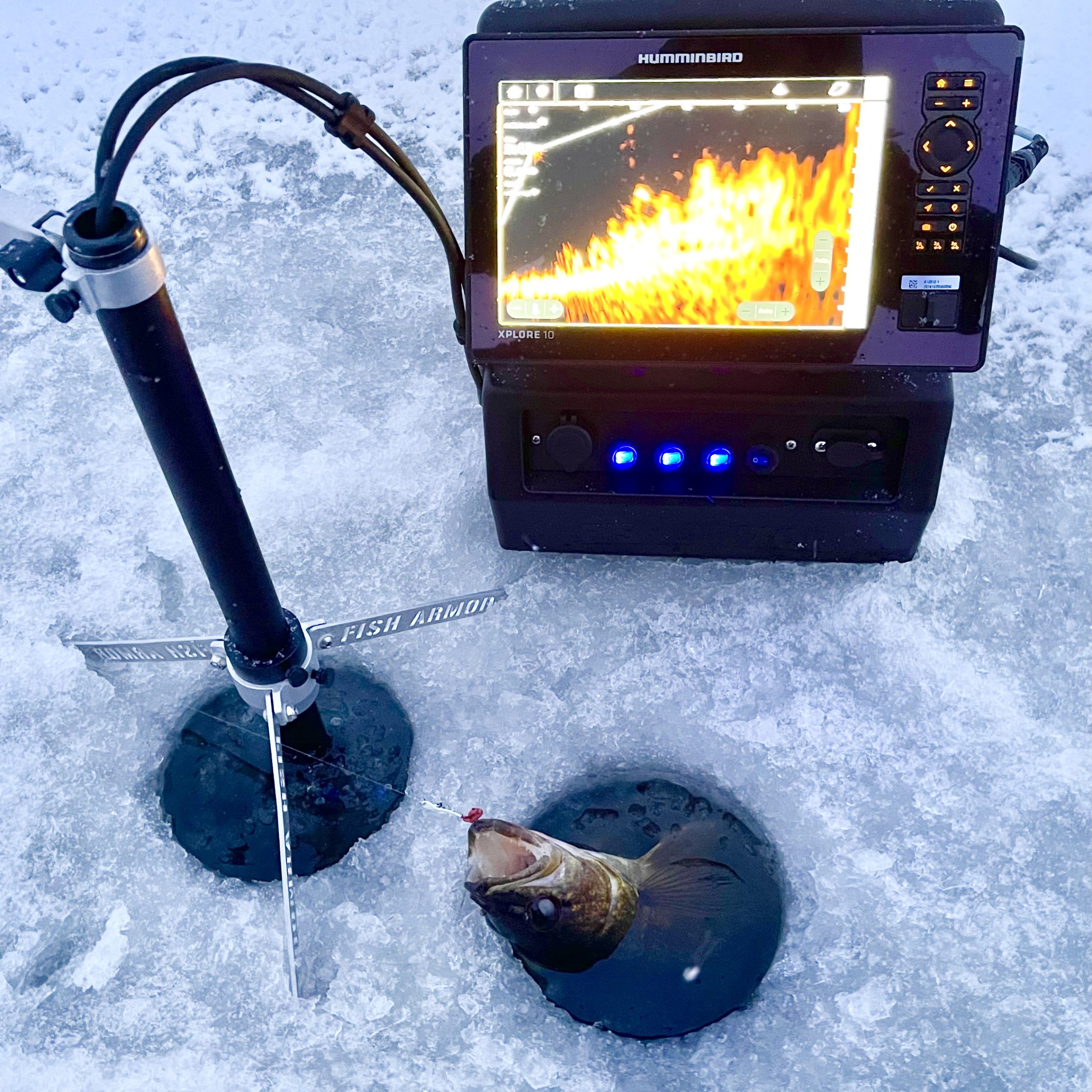
As I am RAZRing holes across the frozen landscape, I drill a zigzag pattern of holes on top of the point and slightly down the steep breakline. If a saddle exists, I also drill this area. I use my Humminbird XPLORE on a Fish Armor Shuttle with an Amped Outdoors 12v 32ah lithium battery and MEGA Live 2 forward viewing. I turn the Fish Armor Pro Pole downrod in a circle to see if there are any boulders or irregularities on the structure. Then, I finetune the holes and add extras that we may need at nightfall. During the “hour of power,” anglers should not be drilling; everyone should be fishing! The holes I drill are close together, within a foot or two. One is for the downrod and MEGA Live 2 transducer; the other is for fishing.
I search from hole-to-hole using a 1-2 punch. On my St. Croix Search Bait ice rod, I use a Northland Thumper Spoon with a minnow head. The spoon tumbles widely covering a massive space. If walleyes are aggressive, they will thump it.
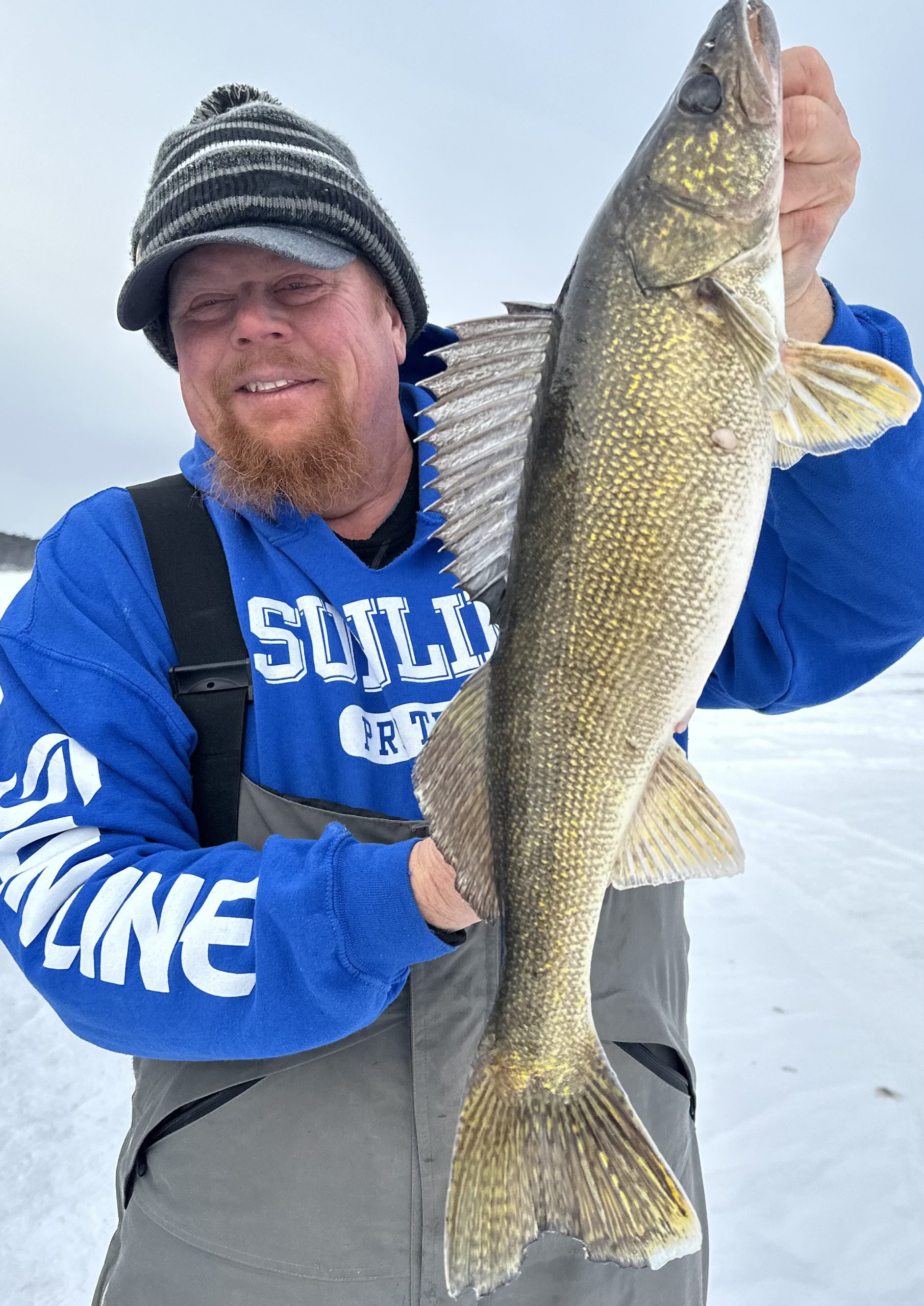
On a second rod, I use a Tungsten Buckshot Spoon with three-quarters of a minnow hooked through the nose. Also known as “the bloody stump,” this is a minnow head snipped behind the dorsal, leaving an air sack so the minnow wiggles and bleeds. Just drop it down and shake it lightly three times with a pause. When a walleye hits, pause for 1 to 2 seconds, then sweep into a hookset.
The Tungsten Buckshot is perfect for fishing a little deeper over the edge of the structure, traveling to the bottom quickly. During the day, walleyes will stage down the break or in the saddle. Larger walleyes will be in “outer space,” suspended off the hump over the basin at the level of the structure’s crown, waiting for sunset.
For my extra line, I use a St. Croix Dead Eye deadstick rod with a smaller SEVIIN GS 750 reel tucked into an I Fish Pro tip-up. Use 5- to 6-pound Sunline Sniper fluorocarbon and a splitshot with a Gamakatsu #4 red Octopus-style hook. Add a dorsal-hooked fathead or rainbow minnow and set it one to two feet off the bottom. The deadstick helps to add numbers, plus they are similar to mouse traps scattered around a spot. If one deadstick gets active with walleye bites, move over to that spot and jig those holes.
Large, shoreline-connected flats
While the basin race for walleyes is going on, there are still schools of walleyes lingering on shoreline-connected spots as long as baitfish are holding there. he walleye activity level is dropping every day as we get to late winter, but there are still plenty of fish to be had. Some flats areas on large lakes are gigantic and go for miles. There may be fish on break features like points, inside turns and steep breaks. But sometimes, walleyes will hold to a depth on top.
For example: I had a great spot last ice in the middle of the flat where it gradually went from 11 to 12 feet. Micro perch were there, and pods of walleyes were swimming through, hunting them. Activity levels ramped up towards sunset. Flats areas connected to shore are nice if anglers don’t have a lot of time to travel across ice. Plus, spots closer to shore generally have thicker ice for safer travel.
Bro Pro Tip: When you are out on the ice searching for spots, pack light and warm. I wear Fish Monkey Yeti Gloves and an AFTCO Reaper Hoodie. You don’t want to sweat on the ice; sweating definitely makes you cold. These gloves and hoodie are breathable, light and warm so I can keep moving to search and fish longer.
Finding gold
Hunting down walleyes on mid-lake structures can lead to big numbers of fish caught during mid-winter, as well as trophy-sized walleyes. Use today’s technology to study ahead of time and execute a plan as soon as you get to the lake, always practicing caution as ice is never 100 percent safe. Remember, a wealth of ice safety information is available online.
Did you enjoy this post?
You can be among the first to get the latest info on where to go, what to use and how to use it!