
A Modern Understanding of Trolling Speed
Next to target depth, the most important variable associated with trolling can be summed up in two words: boat speed. Ironically, most avid trollers don’t fully understand how boat or trolling speed profoundly influences fishing success.
Understanding trolling speed is also essential for anglers who plan to mix two or more common fishing presentations in the same trolling pattern. Say for example that you want to fish bottom-hugging lake trout using the classic dodger and Spin-n-glow combination. This rig fishes best at 1.7 to 1.9 mph. Mixing this presentation with a leadcore and spoon program wouldn’t work out well, as most spoons have their best action at speeds above 2.0 mph.
Understanding which trolling speeds produce best with specific trolling hardware is important, but there is a lot more to understand about trolling speed.
Triggering strikes
Most serious anglers agree that trolling speed is a decisive strike-triggering element. Because lure action changes as boat speed is increased and decreased, anglers can fine-tune a trolling bite by making controlled adjustments to trolling speed. Often, it only takes a minor change in speed to literally light up a bite!
This is precisely why many trollers avoid trolling in a straight line, but rather troll in a lazy “S” pattern. A wandering trolling path essentially speeds up baits pulled on the outside turn, and at the same time slows down those baits on the inside turn.
While trolling the lazy “S” pattern, if more bites are occurring on the outside turn, this is an indication that speeding up the overall trolling speed is in order. On the other hand, if more bites are coming on the inside turn, it suggests that slowing down the overall speed is in order.
On any given day, the most productive trolling speed is a mystery. The only way to determine this variable is by experimenting with speed until a productive pattern emerges. Thanks to modern GPS technology it’s possible to monitor and also adjust trolling speed down to variables of just 1/10th mile per hour.
Making small speed changes
Historically, most open-water trolling chores have been conducted with the help of a small gasoline outboard commonly called a “kicker.” Kicker motors these days are largely four-stroke outboards that are noticeably finicky when it comes to running at a consistent RPM range.
Because four-stroke outboards don’t idle and slow-troll at a consistent rpm range, trolling speeds tend to vary constantly while fishing. Some might imagine that this is an advantage in terms of finding the “most productive” trolling speed on any given day. The problem is, because the trolling speed is constantly fluctuating, it’s tough to pin down exactly what speed is triggering the most strikes.
The solution to this kicker motor problem is to invest in an aftermarket throttle control. Both wireless and hard-wired models are on the market that use a rheostat to stabilize the speed and also to make precise changes to trolling speed. Panther Marine Products is an industry leader in developing throttle controls for outboard kicker motors.
A handful of manufacturers are now producing Electronic Fuel Injection or EFI kicker motors, which start easier and run smoother and more consistently than models that feature traditional carburetor controls.
GPS-guided electric trolling motors
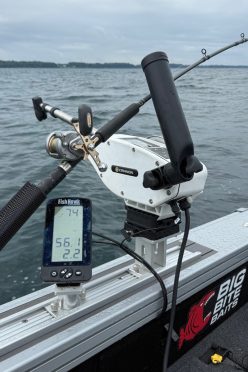 The gasoline kicker motor is the workhorse of small boat trolling, but increasingly more anglers are also incorporating GPS-guided electric motors in their trolling regimen. The advantages of these electric motors are profound. For one, because electric motor thrust is controlled by a rheostat switch, it’s possible to make and maintain very precise changes in trolling speed.
Second, because these electric motors can be set to follow a compass heading, it’s possible to duplicate productive trolling passes in a way never before possible with conventional trolling technology.
Third, GPS-guided electric motors also allow anglers to set down specific waypoints and program the electric motor to navigate from waypoint to waypoint. This feature essentially allows you to follow meandering weed edges or drop-offs like a beagle following a rabbit track!
You can be among the first to get the latest info on where to go, what to use and how to use it!
Modern electric motors use GPS tracking technology that allows you to benefit from several critical trolling functions including Heading Lock, Route Playback and Cruise Control. In the Heading Lock mode, the unit will precisely follow and maintain that course. In the Route Playback mode, up to eight different trolling routes can be programmed and duplicated again and again. The Cruise Control mode allows for a trolling speed to be precisely maintained while in Heading Lock or Route Playback mode, compensating for the effects of both wind and current.
Two-motor trolling
Since the invention of GPS-guided electric motors, a growing number of anglers are incorporating both a gasoline outboard and electric motor into their daily trolling regiment. Depending on the target trolling speed, either a kicker motor or a primary outboard can be used to generate the desired speed. The GPS electric motor is, in turn, used to tweak trolling speed and also to provide GPS navigation chores.
The Fishing 411 crew routinely uses this two-motor trolling option. For salmon, trout, pike, muskies and warm-water walleye fishing where trolling speeds are 2.0 to 3.0 mph, the primary outboard is generally used in combination with the GPS-guided electric motor.
For slower trolling speeds commonly used for targeting cold-water walleyes, brown trout or lake trout, a gasoline kicker motor is used in combination with the GPS-guided electric motor.
When trolling at ultra-slow speeds such as walleye live bait rigging or cold-water crankbait trolling, trolling with just the GPS-guided electric motor is the ticket. A typical 36-volt electric motor will troll a 20-foot “walleye boat” for about 12 hours on a full battery charge.
Between the primary outboard, kicker motors, and GPS-guided electric motors, there are virtually no trolling situations that can’t be mastered with these products.
Trolling speed at depth
 The trolling speeds indicated by a GPS unit are, of course, the speed over ground (SOG) that the boat is maintaining at the water surface. Below the surface, things can be and often are much different.
Subsurface currents are a common problem associated with trolling in the Great Lakes and other deep-water natural lakes. The Great Lakes are actually a huge river system, with the water flowing from Lake Superior in the western Great Lakes to where they drain into the Saint Lawrence River.
Flowing steadily from a westerly to easterly direction, Great Lakes anglers are faced with some amazingly strong surface and also subsurface currents. To complicate matters, layers of water in the Great Lakes tend to stratify, further creating subsurface currents that are impossible to monitor without the help of a subsurface probe.
The Fish Hawk X4D is a probe that mounts to a downrigger ball which effectively provides anglers with trolling speed, depth and critical temperature information at depth. The system functions via a transducer-based signal eliminating any need for special downrigger cables to transfer data.
By monitoring trolling speed at depth, it’s possible to detect subsurface currents and make sure that trolling gear at depth is fishing at the proper speed. Without the help of electronics like the X4D unit, an angler is literally guessing what speed his gear is fishing at depth.
Because a lot of trolling gear is highly speed-sensitive, it’s critically important to know how fast gear is trolling at depth. For example, most trolling spoons have their best action at speeds from 1.9 to 2.5 MPH. If, at depth, these lures fall below this threshold, the baits will have little action and produce poorly.
Summing it up
Trolling speed is one of those fishing variables that seems straightforward, but in truth, is a highly complex subject. Anglers who embrace trolling speed as a means of triggering strikes are on the fast track to fishing success. To anglers who ignore trolling speed and the impact it has on open water trolling… maybe they would be more successful at golf?

Did you enjoy this post?
You can be among the first to get the latest info on where to go, what to use and how to use it!
