
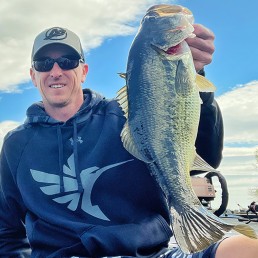
Fishing Wing Dams for Summer Bass
On many of our nation’s large, commercial navigable waterways, a common piece of structure is a fish-holding magnet: a wing dam. Wing dams are finger-like structures made up of rock that are placed perpendicularly along a river’s bank. Their purpose is directing the current back to the main river channel, to keep water levels stable in the main channel for large, commercial traffic.
These rock structures are magnets for holding largemouth and smallmouth bass, especially during the summer months. This is when the flow on a river system is typically at its lowest. Wing dams will have flow on them, however, as they redirect it towards the center of the river channel.
Since a large river may have wing dam after wing dam, it is important to know what to look for and how to effectively target the bass holding on them.
When you find a wing dam, identify the key areas to establish a pattern that you can replicate up and down the main river channel. Some items to look for include:
- Is the wing dam out of the water for the most part, besides the tip, or is the majority of the rock still underwater?
- Is it the wing dam on a bend in the river channel, or a straight section?
- Is the wing dam on the tip of an island? If so, is it on the upstream or downstream side?
When I first pull up to a wing dam and am not sure where the bass are located, I like to get a feel of not only what mood the bass are in, but also the bottom content and makeup.
To accomplish the first goal, I’ll turn to a topwater plug, since bass will be holding on a wing dam to feed. Locating an active school of bass is easy when you can see them hitting your bait. I like a popper such as a Storm Chug Bug, Rapala X-Pop, or the tried-and-true Rebel Pop-R. I like using a popper, as I can pause the bait in key, slack-water sections behind the wing dam; when it sits motionless, minus the current moving it, bass often come up and hit it.
Accomplishing the second goal can be a bit snaggy; getting an idea of what the bottom is like, and how deep the wing dam is, means that you are putting your lure down in the crevices and along the very abrasive structure of the wing dam. Because of this, I’ll spool my Trika Ti 100 casting reel with 17-pound Seaguar Abraz X Fluorocarbon line. This line can take a beating as it is fished around the rock, yet it is still very castable, which is key when I want to make a long cast with a Carolina rig.
You can be among the first to get the latest info on where to go, what to use and how to use it!
I like to cast my C-rig parallel to the wing dam, both on the up- and downstream sides, and drag it all the way to the hole that is usually located near the tip of the wing dam; this is where the current will scour it out. The size of the weight I use depends on how much current is coming over the dam, and the depth, but going with a lighter weight snags up less.
The two plastics I like to C-rig include a green pumpkin Yamamoto Baits 3-inch Yama Craw, and a White Pearl Fat Shad Shape Worm. The first is my go-to, as it replicates the crawfish that the bass are feeding on that live in the rocks. I like the minnow-imitating Fat Shad Shape Worm once the school of bass I’ve been catching on topwater shuts down.
If the bass are feeding, they usually position near the tip of the wing dam, since this is where the current pushes baitfish and insects. Another area where the bass will hold in the current occurs where a hole or break in the rock forms a chute where the water funnels through; this is again a prime spot for bass to actively feed. Letting a weightless. soft plastic bait float through this area can be a dynamite way to put bass in the boat. I’ll switch up between a 5- or 6-inch Senko, wacky-rigged on a TroKar TK133 Pro V Finesse Hook, as the 6-inch will sink a little more than the 5-inch; both will mimic an injured baitfish floating in the current.
As you are fishing a wing dam, boat control is important, as the current can easily move your boat out of ideal casting position, also putting your boat in danger of hitting the rock. Relying on your trolling motor and shallow water anchors is very important. If I’m able to deploy my dual Minn Kota Raptors, I’ll do that; but commonly, the transom of my boat is sitting in deeper water, so I engage the Spot-Lock feature on the Ultrex Quest Trolling Motor.
As the summer months arrive, don’t give up on river systems. Pay attention to details. Presenting your bait properly can put you on a fantastic, late-summer bass bite, all by fishing man-made wing dams.
Looking for some new fishing techniques to try this season? You’ll find plenty of suggestions in every issue of MidWest Outdoors. Subscribe on our website.
MWO
SHARE THIS POST
Did you enjoy this post?
You can be among the first to get the latest info on where to go, what to use and how to use it!
