
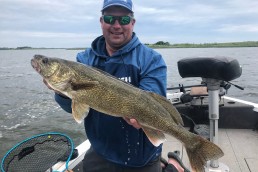
Fall Walleyes by the Hour
When fish are scattered all over, which they often are in the period before fall turnover, Jason Mitchell explains that you simply must keep moving and grooving to create good fishing opportunities.
Fall is a prime time if you love to walleye fish and target big fish. September is considered fall fishing, but how fish set up in September is completely different than in November. I would dare argue that early fall sees a lot more transition and change. Fish can be much more scattered, especially before the turnover. There will be fish shallow and deep. Early-fall fish can also move a lot and you can have a more difficult time putting together consecutive good fishing days.
September walleye fishing can be about locations, but also about the process. Early fall seems more conducive for milk-running good spots and simply covering water, either by dunking into several spots throughout the day or performing big trolling passes. Grinding out one key location seems to burn us more because the fish are simply moving too much. Time management is crucial any time of the year, but becomes magnified in early fall when you simply must keep looking for fish.
This is a time of transition and your watch is as crucial of a piece of equipment as your sonar or map chip. Typically, you can put together a good day if you can average a fish per hour. Cover enough water and hit enough spots so that you can achieve this average. If you can average a fish per hour and then hit a spot where you catch two to four fish in an hour at least once or twice per day, that can add up to a good day.
Reading and understanding locations is crucial in fall, and this knowledge will help you catch more fish throughout the year. Get as good as possible at quickly finding the spot-on-the-spot, like the key ten-yard piece of structure on a bigger piece of structure. Some anglers call this the money spot. When you are combing water, hit as many money spots as quickly as possible. Don’t worry about turning over every rock or fishing an entire piece of structure. Hit the key locations on each spot, as this is a much faster way of hitting as many spots as possible.
Will you sometimes miss fish with this aggressive approach? Sometimes, but what I find is that if there are big fish or aggressive fish on a location, they will often occupy the premium real estate.
Use every tool at your disposal. Traditional 2D sonar is still excellent for marking fish below the boat on classic structure, and I find that I can better determine the size of the fish. Down view is excellent over deep mud or rocks where it is difficult to get target separation from the bottom. Side imaging is great for deciphering clutter over open water or showing fish over large flats that are made up of small rock or sand. Fish on weeds, however, can be much more difficult, if not impossible, to mark with electronics unless the weeds are sporadic and the fish are lying in the open.
You can be among the first to get the latest info on where to go, what to use and how to use it!
If there is one standby in September, however, that I keep falling back on, that would be shallow weed walleyes. If you can still find good, lush stands of green weeds like cabbage or coontail, there are typically walleyes around. I like weeds because weed patterns seem to stay consistent through early fall, when everything else in that ecosystem is undergoing drastic change. Broadleaf pondweed or cabbage varieties are top-of-the-list, but pencil reeds, wild rice, coontail and dollar weed all hold walleye at times. I also believe weeds hold heat as well when the lake starts to cool in the fall. There is just something surprisingly consistent about weed patterns during early fall that make shallow weed patterns somewhat reliable.
Weeds, however, can be difficult to fish, and you just don’t roll into a weed location and figure out the intricacies in five minutes. Weeds take time to figure out come late summer and fall. You might have to map out the outside edge of the weed line. You might have to experiment with casting angles and lures to fish the top of the weed bed. Typically, with weeds and walleyes, we aren’t going into the weeds after fish like you would if you are bass fishing. We typically either fish the outside edge or the top edge. The open water on the edge is typically where we find walleyes. Walleyes seem to cruise through these open lanes and move through these locations as they hunt. Walleyes seem to like gaps and lanes in weeds.
Large soft plastic swimbaits are an overall favorite for catching big fall walleyes in weeds because of the versatility. You can fish a swimbait over the top of the weeds. You can clip the outside edge and fish through sporadic weed growth. Big profiles often seem to work best in the fall. There is an adage with fall walleye fishing to use larger baits, and that does ring true. Typically, there is not as much forage, but the forage has grown larger come fall, so walleyes are used to keying into larger profiles.
The month of September is also a time when many of these weeds start to break down and die. But find standing green weeds with good water circulation come late summer to early fall, and there is a very high probability of finding walleyes. What makes this pattern a favorite is that these fish don’t move as much and are just more consistent.
Manage your time this fall. Have a good milk run of locations to cycle through and dabble with some green weeds when many fish are in transition. September walleye fishing can be inconsistent and sporadic. There’s no doubt that the absolute best fall fishing is yet to come, but there are some enjoyable opportunities to take advantage of as we wait.
If you want more fall fishing tips from the pros who know, check out the fall issues of MidWest Outdoors, available by subscribing on our website.
MWO
SHARE THIS POST
Did you enjoy this post?
You can be among the first to get the latest info on where to go, what to use and how to use it!