
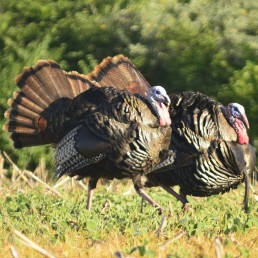
Fall Turkey Smorgasbord
Forget the spring abundance of gobbling, fast-paced turkey activities, and frequent gobbler sightings throughout most rural landscapes. It’s fall, and wild turkeys have dispersed into separate hen and gobbler groups as they gorge foods to prepare for winter challenges. They aren’t necessarily the birds you hunted last spring. While they are still huntable, adjustments might need to be made. Spring turkey hunters often become humbled if they don’t learn fall hunting tactics.
If you’ve never tried fall turkey hunting, you’re in for an exciting adventure. Hunting is usually diverse, because turkeys have one main objective: survival. So, when things don’t go your way, try sitting down and waiting for action. Then, enjoy your time in the woods.
Fall turkey hunting offers cooler days and colorful woodland foliage. Family flocks of hens and current-year poults gather across woodland landscapes, especially where nuts sprinkle the ground. This is the time frame when hens remain in small groups and toms travel in small gangs. Mating isn’t a fall turkey’s focus; it’s simply feeding intensely before winter. Fortunately, hunters can tag a bird of either sex.
Hunting methods can be different for each hunter. Ideally, a single hunter creates less visual and noise intrusions. Are you after a hen, or a tom? If things don’t go your way, change your tactics. Try being creative. Decoys, or not? They are always worth a try during fall because turkeys hang out in flocks and often welcome newcomers. Study their habitat essentials, especially food sources. Scout wherever they frequent the most. Talk with landowner’s and query them on turkey sightings.
Hens, jakes and mature toms can be hunted, and to hunt them, you must first find them. They often frequent open pastures in search of grasshoppers, spiders, and various insects, as well as loose farm crop grains. They are normally seen in small flocks. Therefore, calling to one bird often attracts more than one. Turkeys are social now and apparently feel safe in numbers. Yelps, soft clucks, and the Kee-kee calls of a lonely, or lost bird, tempt them. But, give them time to approach. Turkeys are in no hurry now, unless it’s to escape predators.
Locating turkeys begins by looking for obvious signs. Turkeys love to dust their bodies for insect extermination. Look for obvious dusting spots with tracks and loose feathers. Droppings, and loose feathers, give them away, too. Equally noticeable are semi-circular scratchings throughout leaf-covered woodland acreage. Many fall turkey hunters simply walk and search for birds.
Once you locate a flock, though, patience is in style. Quickly select a concealing location, then sit down. Use subtle clucks, yelps and Kee-kee mouth calls. Occasional calling can tease birds into range, usually at their approach pace. Therefore, remain well hidden. Camouflage helps obscure you as you wait and watch for approaching turkeys. Hens, poults and jakes are likely to visit your calling first. Small groups of toms might try to join you as well. You will probably first hear gobbler “yelps” before they appear.
Begin by confirming legal fall turkey hunting counties. Then, determine your hunting location. Now, plan effective hunting methods Decide what sex bird you want. When things don’t go your way, walk or sit as tactics. Travel light & fast. Should you use decoys? Decoys often interest social fall turkeys.
Is any time of the day best for hunting? Sometimes, I wait until after daylight, when birds are already on the ground. One morning the first flock I encountered was all hen talk. They played cat & mouse with me as I followed the hens throughout the morning. They refused to approach close enough for a shot, even if I wanted to take a hen. Therefore, they aren’t always an easy take. But, it’s an exciting time to experiment with turkeys.
During one fall hunt, I focused on taking a tom because I wanted this hunt to be challenging and to fulfill my Thanksgiving meal. It appeared that I was going to exceed my expectations. Fall gobblers can be very reluctant. But, one rainy October morning, a three-year-old tom gobbled to my yelps several times. Then, he walked directly up the hillside without a gobble. I was surprised, as he silently strolled up the rain-soaked leaf covered hillside and appeared on the colorful woodland landscape.
You can be among the first to get the latest info on where to go, what to use and how to use it!
Do fall harvests affect turkey population numbers? Some fear that fall hunting can shrink populations numbers. I learned otherwise. Studies confirm that fall hunting is not detrimental to bird numbers because variables assure us that turkeys often lead a questionable lifespan. Even if hunters don’t harvest turkeys, they face other obstacles as fall progresses thru winter. Turkeys must deal with adverse weather and diseases, which often lead to starvation. Hungry predators and poaching take a toll, even without legal human hunting. Biologists believe that limited hunting pressures on fall turkeys has minimal ill affect.
Fall turkeys can be tricky, especially when leaf cover creates noisy walking. Regardless, always move slowly and with cautious observations. Fortunately, turkeys make mistakes, too. Also, consider other potential interferences. It’s possible you might conflict with deer bow and squirrel hunters? Be observant.
It’s easy to understand why competing against fall turkeys excites many hunters. Our forefathers believed autumn to be a challenging time to hunt these elusive birds. Today’s hunters are learning this fact, too. When turkey hunters can’t rely upon the sexual dramas of spring courtship, it becomes obvious that fall hunting savvy requires handpicking your strategies. That’s why hunters need to capitalize on optimum advantages.
Realistic calling is vital for harvesting fall turkey. Of course, appropriate camouflage designs permit hunters to blend deceptively with various terrain patterns and adapt to land contour configurations. Equally, knowing where birds roost and feed enables hunters to find turkeys. Landscape knowledge allows us to decide where we can set up and hide to betray these secretive birds. But, if there’s ever a time that you’d better sound like a real turkey, it’s during fall hunting. Intimate knowledge of turkey vocabulary and expertise at operating calling devises is extremely important.
Whether your choice of friction tools are box, slate, or plunger calls, rest assured, each is able of producing convincing yelps, relaxing purrs, and methodical clucks. Besides, friction calls can transmit at far ranges. They’re capable of attracting birds from surprising distances. Yet, you can easily control volume for close range and seductive calling. No matter what your calling style or abilities, practice is the secret to creating persuasive sounds.
Although the flexibility of diaphragm mouth calls offers many advantages, I also use friction calls. I’ve found them to be deadly during fall hunting because their sounds are closely realistic of gobbler “yelps.”
Why hunt turkeys in fall? This sport is a traditional turkey hunting practice in many states, dating back many years. Besides, the experiences are exciting and challenging, and a succulent fall turkey offers tender, tasty meat. And, since fall turkey season usually permits afternoon hunting, the bonus daylight hours allow hunters more opportunities. If you don’t score in the morning, afternoons can fuel more opportunities.
Whether you pursue fall’s bounty of receptive jakes, tasty hens, or bearded toms, rely on slate, aluminum and glass calls. Include box and plunger calls, too. Your call arsenal will help you master notes that can fool reluctant birds. Rely on a cadre of calls and you’ll multiply your odds of deceiving a fall turkey.
For more insight and tips on how to make the most of the time you spend hunting, check out the articles in every issue of MidWest Outdoors, available by subscribing on our website.
MWO
SHARE THIS POST
Did you enjoy this post?
You can be among the first to get the latest info on where to go, what to use and how to use it!
