
Fall Turkey Hunting 1.0
Jason Houser recommends fall turkey hunting for additional opportunities to score a gobbler.
In the fall, most hunters are busy hunting deer, waterfowl and upland game. In fact, you often have the woods to yourself if you are a dedicated fall turkey hunter. This is good for many reasons, but perhaps most importantly, it gives you plenty of time for fall hunting, which is necessary if you are planning on taking a fall gobbler.
Fall turkey hunting requires patience. In fact, it is twice as important as in spring turkey hunting. Busting up a flock of hens and poults and calling them back in can sometimes be over in a couple of minutes. Gobblers, however, are a completely different story altogether. In fall, gobblers could care less about hens and are only somewhat inclined to flock together with other gobblers. Fall gobblers usually cannot be called in using hen yelps, cutts, or cackles. Instead, you must sound like a gobbler to call in a gobbler in the fall. This means using low clucks, yelps, purrs and even gobbles to attract a fall tom.
The techniques consistent from spring to fall are good scouting, woodsmanship and correct calling. The most important part of fall turkey hunting is scouting for birds.
Scatter and call back
The best method for hunting fall turkeys is to scatter a drove and try to call individual turkeys back. The idea is to scout out and get as close as possible to a flock of turkeys and then run towards them, yelling and whooping, to try to get them to break up as much as possible. Running with a loaded gun is never a good idea, so put down or unload your gun before you run.
Ideally, the flock will scatter in all directions, or at least split up in two groups. This will give you the best opportunity to call them back to the flush site. Often, they do not scatter well at all. If they fly off together, your only real choice is to try to scatter them again.
If the turkeys seem to scatter well, but all go in the same direction, walk 100 to 200 yards in that direction before you set up to begin calling. Sometimes, you will not get a good scatter and the turkeys will re-flock immediately, before you have a chance to call in any loners.
Intercept and call
Many people prefer to try to call in the whole turkey flock instead of scattering them. If you cannot call the flock in, then try to scatter them and call in an individual bird.
You can be among the first to get the latest info on where to go, what to use and how to use it!
Locating a flock of turkeys can be done by either viewing a flock and working your way closer, or by using your ears and finding a flock scratching or calling amongst themselves. Once located, try to judge where they are traveling and get in front of them before setting up. Give a few yelps or clucks. If you get a response, copy that turkey’s call.
You can also use a fighting purr. All turkeys, especially young ones, are actively fighting in fall as they try to establish their pecking order, and they love to come running when they hear a fight going on. They make a lot of noise when they fight, so I do, too, when I am trying to call them in. I have had the best luck while hunting with a buddy and having both of us call. It is also a good idea to use a wing or hat to beat on the ground or trees around you. A turkey fight is loud with lots of wing beats, purring, cuts, clucks and more. If you can get close to copying all these sounds, you will sound more realistic and be more effective.
Random calling
If you cannot locate a flock of turkeys, it is possible to just move around in areas known to have turkeys and call, like in the spring, to try to get turkeys to respond. Again, start by giving a few yelps or clucks. If you get a response, copy that turkey’s call. Lost calls also work well in this situation.
There are a lot more turkeys killed in fall by deer hunters sitting in their stands than most people think. Many deer bow hunters also buy a turkey tag just in case a flock of turkeys wanders by their stand.
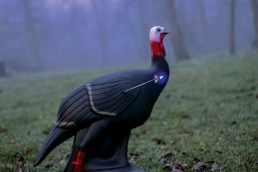
If you plan on taking a shot at a turkey with your bow, be certain of where the vitals are located and practice hitting those small areas. I recommend a 3D target like what Shooter 3D Targets have to offer.
Other hunters who exclusively go after turkeys and scout out a particular bunch of birds to pursue will also use the still hunting technique. If you can pattern a flock and find out when and where they enter a field, cross a creek or river, or travel to and from their roost, sitting in a blind near their path can be the most effective hunting tactic of all.
If you enjoy turkey hunting, you’ll appreciate the tips from our pros in the fall issues of MidWest Outdoors, available by subscribing on our website.
MWO
SHARE THIS POST
Did you enjoy this post?
You can be among the first to get the latest info on where to go, what to use and how to use it!
