
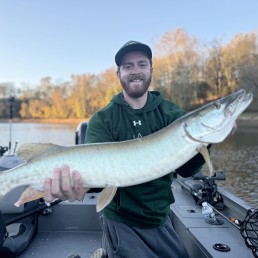
Fall Muskie Trolling
As we move deeper into the cold sunrises and burning sunsets of fall, one muskie tactic always begins working its way back to the front of my muskie mind—trolling.
Fall casting can be excellent, but this is also the time of year when trolling begins to shine. As water temperatures fall and muskies settle into predictable travel routes, breaklines and feeding zones, trolling becomes one of the most efficient ways to cover water and stay in contact with fish.
For anglers who spend most of the season casting, fall is an ideal time to add trolling to the game plan. It does not need to replace casting, and it does not require a complicated spread or a boat full of specialized gear. Even a simple one- or two-line setup can open up new water, improve your understanding of lure depth and boat control, and create opportunities for catching some of the largest muskies in the system.
With that in mind, the best place to begin is with the basic equipment, locations, and presentation details that shorten the learning curve, to make fall trolling productive without making it unnecessarily complicated.
Keep the gear simple
A line-counter reel is the first piece of equipment I consider a prerequisite, because successful trolling is built around replication. If a muskie strikes with 42 feet of line behind the boat, I want to be able to reproduce that presentation, rather than guess at where the lure was running. Once a productive line length, depth and speed are identified, the line counter turns that information into something repeatable.
Long fluorocarbon leaders in the 36- to 48-inch range are another important part of my trolling setup. Muskies can roll during the fight, and the additional leader length helps keep braided line away from the fish and reduces the chance of cuts or other injuries. A good-quality rod holder is also a smart addition to any boat, and there are plenty of budget-friendly options that will handle basic muskie trolling without issue.
As far as rods, anglers just getting started do not need to overcomplicate matters. Specialized trolling rods certainly have advantages, but a standard muskie casting rod is more than sufficient for learning the system and putting fish in the net. The important part at this stage is not building a specialized trolling arsenal; it is developing a repeatable presentation and learning what your lures are doing behind the boat.
Work the first major break
It is common knowledge that muskies can push very shallow during the fall, using weeds, sandgrass, reeds and other forms of cover. Some of the largest muskies in a system, however, seem reluctant to make that extreme shallow-water move. Instead, they often linger around the first substantial break outside those shallow zones, remaining close enough to take advantage of fall feeding opportunities while still having immediate access to the stability and sanctuary of deeper water.
That middle-depth position is what gets me excited about fall trolling. There is something compelling about the idea of a giant muskie holding near the edge of light penetration, waiting to intercept a wandering walleye or an errant cisco. Trolling gives us an efficient way to stay in that zone for long stretches of water.
Targeting these first-break fish does not require a backlog of trolling experience, because the concept is fairly straight-forward: Identify the first significant breakline in the body of water you are fishing, and begin presenting lures along it. Structurally, that break is simply the area where a shallower flat, shoreline zone or structural feature begins dropping into deeper water.
On a small Midwestern lake, for example, the first substantial break might be where 5 or 6 feet of water falls into 10 or 12. On another body of water, those numbers may be completely different. Depth is relative, so the important part is understanding the relationship between shallow and deep water on the specific lake, rather than searching for a predetermined number.
Depth first, size second
Once you understand the breakline you want to target, lure selection becomes much easier. There are seemingly endless trolling lures available, but I believe the decision can be simplified to two primary considerations—the depth the lure can reach, and the size of the presentation.
Running depth comes first. If I am targeting water 8 feet deep, I can immediately narrow my selection to baits capable of effectively working somewhere within that zone. Whenever possible, I prefer lures that reach the desired depth with the shortest practical amount of line behind the boat, because shorter leads make it easier to control the presentation around turns, structure and cover.
Knowing the relationship between line length and running depth also makes successful presentations repeatable. Instead of simply knowing which lure caught the fish, you know how much line was out and approximately where that lure was positioned in the water column. Those details become increasingly valuable as a pattern begins to develop.
You can be among the first to get the latest info on where to go, what to use and how to use it!
Lure size is the second consideration, and I generally allow the forage base to guide that decision. There is little reason to make an enormous 15-inch bait the foundation of the program in a system where forage of that size is largely absent. Larger baitfish usually justify larger trolling presentations, while lakes dominated by smaller forage often call for a more moderate profile.
That does not mean oversized trolling lures will not catch muskies. They certainly can, but presentations in the 8- to 12-inch range have consistently served both me and my guide clients well. On the waters I regularly fish, 10-inch Super Natural Headlocks, 10-inch Super Natural Mattlocks, and 8-inch Joe Bucher Depth Raiders have long been staples of my trolling arsenal. Add a few mid-sized Jakes and Grandmas, and you have more than enough firepower to build a productive fall trolling program.
Make the boat work the bait
One of the most important concepts that new trollers often overlook is that trolling does not mean simply dragging a lure behind the boat in a straight line. Straight-line trolling can and will catch muskies, but a high percentage of strikes occur after something changes within the presentation. Speed changes, direction changes, and turns all alter what the lure is doing beneath the surface, and those alterations can be exactly what a following fish needs to commit.
Adding a gradual swerving motion to a trolling pass is one of the easiest ways to introduce that variation. As the boat turns, the outside lure accelerates while the inside lure slows, creating two different presentations without making a single adjustment to the rods. More pronounced turns into and away from structure can create even greater changes in speed and direction, while also moving lures through slightly different portions of the water column.
This is where boat control becomes one of the most important skills in successful trolling. The better you understand where the boat and lures are positioned in relation to structure and cover, the more confidently you can manipulate your trolling pass. Once you have a firm grasp of what lies beneath you, you can begin adding turns, speed changes, jukes and other movements designed to trigger muskies that may already be following the bait.
Learn the pass before you push it
When I am learning a new area, I start conservatively. The first trolling pass is made with the lures running at a relatively shallow or moderate depth, which reduces the likelihood of hanging up and allows me to concentrate on learning the structure, rather than constantly worrying about recovering a snagged lure.
During that first pass, I pay close attention to the electronics, identify hazards, and learn how the breakline bends, tightens and changes beneath the boat. Once I have made a pass or two and have a better understanding of the area, I begin adjusting lure depth and making more aggressive moves into and away from the structure.
This progression is especially important for anglers who are new to trolling. Good boat control develops much faster when you first understand the water beneath you. Trying to make aggressive turns with deep-running lures before learning the pass usually leads to unnecessary snags and frustration, rather than more muskies.
Start simple this fall
Like nearly every aspect of muskie fishing, trolling can become incredibly technical if you allow it. There are endless combinations of speed, lure depth, line length, boat angle, structure and seasonal movement to explore, and even experienced trollers continue learning every season. None of that complexity should prevent you from getting started.
For someone new to trolling, my advice remains simple: Start simple and keep it simple. One or two lines, a handful of proven trolling lures, and a basic understanding of the structure you are fishing are enough to begin. Concentrate on knowing where your lures are running, maintaining control of the boat, and repeating the details when a fish finally commits.
Fall provides some of the best opportunities of the season to put a truly large muskie in the net, and many of those fish will be positioned in exactly the type of water where trolling excels.
For more fishing insight from the pros who know, check out the next issue of MidWest Outdoors, available by subscribing on our website.
MWO
SHARE THIS POST
Did you enjoy this post?
You can be among the first to get the latest info on where to go, what to use and how to use it!
