
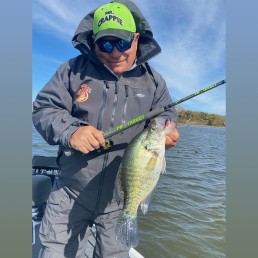
Fall for Crappies
Many very accomplished and well-known anglers have made the observation that crappies are a mysterious fish. In mid and late summer in a good number of lakes, they seem to disappear from areas where they were abundant just a few weeks earlier. But if you keep a few things in mind, you can catch them when they reappear in the fall.
Crappies are crepuscular. This means that they are most active early and late in the day much of the year. In the fall, though, they’ll often bite all day.
Depending on where you’re fishing, there are a couple of very good ways to catch crappies right now. The favorite technique of many crappie-catchers is to cast a light jig to a deep weed line or dock. Crappies like the cover that each provide and they also like that baitfish will hang around the same areas. Crappies will also suspend off the deep edge of the weed line. Watch for dimples on the water’s surface. The dimples reveal crappies slurping bugs off the surface. Throw a jig around the dimples and they’ll often slurp the jig.
Another technique that works well in these same areas is to rig your jig under a slip-bobber. There’s something about watching a bobber float across the surface, then slowly go down that’s almost magical. Experiment with how far your bobber is set above the jig. At times the fish like the bait close to the surface, especially when there’s less light penetration or a bug hatch. Sometimes they want it deeper, like when it’s brighter out.
Last technique. In some lakes, crappies will move into deep water and spend much of the rest of the year there. They’ll hang out close to the bottom in deep water. If you watch your sonar carefully, you’ll be able to see the crappies holding near deep-water points or even in the basin of the lake. Sometimes you’ll see fish that you believe are walleyes on the sonar and they are actually crappies. This time of the year crappies can look much like walleyes on the sonar. You’ll frequently catch some walleyes with the crappies, and that’s not a bad thing. Many anglers would consider that a winning deal. Walleyes and crappies in the same spot. In this deep water a 1/8-ounce jig fished on 4- or s6-pound line will be most productive.
You can be among the first to get the latest info on where to go, what to use and how to use it!
In all these techniques we’re mostly using jigs in either 1/16- or 1/8-ounce sizes. The 1/16-ounce size when casting to the weed line or docks, the 1/8-ounce jig in the deeper water. And consider a 1/32-ounce jig with a split shot under the bobber.
Through the years, serious crappie chasers usually had a rod rigged with a minnow on a jig. Not so much anymore. Crappie plastics have become so good there hardly is ever a time when a minnow is better. Maybe when the fish are being really finicky a live minnow will be more productive. Plastic offers more colors, shapes, and durability. Mr. Crappie Grubs, Crappie Thunder, and Slabalicous plastics are outstanding. Start with brighter colors and go more natural if the crappies aren’t aggressive.
Crappies are fun to catch and can be willing biters. If you keep these ideas in mind, you’ll be able to catch them through the autumn months. They’re outstanding on the table, so don’t hesitate to keep a few. Once you get onto it, catching a few usually won’t be a problem this time of year.
For more insight and tips for fishing throughout the year, check out the articles in every issue of MidWest Outdoors, available by subscribing on our website.
MWO
SHARE THIS POST
Did you enjoy this post?
You can be among the first to get the latest info on where to go, what to use and how to use it!
