
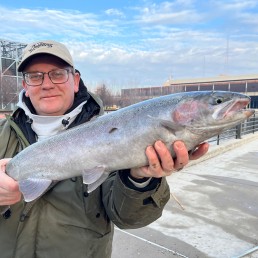
Drop-Shot Fishing Great Lakes Harbors for Steelhead
Like everything, Lake Michigan is also constantly evolving. When I started shore fishing in 1974, on a good day, the water had a visibility of maybe a foot. We were all chucking big spoons in gawdy colors just to get the fish to find the lure. We even added rattles to spoons to help them home in on it. Well, that has sure changed.
Now, on a good day, we can see the bottom in 15 and even 20 feet of water. These are the exact conditions that forced bass anglers to change to finesse tactics, and the same is true here on Lake Michigan.
What I really fell upon was the effectiveness of the drop-shot on winter and spring steelhead. My success was not in streams or rivers, but in open-water harbors. I was working seawalls, riprap edges, and harbor channels, and instead of smallmouths, catching steelhead! Pesky, 8- to 12-pound steelhead. What a problem to have!
I love fishing hair jigs for smallmouth. Casting a 1/16-ounce hair jig almost free-floating to a cold-water smallie. It works great in 6 or 8 feet of water. These harbors are different. We are talking 15 feet or more and a lot of wind. A normal hair jig wouldn’t cut it, so I started tying my standard marabou on a stout hook and fishing it on a drop-shot rig. Success was instant.
It was the best of both worlds. The deep-water contact of a drop-shot rig with the subtle free-flowing action of a hair jig.
Smallmouths loved it, but then the steelhead action started. Steelhead started loving it more than the smallmouths! Eight-, 10-, 12-pound steelies on my medium-light bass drop-shot rod.
The rig is simple, using standard drop-shot weights in 1/4-ounce. I prefer either a walking one or a long, slim one over a bell or ball shape. I try to keep it moving ever-so-slowly while making bottom contact.
You can be among the first to get the latest info on where to go, what to use and how to use it!
If you don’t tie your own flies, don’t worry. Any leech imitation fly available in your local fly shop will work. A few good ones are the Balanced Leech, The Egg Sucking Leech, and the good old Wooly Bugger. Any color works as long as its black! Olive has worked, too, but black has been the best. The fly you tie or buy should be about 2.5 inches long.
I like the drop from the fly to the weight to be about 18 to 20 inches.
Cast it out and let it get to the bottom. Then do a lift-and-drop of the weight about 6 to 12 inches at a time. I’m not pausing too long; just enough to take up the line. With cold-water smallies, the bite will just feel heavy. Steelhead slam it. They absolutely eat it!
I have gone to a medium, 7-foot rod with 8-pound mono or fluorocarbon. It’s too tough to fish braid in below freezing temps, so it’s the one time of the year I have to go back to mono. It’s hard to beat good, old Trilene XL for a soft winter line. For fluorocarbon, I really like Seaguar Red Label. It’s tough and very affordable.
This spring or next winter, take a tip from finesse bass fishermen and try drop-shotting for steelhead in your local harbor. I fell upon it by accident, but I love finding a new tactic to use on Great Lakes trout!
For more fishing insight from the pros who know, check out the next issue of MidWest Outdoors, available by subscribing on our website.
MWO
SHARE THIS POST
Did you enjoy this post?
You can be among the first to get the latest info on where to go, what to use and how to use it!