
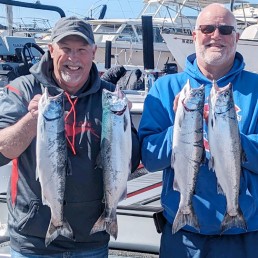
Coho-a-Go-Go
For many decades, southern Lake Michigan has been the place to be in April for anglers who enjoy targeting coho salmon. As the “original,” non-indigenous gamefish species, coho were established in Lake Michigan before chinook salmon. These fish spend the winter months in southern Lake Michigan where alewives are abundant and water temperatures a little warmer than farther north.
One of the most noteworthy conservation success stories ever told, coho salmon have thrived in Lake Michigan and other Great Lakes waters for the better part of five decades! Certainly, there have been ups and downs in the coho stocking program over the years, but in the big picture, coho bring a lot to the party.
These popular Pacific salmon grow quickly; their bright, red meat makes for amazing table fare, and they put the fun back into spring fishing. When other species are either spawning or getting ready to spawn, coho are putting on the feed bag in an effort to pack on the pounds.
Coho classics
Coho salmon are caught on a wide variety of popular salmon trolling gear, but a few lures/presentations rank as classics for boxing a quick limit. Every coho enthusiast needs these lures tied on the ends of their lines.
Trolling small, diving crankbaits puts fish in the boat, day-in and day-out. The beauty of floating/diving style lures is that they are readily fished in combination with planer boards, helping to spread out lines and literally flood the water column with lures.
The top baits in this category include the Yakima Bait Mag Lip 3.0, the Brad’s ThinFish, the Storm Original ThinFin, and if you are lucky enough to own some, the discontinued Storm Rattlin’ ThinFin. These baits do an excellent job of imitating young alewives and are lights-out for coho in the spring of the year.
None of these lures are especially deep divers, but in April, most coho are caught in shallow water. If it becomes necessary to get any of these baits a little deeper in the water column, the Off Shore Tackle Pro Weight System (aka Snap Weight) does a great job of helping each lure achieve some additional diving depth.
A widely used in-line trolling sinker, the 2-ounce models are the most popular choice among crankbait trollers. Trollers typically consult the Precision Trolling Data phone app and the 50+2 Data to determine exactly how much lead length is required to achieve specific target depths. This setup works by first letting the lure of choice out 50 feet behind the boat, then placing a 2-ounce Snap Weight on the line, followed by deploying the additional trolling lead length required to reach the desired target depth.
When fish are hooked, reel in both the Snap Weight and fish until the Snap Weight can be removed by hand from the line and the fight continued to net. This simple, yet effective trolling strategy allows anglers to get diving crankbaits to much deeper depths than they would otherwise dive unassisted.
Trolling spoons are the other lure every coho angler needs to embrace. Typically fished in combination with downriggers and diving planers, the most productive spoon sizes for coho are the “Mini” and “Standard” models.
Spoons are popular not only because they consistently produce fish; these lures also pair well with other popular trolling presentations like diving crankbaits. On downriggers, spoons produce best when set 25 to 50 feet behind the downrigger ball and run approximately halfway down in the water column. Even in shallow water, this timeless approach is deadly effective on coho.
When diving planers like Dipsys are employed, spoons are again the “go-to” lure. A diving planer was originally designed to be attached to the main line, then a short leader added to the back of the diver where the lure is ultimately attached. These days, more and more Great Lakes anglers are using much longer leaders for fishing diving planers.
This is accomplished by modifying the diver by adding an Off Shore Tackle OR18 Snapper clip to the trip arm of the diver. This allows the diver to function as an in-line device instead of attaching to the terminal end of the main line.
Load a diver rod/reel combination with 40-pound test superbraid; then, using a double uni-knot, add a 25-foot leader of 20-pound test fluorocarbon line. Attach the spoon to the end of the leader and let it back 25 feet. Next, attach the diver to the line at the point the braid and fluorocarbon line meet, using the OR18 Snapper clip. Then simply let the diver down into the water and start playing off line to get the diver to the desired depth.
You can be among the first to get the latest info on where to go, what to use and how to use it!
When a fish is hooked, the tow arm on the diver pops, open tripping the diver and leaving it dangling on the line like a Snap Weight. This makes it easy to fight the fish, remove the diver from the line and continue the fight to net.
The trick to using this setup is setting the diver slowly so it doesn’t roll and become tangled during deployment. This is best accomplished by putting the diver in the water, putting the rod in a conveniently located rod holder, and then backing off on the reel drag until the resistance of the diver slowly plays line off the reel.
The third “must-have” coho presentation is a dodger/fly combination. Dodgers are metal attractors; the smaller sizes are usually employed for coho fishing. Likewise, smaller, “coho-specific” trolling flies are added to the back of the dodger.
This rig is often fished in combination with leadcore line and in-line boards to spread out gear. Dodger/fly combinations can also be fished on diving planers or downriggers with success.
The flame orange and chartreuse/orange dots color combos are hands-down the most popular choice among seasoned coho anglers.
New kid on the block
The majority of coho caught in southern Lake Michigan every spring come on diving crankbaits, trolling spoons and dodger/fly combinations. These “coho classics” should be a part of every spring fishing trip.
New on the horizon are rotating-style plugs that are designed to replicate a cut herring or dying alewife presentation. The Yakima Bait Spin-N-Fish and Cut Plug are hollow and designed to be stuffed with a combination of fishing scent, cut bait or tuna fish that creates an enticing scent stream in the water.
Rotating plugs can be fished clean behind a diving planer or downrigger, but the most productive way of presenting these lures is behind an 8- or 11-inch flasher. Thread the rotating plug onto a 28- to 32-inch leader of fluorocarbon line armed with a couple of octopus-style hooks. Hook the rig to the flasher, and then fish the flasher fished off a downrigger or diving planer.
Anglers use all kinds of concoctions for stuffing rotating plugs, but a mixture of canned tuna packed in oil, with Pro Cure Bloody Tuna baitfish oil, a little sea salt and some Pro Cure Bloody Tuna powder, makes a powerful fish attractant.
Size 2.5 and 3.0 rotating plugs are ideally suited to targeting spring coho salmon. While this presentation is relatively new to Great Lakes anglers, flasher/plug combinations have been catching salmon in the Pacific Northwest for decades.
Spring coho fishing is a ritual that lives on. The action is almost always fast, the fish a riot to catch, and nothing with fins tastes better on the table. Even better, most of the fish are caught in shallow water, which means small-boat anglers can get in on the action.
If you want to try a different, exciting fish species or technique, you’ll find plenty of suggestions in every issue of MidWest Outdoors. Subscribe on our website.
MWO
SHARE THIS POST
Did you enjoy this post?
You can be among the first to get the latest info on where to go, what to use and how to use it!
