
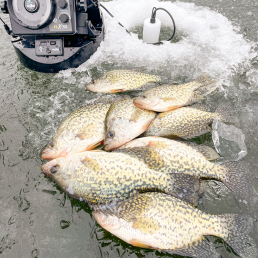
Chasing Down Spooky Panfish
As my fishing partner and I strapped on our cleats in preparation for a trek across the smooth ice, we discussed the possibility of dealing with spooky fish. We had fished this lake together several times before in the early-ice scenario, and knew we could be in for a challenge.
With no snow on the ice and an ice thickness of about 6 inches, the noise we would make would be substantial. Because water molecules are close together compared to air, sound is greatly magnified in water. A small noise on the surface becomes considerably louder under the ice.
With the help of GPS, we were soon in the general vicinity of where early-ice crappies typically hang out. With the aid of forward-facing sonar, we were quickly able to locate a small school of fish. I watched on the screen as my partner walked toward the school. As he got close to the fish, they moved off 50 feet to the side.
This cat-and-mouse game continued for a while until we gave up on these fish and searched for a new school to work. We did not catch a single fish out of this cluster of crappies.
After several years of ice fishing with forward-facing sonar, I have learned that winter fish are a lot spookier than I ever realized. The noise of walking and drilling holes makes fish nervous. During the early season when there is less ice and snow, the issue of spooky fish greatly increases.
There are some things that you can go do to combat the issue of spooky fish. One of the strategies we use is to look for fish that are less spooky. I don’t know why some crappies react to surface noise more than others, but they do.
Fish in shallow water are generally spookier than fish in water over 20 feet. Picking a lake that has deeper fish can help. However, even deep fish will get nervous with excessive noise on the ice.
You can be among the first to get the latest info on where to go, what to use and how to use it!
Generally, I like to drill a series of holes all at once to get the noise over with. However, there are times that I will drill as few holes as possible and be ready to drop a jig down before the fish decide to move away. When they do slide off to the side, you may be able to follow them and continue to pluck a fish or two from each hole.
Typically, I am not one to wait for fish to come to me. Instead, I try to chase them down. However, there have been times when we have drilled holes in a large area and waited for fish to move back in once they were chased out.
Snow on the ice is helpful and makes travel quieter. Cleats are necessary on smooth ice, but they do make more noise.
Fishing later in the day can also help. Once the sun dips towards the horizon, panfish tend to become less spooky. The magic low-light period can be productive.
Understanding the fact that winter panfish are often nervous creatures is an important first step in successfully catching them. Being as quiet as possible on the ice certainly helps, but after that, you may need to experiment with different options to outsmart the spooky fish.
Get better results from the time you spend fishing. Use information from the pros found in every issue of MidWest Outdoors, available by subscribing on our website.
MWO
SHARE THIS POST
Did you enjoy this post?
You can be among the first to get the latest info on where to go, what to use and how to use it!