
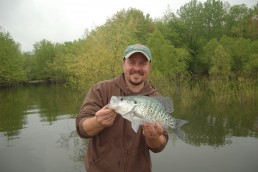
Catching Spring Crappies Before They ‘Come In’
You don’t have to wait for crappies to get to the shallows. Dave Csanda shares where to find spring crappies before they “come in.”
It’s a common early-spring complaint on reservoirs throughout the Mid-south and South: “The crappies haven’t come in yet.” So, folks stay home until they get word that someone has started catching crappies in shallow, flooded brush along shorelines. Then they come out to load up on the “easy fish” concentrated in visible locations along shore.
Had they bothered to try fishing a little deeper for crappies that were nearby, but not on shore, they could have been catching fish for a month or more.
As spring approaches, hordes of reservoir crappies begin moving toward the back ends of coves, in anticipation of shallow feeding and spring spawning. Until they actually move ashore in full pre-spawn mode, you have to look for them somewhere adjacent to their spawning grounds to catch them.
Let’s examine several common reservoir types to see where crappies hang out prior to spawning, and how you can catch them.
Flatland impoundments like Kentucky Lake, Kent./Tenn., have extensive shallow flats—maybe 8 feet deep or so—near the mid-portions to back ends of coves. Schools of crappies follow the more distinct portions of creek channels into the cove, up until the channel disappears. At that point, they tend to scatter.
Local anglers or fisheries agencies plant fish attractors in strategic places on the flats. The ones that lie offshore will gather and hold loads of fish up until they move shallower to spawn.
If you know where these fish attractors lie (sometimes, marked maps are available), you can drive right to them and catch fish. If you don’t, you can longline troll crankbaits until you snag them. Local anglers use fairly heavy line, like 8-to 10-pound-test, with fixed bobbers to suspend a baited hook 4 to 8 feet down; ideally, your minnow will drift just over the tops of the fish attractor, tempting fish to rise up from below. Use a soft, thin hook like a size 1 or 2 Aberdeen to hook your minnow through the back or lips. Should you snag, your heavier line will straighten the hook out and get your rig back.
You can be among the first to get the latest info on where to go, what to use and how to use it!
Highland impoundments like Bull Shoals or Norfork in Arkansas have steep, deep coves and very little wood cover offshore. In early spring, loose schools of crappies move into and suspend in the back ends of coves, often over 20 to 30 feet of water. Local anglers drift with multiple poles, lines and jigs or baited minnow rigs, suspending baits/jigs at different depths to contact fish.
Anglers practicing for walleye tournaments discovered that they could catch loads of suspended crappies, 10 to 15 feet or so down from the surface, by trolling jigs or small, shad- or minnow-profile diving crankbaits, spreading multiple lines to the sides of the boat with online planer boards.
Hill-land reservoirs like Truman in Missouri typically have more gently sloping coves than highland impoundments, and more structure than flatland impoundments in the form of creek channels, points and standing timber. This leads schools of crappies to follow channels into coves and stack up in channel bends, or at channel intersections. Standing timber on adjacent structure is likely to attract and hold fish, suspending in and around submerged tree branches.
Vertically jig a 1/16-ounce crappie jig, or a slip bobber to suspend a small jig or hook-sinker-minnow combo, at the depths which crappies are using in and around trees—generally 5 to 20 feet deep.
In all cases, some form of side-imaging or scanning sonar—Humminbird Side Imaging, Lowrance Side Scan or Garmin Panoptix LiveScope—provides massive advantages. You’re able to see fish below or to the sides of the boat, establish their depth, locate baitfish schools they may be feeding on, establish the depth and shape of wood cover, and in general fine-tune your approach quicker, rather than having to do so by trial and error.
If you like fishing for panfish, you’ll appreciate the tips and techniques you’ll find in every issue of MidWest Outdoors, available by subscribing on our website.
MWO
SHARE THIS POST
Did you enjoy this post?
You can be among the first to get the latest info on where to go, what to use and how to use it!