
Busting for Action
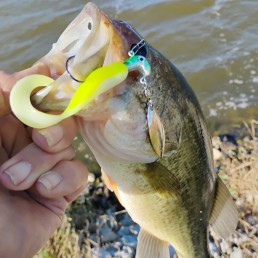
“Shad busts” are among the best indicators of actively feeding black and white bass. These feeding explosions can be found on the surface in any depth of water. Learning how to fish them to their maximum potential makes the difference in the numbers of fish caught.
The duration and size of a “bust” can vary. In shallow water, it is often a quick, violent burst of baitfish around some type of structure (weeds, stump, lay down, etc.). In deep water, it takes on the look of boiling water as a school of bass come up to feed on a large group of baitfish, often called pods.
Lures for fishing shallow and deep-water busts vary slightly.
For shallow water, try a 1/4-ounce Rat-L-Trap, 3/16-ounce Hammer Trap, shallow-running crankbait, 3/8-ounce stickbait, Casey’s Runner Head with trailer, 1/8- to 3/8-ounce spinnerbait, 6- or 7-inch plastic worm, or a jerk worm/shad.
For deep water, a 1/2-ounce Rat-L-Trap, 5/16- and 5/8-ounce Hammer Traps, 1/2- and 1-ounce Blitz Blades, deep-running crankbaits (including a deep stickbait), 6-inch jerk worm (such as Natural Forage Baits FT-Shad), swimbait, topwater plug or a 1/2-ounce or larger, double willow leaf spinnerbait.
Part of the reason for using larger lures in deep water is the ability to make longer casts, which in most deep-water situations is essential; they allow the lure to go deeper when the fish drop below the schools of baitfish. Also, in the case of the Hammer Trap, it is designed to be pumped, and has action and sound on the drop.
Shallow-water busts can be the most productive for numbers of bass. In a stump field, on a point, along a weed line, or in an opening flowing into another area, several quick bursts of feeding action indicate that active bass are covering the area. While larger fish can be caught in these shallow busts, deeper busts tend to hold a larger-average-size fish, but fewer numbers.
The starting lure choice for the shallows depends on the structure being fished. In most cases, a willow leaf spinnerbait, either regular-skirted, or an underspin such as the Casey’s Runner Head with QC Lure Worx Puddle Thumper, are good, all-around choices. But on open points, around weed patches and along weed lines, a Rat-L-Trap is often deadly. When the action slows, continue fishing the area with a jerk shad like an NFB 5-inch FT-Shad, or a swimbait such as an oyster shell B-Fish-N Pulse R, and then go to a plastic worm. If there is a deeper-water ledge, weed line, or some type of structure out from the shallow area, fish this spot before moving on.
With deep-water busts, a Rat-L-Trap and Hammer Trap are excellent starting baits. As the surface activity starts to fade, use the jerk worm/shad and swimbait. Once the surface is clear, begin pumping the Hammer Trap and Blitz Blade, and fishing deeper-running crankbaits. After cranking a deep-running stickbait down to a desired depth, try using a rip-and-pause retrieve which resembles a crippled shad, or a stop-and-go retrieve with a swimbait. Or pump or slow-roll a Casey’s Runner Head with a jerk shad, swimbait or Puddle Thumper as the body. These fish are still in the area, and if dark patches of baitfish are still visible on or near the surface, then the bass will be back.
You can be among the first to get the latest info on where to go, what to use and how to use it!
The finger jigging” technique works in both shallow and deep water, using soft plastic, minnow-type bodies of different sizes. I use Natural Forage Baits T-Shad and Phat Shad, and QC Lure’s Worx Lock 14 Minnow with a B-Fish-N H2O head for the smaller size; and for larger sizes, Natural Forage Baits’ FT-Shad on the H20 head, and Z-Man’s 3-inch Jerk ShadZ on an EyeZ head, This technique can be used at any speed and depth with an open-face spinning rig, using a 6-foot, 6-inch or longer rod having good tip action, such as B‘n’M Fishing’s 7-foot, Sam Heaton Super Sensitive and 7 1/2-foot, Godwin Crappie Cast.
When fishing a feeding school, don’t cast directly into it. In most cases, that may result in catching one fish, but in all likelihood, it will be the only one caught in the school.
Fish the outer edges first, and make long casts past the bust, to catch numbers of fish.
Take note of the time of day at which these fish were feeding in a certain location, and return to this, and similar locations, the next day, at the same time. Early-morning action can also indicate late-afternoon action in the same area. On very rare days, feeding will continue in the same area all day long.
While this article has mainly been referring to black and white bass, these same conditions can be found for crappies. So don’t forget to have a good selection of Team Crappie Road Runners at hand, such as the Slab Dragger, Slab Spanker and Crappie Tamer. Also, the previously mentioned “finger jigging” technique with smaller-size lures is perfect in this situation.
No matter what body of water, or at what time of year, if you’re “busting for action,” remember to watch for “shad busts,” and be ready to experience first-class, fish-catching action.
For more fishing insight from the pros who know, check out the next issue of MidWest Outdoors, available by subscribing on our website.
MWO
SHARE THIS POST
Did you enjoy this post?
You can be among the first to get the latest info on where to go, what to use and how to use it!