
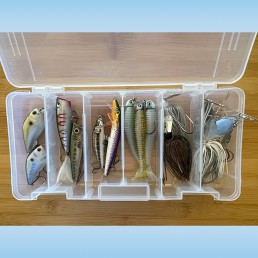
Building a Fall ‘Six-Pack’
This column has nothing to do with fitness and nutrition, or sporting those chiseled abs we once had tucked underneath our fishing attire. The “six-pack” referred to in the title of this column is directed toward my selection of six of my most productive bass baits for the season we are entering—the early-fall transition period for bass, and for almost species for that matter. Around this time of year, I often work this transition period into my teaching concept, because it is critical for success during this portion of the fishing season.
The late-summer/early-fall transition period is undoubtably my favorite and most productive time to be on the water. Basically, for a couple of months (weather depending), bass are on the move. Their bodies sense the coming of another winter, and they are in feeding mode. With water temps back on their way down, bass start moving from their deeper-water haunts and unburying themselves from weed lines, which now puts them well within casting distance for bank bassers.
While a bass’ food requirements are rather predictable at this time of year—basically, they eat as much as possible—their whereabouts aren’t as carved in stone. This time of year, I’ve found bass in the shallows, working deeper edges of cover, roaming in open water at various depths, and breaking the surface; no part of your body of water is off limits for transition bass. With all this in mind, to choose the best bait selection for the next couple of months ahead, here’s where the “six-pack” comes into play.
The “six-pack” concept originally started (for me) because I selected six of my most productive, early-fall baits that would fit into a handy, six-slotted Plano box. Keep in mind that, to find active bass at this time of year, you will be on the move. For that reason, I reduce my tackle hauling to one simple box. For that reason, I’m a little more selective these days as to how much I’m willing to carry on my back! My “tackle carry” choices have become a bit more refined.
So, what does my refined bait selection consist of, in two words? Search baits. I focus on baits that I can make long casts with, to cover as much water as possible. I also want baits that work the mid- to upper layer (and surface) of the water column, as bass are often “feeding up.” So, I want my baits to constantly be in plain sight—preferably overhead, or at least at their traveling level.
I’m not listing these lures out of bait preference or effectiveness; rather, I’m just going to start with baits on, or up near the surface, and make my way down. These are my favorites; you might have other options that you prefer to create your own “six-pack.” I’m just kicking out a few ideas to get you started.
Let’s start with the surface. For certain areas and fisheries, topwaters are the only baits that some anglers throw at this time of year. I find them productive when the water is on the warmer side at the early part of this season, just coming out of summer months, so the early part of September/October sees more use by me.
I know that lots of bank bassers break out buzz baits, and they are successful, but I prefer a fast-moving, popper-style bait. I kinda got hooked on Lobina Lures Ricos a couple years back; I’m not sure what the difference is to bass, but they seem to draw a few more strikes. They are on the pricy side, but there are multitude of popper options. The Rebel Pop-R has been around forever and is another favorite of mine. Choose your favorite brand. Just keep your bait size in that 3-inch range; it’s been my most productive size.
My next bait, while it makes for an incredible surface twitch bait, it as an outstanding choice to work just below the surface as well: the Original Rapala Floating Minnow. I think that every tackle box has at least one, and it has been catching bass since back in the late 1950s. This minnow bait still produces amazing numbers of fish. It’s a great topwater for slow-twitching just under the surface, letting it pause, and makes for a great, non-suspending jerkbait. In this case, it can be worked exceptionally fast. The Rapala Countdown Minnow, a cousin to the floating model, is a great bait when trying to locate active fish by letting the bait settle into the depths in search of active bass. These baits come in various sizes, but the 3- to 4-inch is my normal choice.
You can be among the first to get the latest info on where to go, what to use and how to use it!
Next was probably my go-to bait for many years: the square-bill crankbait. I still use them, although I throw a few more options today. A square-bill crankbait is a bass-locating machine. It probably covers water faster than any other search-type bait and it still pulls in bass for bank bassers. These baits cover the surface to 4- to 6-foot range, which is almost perfect for locating bass on the move at this time of year. For newer anglers, not much action is required on the angler’s part, other than to cast and crank; it’s a great learning bait. For the most part, throw the 1.5 series, which are in the 2.5-inch range; you can try larger or smaller, but the 1.5 is one of the most productive sizes, in my opinion.
A bait that has taken over my square-bill presentation as far as a search bait is the paddle tail soft swimbait. I won’t get into all various tail options. Keitech Swing Impact Fat baits have and will continue to be my favorite choice. They come in a multitude of sizes, but for fall bass, I stick with the 3.3-inch size range, which catches everything from 1-pounders on up to and past the 5-pound mark. You’re not limited to just Keitech with these types of swimbaits; it seems like every soft bait company has some version, so choose your favorites. I usually use a standard swimbait jighead, but if things get a little weedy, I choose a weighted swimbait hook. If you only had one single bait to throw exclusively at this time of year, in my opinion, it would be a soft swimbait.
Next up, and pretty much all the craze now, is the bladed jig, often referred generically as a Chatterbait, which is Z-Man’s actual trademarked bait and name. Size-wise, I generally throw the 1/4- to 3/8-ounce throughout most of my season, and do so at this time of year as well. Trailer-wise, that’s always a source of debate. Many anglers throw a soft swimbait tail such as the paddle tail named above, or straight-tailed minnow baits. While there is no wrong tail, I prefer a much more subdued action in the tail. Small, soft jerkbaits, or even sections of short finesse worms, work for me. The bladed jig is certainly another search bait that needs to find its way into your early fall rotation. It’s an excellent search bait that can be worked throughout the depths, challenging the versatility of even the paddle tail as a search bait during this time of year.
Our final bait to fill a slot in the 6-compartment Plano is one of the greatest bass baits of all time, yet has fallen from the spotlight: a spinnerbait. The bladed jig has pretty much taken the interest away from the spinnerbait as of late, but they are actually two different baits, yet many bass anglers compare the two against each other. I get the comparison, but they are stand-apart baits, and for that reason, I’ve included both to fill my “six-pack” box.
Years ago, the spinnerbait was considered an exceptional fall bait, on up until the cold-water season, depending on how you ran the bait. This time of year, I can search the water column, from burning it just under the surface much like a buzzbait, on down though the depth ranges, in search of active fish. Blade-wise, double willows are my favorite and get the job done, but you can opt for larger Colorado type blades if the water is stained and you need a little more thump. Size-wise, 3/8-ounce is my standard; once again, you can go smaller or larger if the fishing demands a different-sized bait.
Color-wise on all these baits, just pick your favorites; I believe we spend way too much time on color debates. I don’t really believe that bass are all that concerned with color variations as much as anglers are. Use confidence colors that you’re familiar with. The ability to search and cover water are much more critical than bait colors.
So, as the days begin to shorten, pack up that light “six-pack” box and head on out for some the most incredible action of the entire season!
For helpful bass fishing insight, check out the articles in every issue of MidWest Outdoors. Subscribe on our website.
MWO
SHARE THIS POST
Did you enjoy this post?
You can be among the first to get the latest info on where to go, what to use and how to use it!