
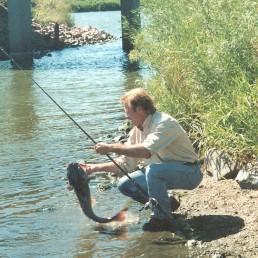
Bank Fishing Summer Catfish
The sound of the cicadas fills the air with a constant hum. A song of summer.
Probably the most popular fishing technique for summer catfish is bank fishing. By including all the fish caught in ponds and during summer picnics as well as the more serious anglers who pursue the whiskered wonder there are a lot of people out there enjoying the sport of catfishing. While bringing them to shore, catfish bite hard and give a good fight.
This widely distributed species is in most lakes and ponds, having either established naturally or been stocked by private parties and governmental programs. Fisheries biologists, particularly in the middle part of the U.S., report the stocking of catfish is probably the most popular of their programs.
The terminal tackle for catfishing is as simple as a worm threaded on a hook and suspended below a float. Other baits include a variety of artificial or natural offerings. Popular natural baits include such items as nightcrawlers or worms, minnows, chicken liver, blood, shrimp, etc. Artificial baits include crankbaits and jigs.
A popular bait is the cheese bait in all its forms. These often-foul-smelling concoctions are available from tackle dealers and bait shops. They are usually in plastic containers. Ethical anglers are sure not to leave the empty containers on the shore when they head home. Most cheese bait systems have a plastic worm you dip into the mix to soak it up. The fish then chew on the bait and set the hook.
Although catfish rods and poles come in a variety of shapes and sizes, they all work. Reels such as spin casting, spinning, and bait casting are all effective. The latter is a little more popular due to their ability to set a clicker system to alert the angler to a strike.
Due in part to the heat of the day, most catfish anglers prefer low light conditions, such as early morning or late afternoon and night. It is wise to fish hard and move when the fish are not biting. By locating stumps and other submerged wooden structure, one can find the larger fish.
In the heat of summer, catfish tend to hole up in the deeper water during the day, as the water is cooler, and the oxygen level is higher. As with all cold-blooded animals, fish regulate their body temperature through movement into and out of different water temperatures. Water at deeper levels tends to be cooler in summer than that near the surface where the sun has a chance to warm it.
You can be among the first to get the latest info on where to go, what to use and how to use it!
In evening and at night, catfish move up into shallow flats to feed. In early morning hours, they tend to seek the shade under lily pads before the water begins to warm up for the day. They seek the refuge of deep holes for comfort.
As an angler approaches an area, it is a good idea to look for shady spots where he will be comfortable and still can cast to the water he wants to fish. It is important that he can cast far enough out into the water to reach the spot he thinks holds fish. And, to do so without hanging up in overhanging tree limbs.
Anglers need to cast out accurately and wait for about 15 minutes. If you get no bite in that time, re-bait and try it again. Repeat the process a maximum of three times. If you catch no fish, move on to another location and begin again. Keep repeating the process until you catch fish.
If you are fishing a deeper hole, it is wise to begin at the bottom. If no fish bite, try using a float to hold the bait at specific levels, gradually working toward the surface. Usually, the catfish is in the bottom of the hole or about 18 inches from the surface.
The key to this pattern is to fish all the water both horizontally and vertically. Keep after it until you find fish and then have fun.
If you enjoy catfishing, you’ll find suggestions for locations and techniques in every issue of MidWest Outdoors, available by subscribing on our website.
MWO
SHARE THIS POST
Did you enjoy this post?
You can be among the first to get the latest info on where to go, what to use and how to use it!