
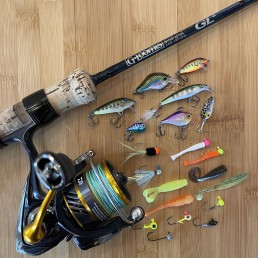
Backup Rod and Tackle
I was on a quest awhile back, geared toward locating a fishing rod that I believed I still had. As I pulled out the rods, I was hit a moment that quickly carried me back to the past.
I held in my hand a weathered, cork-handled, ultra-light spinning rod. Just holding that rod in my hand flooded my mind with fishing days gone by.
The rod at the center of this feel-good moment is a G-Loomis GL 2 5-foot, 4-inch Mag-Light EX-Fast Action 4- to 8-pound, 1/32- to 1/4-ounce spinning rod. I believe it’s about 30 years old, and I purchased it from a probably familiar fishing tackle destination for many in the Chicagoland area: Henry’s Sport and Bait. Henry’s doors are closed now, but it was a staple for anglers on the south side.
This little gem of a rod carried a pretty hefty price tag way back then, to which I added a Shimano Stradic 1000 reel. With a combo price of about $200 dollars, I had to scrape up some extra funds to buy line for it! With tackle prices today, that probably doesn’t seem like much, but back then, it was my showpiece rod for sure.
Why the heavy investment in just one rod? Back then, fellow CBA club members and I were into light-tackle presentations; float rods, long poles, small jigs with live bait, and the ultra-light tackle craze was in its infancy, and this particular rod combo was perfect for casting very light baits. Not many rods back then could cast a 1/32-ounce jig any distance, but this one accomplished that feat. I have to lay the blame for this expenditure on fellow anglers who introduced me to the Cubby Mini-Mite Jig.
I went through a time in my fishing when that GL2 rod was a mainstay in my fishing no matter where I went. But as with many things, we evolve as our angling experience grows and often goes down different paths. I never totally stopped the ultra-light approach, but that presentation went from an every-outing tactic, to more limited excursions. The float rods remained behind as I pursued other avenues of angling, chasing a multitude of species, both big and small. Yet for many seasons, no matter what my pursuit species was, that 5-foot, 4-inch GL2 rod and a tiny box of micro baits were safely packed away among bass, walleye, musky, carp, and catfish rods and tackle. Why? Because it was always my backup plan. If my truckload of various species gear failed to produce, my ultra-light GL2 became my “Hail Mary” play in the fishing world!
I had many fishing outings where everything just wasn’t working as planned for finicky muskies, reluctant walleyes, or cold-front bass, and my bundle of rods and bags of gear just couldn’t draw a strike. Yet my GL2 gave a little comfort, usually bringing in a few panfish, bass—anything to save the day. I’ve never lost that adolescent need to reel in something, and I never became a trophy-fish snob; I’m excited when I’m into a mess of bluegills and crappie, as much as I’m excited to land a 5-pound bass.
While I resurrected this old GL2 rod, my old Shimano reel met an early demise; basically, I used it so much that it just fell apart, literally, and has been replaced with a new shiny Daiwa Revros reel. My line of choice back then was either 2- or 4-pound mono; now, my reel is spooled with 6-pound braid, which is capable of making substantial casts with micro baits down into the 1/32-ounce range, which are all carried in a pocket-sized tackle box.
You can be among the first to get the latest info on where to go, what to use and how to use it!
The attribute of ultra-light gear is nothing new, but if it’s not something you’ve ever considered, maybe I can pique your interest. Small baits are very natural-looking to most fish and bring on less suspicion from wary predators, especially in heavily pressured waters.
My suggestion for ultra-light tackle is different than buying gear targeted for certain species of fish; instead, purchase ultra-light gear for just what it is: a way to present small/micro baits in a very natural manner. Many times, with my ultra-light gear, I’m not targeting any fish in particular, especially when I’m using it as my backup rod; you know, the “everything else has failed” concept. Ultra-light gear is awesome for wandering down the banks, with nothing extra to haul; just one rod in hand, great for covering quite a bit of water. This approach is also awesome when exploring new and unknown bodies of water; small baits let you sample what lives below the surface.
Rod selection is critical when casting ultra-light baits. You need to check out the rod’s rating; you’re looking for line weights in the 2- to 6-pound range, bait weights in the 1/32- to 1/4-ounce. Rod lengths can vary. Some ultra-lights can be a little too short; I find 5 1/2- to 6 1/2-foot, extra-fast actions are perfect. Medium-action rods have too much of a parabolic arch, becoming too whippy for casting; stick with the stiffer actions.
1000 to 2500 series spinning reels work best. Lately, I’ve been spooling up with light braid in the 6- to 8-pound range; if you prefer mono, 2- to 4-pound test will give you optimal casting.
For baits, you can’t hardly beat small jigs. I’m a big fan of 1/32-ounce jigs; I have always been a Cubby Mini-Mite fan, but there are a lot of other small jigs out there as well. Tails for these jigs—straight or swimming tails—I use them all. You have to do a little experimenting. But I can give you one bait on which I’ve been crushing pretty much any species that sees them: the Keitech 2-inch Easy Shiner matched with a 1/3-ounce head. Hold onto your rod when using these baits! Small, inline spinner baits and micro crankbaits are exceptional as well. Once you try these tiny offerings, you’ll be wondering why you’ve waited so long!
Whether you want to make an ultra-light setup your backup, or just want it for your primary rigging choice, you might find a bit of excitement that has possibly been void in your angling experiences as of late.
If you want to try a different, exciting fish species or technique, you’ll find plenty of suggestions in every issue of MidWest Outdoors. Subscribe on our website.
MWO
SHARE THIS POST
Did you enjoy this post?
You can be among the first to get the latest info on where to go, what to use and how to use it!