
The August Walleye Bite on Lake Mille Lacs
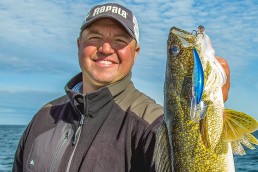
MWO’s Roger Cormier recently sat down with Tony Roach and asked about his success fishing Lake Mille Lacs.
MidWest Outdoors contributor and noted fishing guide Tony Roach shares his secrets for catching walleyes on Minnesota’s Lake Mille Lacs during the hottest month of the year in central Minnesota. Roach guides on this vast central Minnesota fishery in all seasons.
MidWest Outdoors: Tony, start by educating our readers about how the walleyes have transitioned from their early-season locations to your main August hotspots. There is a distinct change in the fishing pattern that anglers need to be aware of, and they need to adjust their tactics to stay on fish. Describe what happens.
Tony Roach: Once the big mayfly hatches are done around the first week of July, the walleyes transition from being concentrated on that deep structure to really scattering throughout the lake, especially across the main lake basin and around the mudflats. That’s the time I like to deploy crankbaits and troll with leadcore line, covering water “off structure.” That last big Hexagenia hatch usually happens in early July. When the fish run out of those larger bugs to eat, they start to roam a lot more, and trolling crankbaits is the way to catch those walleyes consistently. It can be a free-for-all on live bait around that last hatch, but I’ve literally had it happen overnight where you are catching fish with bait one day, and the next day that bite is gone.
MWO: Where should anglers focus their efforts to stay on fish?
TR: I generally start trolling around that same structure where I’ve been fishing with live bait. So, close to the mudflats, over the tops of the flats, or over the deep gravel bars. However, as we get later in July and into August, that can rapidly shift to trolling in “no man’s land” over the featureless basin. This coincides with the warmest water temps of the summer, along with a few small insect hatches in the basin that draw ciscoes as well as shiners and young perch into these areas. The walleyes follow them.
MWO: Leadcore is a great way to catch these walleyes for a lot of reasons. Tell us why.
TR: Obviously, number one is you can cover the most water. We troll leadcore at 1.8 to 2.2 miles per hour, and I will vary the “colors” of leadcore I let out to between two-and-a-half and four colors.
Editor’s note: Leadcore line is weighted, to pull lures to the depths without requiring sinkers or snap-on weights. Leadcore is segmented into 10-yard colors (30 feet) and the number of “colors” you let out determines the depth you fish, in tandem with the dive curve of the lure that’s attached.
You can be among the first to get the latest info on where to go, what to use and how to use it!
Because Mille Lacs is clear, I use very long monofilament leaders, much longer than what anglers might use on other Midwestern lakes. I like monofilament because it stretches (up to 20 percent) so much, making it more forgiving along with leadcore, which has no stretch. I use 10-pound-test mono, and 20- to 30-foot leaders. On other lakes where I troll leadcore, I might only use a 6-foot leader, so that gives you an idea of how clear Lake Mille Lacs is and how sensitive I am to being stealthy with my presentation.
MWO: Review your lure selection.
TR: As I’ve continued to experiment and refine my Mille Lacs trolling patterns, it’s become clear to me that fast-action, heavily erratic lures are the most productive options when trolling the open Mille Lacs basin. I’m a huge fan of the Rapala Scatter Rap series, especially the Jointed and the Taildancer versions. Jointed lures in general have been over-producing these last couple of years. That tight wobble—a fast, erratic action—is what triggers the most bites. And nowadays, it’s hard to beat the #5 Shad Dancer. This lure is an absolute killer with its tight, hard wobble that gives off a ton of vibration. I like to say: “It’s got exactly the right shake.”
MWO: Give us some secret tidbits about the Mille Lacs trolling bite that you’ve learned after logging so many hours on the water there.
TR: It’s interesting to note how colors and lure selection can vary from one section of the lake to another. Some areas of the lake, perch-colored or firetiger lures tend to work best. Then you troll other areas of the lake, and the best colors are completely different.
For example, when I’m trolling the south and east sections of the lake, I almost always catch more fish on crayfish colors and some of those perch patterns. Why? This is the part of the lake dominated by rock structure. Crayfish live here. Dark-colored crayfish lure colors simply catch more fish when I’m trolling near rock structure or over the deep gravel.
MWO: Great stuff, Tony! An occasional visitor to Mille Lacs wouldn’t necessarily be able to spot these trends.
If you want to find more great fishing advice from the experts, check out the August issue of MidWest Outdoors, available the first full week of August at the newsstand or by subscribing on our website.
MWO
SHARE THIS POST
Did you enjoy this post?
You can be among the first to get the latest info on where to go, what to use and how to use it!