
Alien Doves
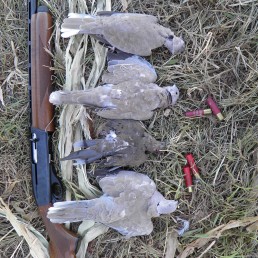
September is dove hunting time. On Labor Day evening 2023 I accompanied good friend, Luke Terstreip, Sr., to a freshly cut silage field. Luke had done some scouting, and we put out a rotating-wing dove decoy and let the birds come to us. For the first time in my dove hunting career, I saw and killed Eurasian collared doves.
The very first dove I killed that evening was dramatically different from the thousands of mourning doves I have taken in my life. First of all, it was huge. Secondly, it was a very light color, almost beige instead of the dark gray of the doves I am used to. Lastly, the bird had a distinct black ring around the back of its neck. I thought it was a ring-neck dove.
Later in the hunt, a pair of doves buzzed the silage, and I took them both. Both birds were also the larger sub-species that I later learned are called Eurasian collared doves.
The Eurasian collared dove is not native to the United States. It was introduced in Florida in the late 1980s. I am not sure why or how these birds were released in Florida, but their range has been moving northward at a very steady pace since then. They have now been documented in 48 states and provinces.
The first sightings in the Midwest were in 1997, and as of the dove census of 2021, Eurasian collared doves were found in hundreds of counties throughout the Midwest. They are currently most common in south/central Missouri. These statistics are bound to go up since studies have shown this dove’s population can double every 15-months. According to the U.S. Fish and Wildlife Service, there were over 194 million doves in the continental United States. This census included the foreign species.
You can be among the first to get the latest info on where to go, what to use and how to use it!
These doves are most commonly found very close to towns or to grain elevators. They have shown no adverse effects to native doves so far and are a much larger target. They are about 67 percent larger than mourning doves.
In Missouri, you can kill a total of 15 doves a day of combined species, with a 45-dove possession limit. Rules may vary from state-to-state, so check your local regulations.
So, as you can see there are lots of reasons to get out into the field and scratch-out a limit of doves before harvest, regardless of what they look like or what they are called.
If you want to try a hunting a different, exciting species or using a different technique, you’ll find plenty of suggestions in every issue of MidWest Outdoors. Subscribe on our website.
MWO
SHARE THIS POST
Did you enjoy this post?
You can be among the first to get the latest info on where to go, what to use and how to use it!