
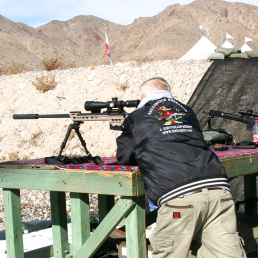
A Shot Too Far?
Two decades ago, riflemen were pleased to see long-gun accuracy at long range, which in those days was about 500 yards. Within the past decade, massive advancements in long-range shooting vary from very different rifles to space age ammunition in terms of design, which is often off-the-charts effective.
Over the previous 40 years or so, I have written three books and penned countless articles covering new guns, loads and real-time field test events. Some projects took place in the USA, whole some work also was completed in Australia over a five-year period. Australia was critical in this learning curve because, in the Outback, massive numbers of commercial-level warm targets were taken. Most were gunned at ranges well beyond what most hunters would consider normal.
Some writers tend to favor the development of new rifles due to a major advanced design element in range extension. While I agree with some of the design changes in rifles, I believe that most of the jump in long-range activity can be attributed to new optics, advanced ranging system (measurements), and advanced ammunition and cartridge design. Fifty years ago, I was shooting Remington VS bolt actions in 22-250 Remington that were pushing 500 yards against 1-inch, head-shot targets, as in prairie dogs.
Even using throwback 30-06 Springfield war production rifles rebuilt from the action on up, we were getting 1000-yard, paper-punching results, as well as some 400-yard-plus success on western mule deer hunts. Lacking at the time were scope sights that we now associate as very normal performance among longer-range rifle advocates today. Along with that, advancement in the world of ranging systems has jumped from almost stone age thinkers to a short trip to the moon. Something the size of a beer can returns information dead accurate out to a mile today.
Scopes in some cases feature built-in ranging as well as automatic sighting adjustment programs that only require the shooter to point, follow the red dot that is auto computing the exact range to the target, then adjusting the corrected elevation (drop) based on the cartridge and bullet you’re shooting. Even wind correction is currently under development using the measured speed of wind-driven dust particles for the exact adjustment regarding a bullet’s degree of drift; as well as the movement of the earth itself on ultra-long, north-to-south shots (one mile or more).
A local cowboy hunter here in western South Dakota watched his nine-year-old son drop his first elk in Wyoming by way of a 7mm-08 at 400 yards. It was a point-and-shoot task, as the small red dot set on the vertical cross hair adjusted to the exact range that the boy was holding on at the time (auto set drop system). Learning trigger control and the use of good rifle rest was all that was required. The point being, are we pushing the range envelope too far with all this advancement in guns, scopes, and loads?
Two schools of thought
The first school of thought is the guy who says, “If I see it, I shoot at it.” This person is common. Just because he spent the family budget on a long-range rifle and paired cartridge designed to hit a mouse at one mile, and then pays a guy to haul him around in the cab of a pickup truck all day, glassing for trophy bucks, does not make him a long-range hunter. In most cases, he came from a big-city environment with little or no understanding regarding fair chase or solid, hunter field ethics. Living in the American West, I am sorry to say that I see a whole lot of that nowadays. What this hunter needs is some education versus a sales pitch. Learning wind drift, animal behavior and some general knowledge of rifle ballistics could make a major difference.
You can be among the first to get the latest info on where to go, what to use and how to use it!
The second school of thought is that the hunter has spent time learning solid ballistics profiles associated with his selected rifle and cartridge. And learned how animals react to varied conditions in the field, with bullet hang time understood—meaning the time spent in flight as the bullet leaves the muzzle and reaches the intended target. Why is all this necessary? Because even one or two seconds spent as the bullet passes across the distance from the hunter to the game animal can mean a gut-shot elk, deer, or bear. I believe in shooting to 400 through 500 yards on an animal at rest. Even if a target animal begins to stand at the shot, the odds are that the vitals will still be hit.
Our second school of thought requires some dedication to the game of long-range shooting with hands-on, real-time practice leading the program. Even if knowledge is acquired from books or film, hunters need to become well versed in hard-nosed, long-range shooting techniques.
As such, what then is a shot too far? I believe that any shot where the hunter comes from a lesser skill level than what is required at the time is just too far in all cases. I got into long-range shooting by hanging around some 1,000-yard, open-sight, military shooting types, well before it ever became a point of major interest among some big game hunters. I trained with good rifles and proper cartridges on the prairie dog fields of South Dakota, and the Big Horn Mountains of Wyoming for several years prior to even trying my first 400-plus-yard poke at a trophy mule deer. Coming from Minnesota as a stump-jumping timber hunter, I had never taken a shot much beyond 200 yards regarding a big game animal; for the most part, brush-country shooting back East was, on average, under 50 yards when shooting a 30-30 Winchester with 170-grain round-nose bullet.
The bottom line here is, simply do not shoot beyond your skill level or equipment’s ability to accurately deliver a bullet. At times, I was not popular on Wyoming mule deer hunts when a low-skills hunter wounded a nice animal; as it stopped at the crest of a ridge to look back, it then got tagged by my 7mm Remington Magnum, versus losing the animal to coyotes. Believe me when I tell you that over 60 years of western shooting has allowed me to observe just about every kind of shooter imaginable. These observations have resulted in reaching the conclusion that most part-time riflemen need to stay in their correct performance lane and keep their big game shots under 200 yards, if even that far.
For more insight and tips on how to make the most of the time you spend hunting, check out the articles in every issue of MidWest Outdoors, available by subscribing on our website.
MWO
SHARE THIS POST
Did you enjoy this post?
You can be among the first to get the latest info on where to go, what to use and how to use it!