
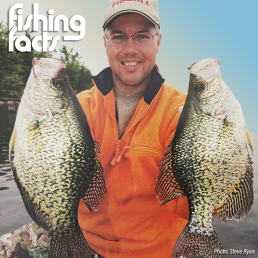
A New Spin on Crappies
written by Steve Ryan and previously published in Fishing Facts Nov/Dec 2007
The sun had yet to break the horizon as we motored toward the stump-filled bay. Several boats were already tied up to the shallow stumps in search of crappies. Cutting the outboard motor, I noticed the telltale sign of crappies chasing minnows well outside the stump fields. No need to join the pack. It was time to make hay while the big crappies were feeding aggressively over deep, open water.
The slip bobber rigs that we intended to use were shelved for a different approach. Since crappies generally feed in an upward fashion when corralling minnows, spinners are a natural lure choice. These lures offer a quicker and more efficient method for catching open water crappies. Since spinners come in a multitude of styles, experiment with different blades, sizes and colors until the best combination is discovered.
Spinners
As for spinner designs, companies like Worden’s, the makers of the Rooster Tail spinner, offer three different designs for all possible applications. The Sonic Rooster Tail has the blade spinning directly on the lure’s shaft without any clevis. This blade design creates maximum noise and vibration for stained water conditions. The second spinner style is the original Rooster Tail, which offers a narrower blade similar to a rounded willow blade. This blade spins quicker with less resistance and excels when one needs to cover more water. The third style of spinner is the Sonic Rooster Tail that contains a French blade. This blade knocks against the brass body of the spinner to send out vibrations, which mimics schooling baitfish. The greater “lift” created by its wide, cupped blade allows the Sonic Rooster Tail to be fished at slower speeds. All these Rooster Tail spinners come equipped with treble hooks, increasing the odds of hooking and landing paper-mouthed crappies.
The primary tactic when fishing spinners for crappies is to make long casts and methodically fan cast large grid areas. Keep the spinner high in the water column by holding the rod tip high and using a slow, steady retrieve. Once crappies are located, stay on the school with the electric trolling motor. The noise from an outboard motor will chase down bait and disperse crappies. Constantly scan the area for surface activity and make as little noise in the boat as possible.
Casting tube jigs
When the bite slows on spinners, immediately switch to a tube jig and minnow combo. Again, make long casts and allow the tube to sink several feet before starting a slow, steady retrieve. Pay attention to how far the tube jig sinks on each cast and at what depth bites occur. When casting tubes, don’t be afraid to fish a slightly heavier jig. One of the more productive combos is a 3/32-ounce jig head with a 1-1/2-inch Prowler tube. Prowler’s crappie tubes come in an assortment of crappie catching colors and the heavier jig head allows for longer casts to wary crappies.
You can be among the first to get the latest info on where to go, what to use and how to use it!
When the open water school scatters, crappies often move tight to cover. Wooden piers, old pilings, stump fields and deadfalls soak up heat from the sun and radiate it back into the surrounding water. These warmer temperatures and natural cover attract minnows—crappies follow.
When anchoring along stumps or pilings, position the boat to allow various casting lanes along the edge of the cover. Spinners can be worked high over the top of submerged cover without snagging. Again, follow up with tube jigs fished deeper and closer to cover. Next, switch to live bait fished under slip floats as the third option.
Live baiting
When live bait fishing, one trick that will result in more crappies being caught involves keeping bait healthy and lively—not merely alive. Crappie minnows require a constant supply of oxygen and cold water. Bait also becomes stressed when overcrowded in small containers. The most convenient way to accomplish these objectives is to use a Frabill Aqua-Life Bait Station container. At six gallons in size, the Frabill Aqua-Life Bait Station is much larger than most minnow buckets. The Frabill container is insulated, which allows the water to stay colder longer. In addition, the Bait Station contains a built-in aerator pump that runs on two D-sized batteries or an included 12-volt adapter. The Bait Station will keep more than five-dozen minnows in prime shape over the course of a long fishing day.
Since healthy bait is a key to catching more crappies, change bait often. It is a simple rule that few anglers follow. If you fail to have a bite after ten minutes, change your bait. Fresh bait reacts differently in the water, and crappies are attracted from greater distances to a lively bait.
Most anglers have experienced this, even if unknowingly. Have you ever been in the situation where one person in the boat is catching most of the fish? Everyone is using live bait and fishing the same spots, yet one person is catching fish after fish. With every fish they catch or miss, they put a new fresh bait on their hook and the fish react accordingly. Whereas the other anglers in the boat soak the same lethargic bait for extended periods of time. Quite simply, the person with the “hot” rod consistently has the best bait on their hook.
Conclusion
Keep these tips in mind the next time you are in search of crappies. Don’t be too quick to join the crowd. Work spinners aggressively when crappies are schooling over deep water. Change up to tube jigs fished slightly deeper, and always fish the healthiest live bait possible.
MWO
SHARE THIS POST
Did you enjoy this post?
You can be among the first to get the latest info on where to go, what to use and how to use it!
