The Autumn Shift for Lake Trout
During the heat of the summer months when the unrelenting hot sun warms the water of the upper column, lake trout in northern lakes seek asylum in the depths. With lake trout sometimes suspended in depths of 100 feet or more, anglers must rely upon downriggers equipped with heavy cannonball weights to sink and troll lures. While these anglers maintain the ability to catch deep-water-resident trout, not all anglers are capable of participating. With equipment limitations preventing the reach into deep water, most spinning rod and flyfishing anglers must sit on the sidelines—for now.
The crumbling of the prison wall
Throughout the warm months of summer, lake trout are effectively prisoners being held captive by a restrictive prison wall of warm surface water. This prison wall exiles lakers to a dark, cold dungeon far beneath the water’s surface. The sun cannot enter this dungeon to provide light, nor is it capable of generating warmth below the summer thermocline. Within this frigidly-cold darkness, lake trout rule as kings, prowling their domain for prey.
When the days begin to shorten and the fall season arrives, a transformation slowly begins. The surface water gradually undergoes a cooling transition. The prison wall of warm surface water that kept lake trout captive in a deep dungeon begins to weaken. Exiled no more, lake trout charge upward into water that was previously uninhabitable for them, and is now compatible with their preference for cold water.
With this cooler water now present everywhere on the lake, lake trout stage a full-scale invasion into many areas. Nothing is out of reach now, including shallow water along shorelines, reefs and rocky shoals. The ruling kings of the lake are now venture anywhere, and nearly the entire lake becomes the lake trout’s hunting territory. They now launch into aggressive territorial dominance and feed heavily.
Where, when and how
For anglers fishing with a spinning or fly rod, the fall season creates a welcome opportunity to catch lake trout. When the lake’s water temperature moves into the 50-degree range, lake trout display a steady presence in the upper 10 to 15 feet of surface water. They also make feeding forays into considerably shallower water, including along shorelines.
This generates a variety of fishing opportunities. Fall is a highly productive time to troll lures in the upper 10 to 15 feet of surface water, in both deep or shallow segments of the lake. Lake trout can be present near the surface during anytime of the day, but the best fishing opportunities will occur during low-light periods, such as early morning or evening. Trolling is a favored technique to effectively cover substantial portions of productive real estate, which dramatically increase your chances for connecting with lakers.
Sometimes, you may encounter fish while journeying across the surface of the lake. A large group of lake trout may be seen actively feeding on prey in a particular segment of a lake. If this occurs, cease trolling and start casting. At times, you’ll actually see feeding lake trout in the water, providing visible casting targets.
It’s important to choose the right rod. A spinning rod that has an industry-standard, fast-action tip will not perform well faced with the resistance of a trolled lure. A better choice for near-surface trolling is a medium-power, moderate-fast-action, graphite/glass composite rod 7 1/2 to 8 1/2 feet in length. This type of rod has the flexibility forgiveness that’s necessary to handle hard strikes on short lengths of line.
Lightweight, paper-thin flutter spoons, minnow-shaped plugs, and jerk baits are good lure choices for fall lake trout. If really big lake trout are present, try a wide-action plug. For flutter spoons, good choices include the Sutton 88 Spoon, Michigan Stinger and Silver Horde Kingfisher. Troll these flutter spoons 100 to 150 feet behind the boat for best results. For a plug and jerk bait, try a Smithwick Perfect 10 Rouge or a Rapala Original Floater (F11 and F13). For wide-action plugs, a good option is a Luhr Jenson Kwikfish (K13 to K15).
Try silver, silver/blue, silver/black, or copper on bright days with clear water. During low-light periods or overcast days, go with orange and chartreuse. During fall, a trolling speed of 1.8 to 2.4 mph, combined with multiple S-curves, will produce lake trout hits.
You can be among the first to get the latest info on where to go, what to use and how to use it!
When using a fly rod to troll for lake trout, a 9-foot, medium-fast-action fly rod paired with an 8-weight fly line is a good choice. Depending on the trout’s determined or suspected holding depth, a floating line or intermediate fly line works well near the surface; a full sinking fly line will effectively get you deeper if required. For fly patterns, try a grey ghost, black ghost and Edson tiger. These patterns in tandem, double-hook style provide the advantages of a larger profile in the water.
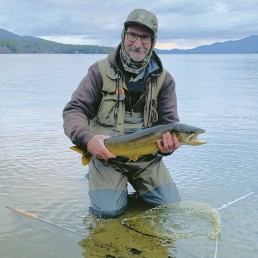
The fall season also creates enhanced chances for fishing from shore, along with shallow-water wading to catch lake trout near the shoreline. In fall, it’s common for lake trout to migrate into shallow shoreline water during the evening hours to hunt for prey. Many lake trout linger throughout the night, and some will still be along the shoreline during early morning.
Good locations for shoreline and wade fishing are along flats that have a connecting edge to deeper water, along with locations that have steep drop-offs along the shoreline. With this nearby safety haven of deeper water, lake trout will comfortably hang in these areas.
Lake trout will also gather in masses over rocky shoals, reefs and rocky segments of shorelines to spawn during the fall season when the water temperature ranges from 48 to 57 degrees. The male lake trout arrive days or sometimes weeks before the females; the females’ arrival is often prompted by gusty, fall winds that create water movement over the spawning areas. This water movement enhances the survival of eggs that are broadcast among the rocky bottom.
During fall, ciscoes and whitefish spawn within deep, cold lakes. Both are favored prey for lake trout, and their spawning often occurs in the same rocky shoals, reefs and rocky shorelines where the lake trout previously spawned—just not at the same time the lake trout are spawning. Whitefish spawning occurs with a lake temperature of 40 to 48 degrees, and ciscoes spawn afterwards when a lake’s water temperature drops to 38 to 40 degrees.
Whitefish and cisco spawning events really rings the diner bell for lake trout, and they will prey intensely upon these spawning fish. Large numbers of ciscoes and whitefish begin to arrive in spawning areas before dark, linger throughout the night to spawn, and then depart for the safety of deeper water in the early morning hours. Those time periods generate the best fishing opportunities for lake trout.
Without a doubt, the cooler water that occurs during fall provides a fantastic opportunity to catch lake trout. Get to your favorite lake this fall to find out how exciting it is to catch lake trout during this time!
Get better results from the time you spend fishing. Use information from the pros found in every issue of MidWest Outdoors, available by subscribing on our website.
MWO
SHARE THIS POST
Did you enjoy this post?
You can be among the first to get the latest info on where to go, what to use and how to use it!