Fall Fishing is the Best Fishing
The air felt crisp, the leaves sported a rainbow of color, and the rods continued to buckle under the weight of dandy doubles of bluegills. The lake was ours to enjoy in solitude. The summer thermocline was still present, but would be gone in a few weeks.
Fall is without a doubt the best panfishing of the year. I’ll repeat this because it’s superior to any other time of the year. Fall fishing starts in early September and continues until the lakes freeze over.
The boat launch is empty, the pleasure boaters are done for the year, and most anglers have taken up other activities or simply given up for the season.
When we mention panfishing, we mean fishing for bluegills, crappies, and perch.
On the inland lakes we fish, a combination of the two mentioned species, and sometimes all three, is caught on one outing.
Location can be paramount and varies from lake to lake or within a lake. Generally, by mid-October, some of the fish will start using the shoreline structure.
Five-foot depths, plus or minus a foot or two, can be very productive. Other schools will be found hovering in the deeper basins of the lake. On many of our lakes, this depth is between 25 and 30 feet. The fish will normally be down 12 to 20 feet, depending on the thermocline level. The fish will be found nose to the bottom and perhaps halfway up after the fall turnover takes place.
Our favorite locations are the deep-water basins. I just love locating a school of deep-water fish. Almost always, this will be a mixed bag of fish species. Often, we will find the bluegills suspended slightly higher than the crappies.
Side Scan will pinpoint these large schools of fish. We set our side scan to read 80 feet to each side of the boat. Once a school is located, we throw out a marker buoy. We continue onward, looking for a second school in the same vicinity.
When we are fishing at depths greater than 15 feet, we fish vertically. When casting, we cast and follow our baits down to the bottom. Once the bait hits the bottom, we let it sit for a few seconds, then twitch it a foot or so.
In nearly any situation, we fish a tandem rig. The tandem rig can be made up with a combination of the following: some type of perch fly, which could be a fish skin bait or a fly made with marabou; glow-in-the-dark teardrops; pinky-style jigs; small bluegill flies; and small crappie jigs, with my favorites being made with marabou, deer hair, or chinchilla.
We tip these baits with either a piece of worm when the water temperatures are above 55 degrees, or a wax worm when the water is cooler. If we suspect that crappies or perch are present, we carry a dozen or two minnows.
I rarely use minnows in warm water. Once the water temperature falls to the low 50s or into the 40s, I get a bit more serious about using minnows.
As the water cools, slow down your retrieve or drift. Drifting between .3 mph and up to one-half-mile-per-hour is okay early in the fall. As the cool weather kicks in, your bait needs to become nearly stationary. Think about how fast you move in winter, and move slowly.
The Gulp Minnow is an overlooked bait that worked well for us in the past. The 1-inch minnow caught plenty of bluegills, perch, and crappies. A friend put me onto this bait, and it works surprisingly well.
Adding glow to your presentation increases your return. A glow-in-the-dark teardrop, a fly with a glow strand of flashabou, or a small glow egg added to your line, for some crazy reason, draws in the fish.
You can be among the first to get the latest info on where to go, what to use and how to use it!
We fish with two rods, most often with two different baits or lures on each. Once the fish tells us their preferred bait or lure, we adjust the balance of baits and lures.
From late November through all of December, one potential hazard or distraction will present itself—skim ice! This happens every year, as will a few snow flurries. Trust me, the temperatures might be cold, but the action will be hot.
In the past two years, we have been able to fish right up to New Year’s Day. In the past five years, we fished late into December. A few years back, we were shut down for five days, and then a warm spell gave us a break.
We noticed a pattern during these five years. Fish locations changed a bit from early October through freeze-over. Suspended fish became less common, and bottom-hugging fish became more common. Most often, the locations where we find fish in late October will remain productive late into December. But the speed at which we fish will most certainly change.
We often Spot-Lock once we find a school of fish. These fish want a small bait or profile bait. And they want it on their noses, enticing them. Become a line watcher; bites can be subtle, even when two fish bite at the same time.
Last December, we caught crappies within 2 feet of the bottom. The bluegills were two to four feet off the bottom. We also noticed that as the water cooled, the required hook size shrank. The largest hook we use for ‘gills is a size 8; a 10 is better. Crappies would hit a size 6 or a size 8.
Some of our fishing buddies fish in shallow water. At times, this might be 3 to 6 feet. They look for the warmest water in the lake, which is often near a shoreline that receives the most sunlight.
These anglers use the smallest possible slip floats. They also weight the line so only 30 to 40 percent of the float is visible. They also use a lot of glow-in-the-dark teardrops from Stopper Lures. For really finicky fish, they use Skandia Tungsten glow teardrops. Their Tungsten jigs have a smaller profile.
The second change was the sinker weight. As the water cooled, the sinker needed to be lighter. This was a critical part of the game. Spot-Lock became a must-have item.
A sensitive rod and light line are required. Four-pound test is the heaviest we have ever used. Our favorite rods are fly rod blanks that we built using spinning rod guides. A sensitive but slow-action rod works better than a faster-action rod.
Red worms or leaf worms thrive best during the warm-water period. Wax worms and spikes work best during the cold-water period. Perch Pounder rigs work great, as do small flies tied onto a 1/64-ounce jighead. Make sure that you use something with a bit of glitter or something that glows. We add a soft glow egg and slide it over the barb, right up the eye of the hook. Minnows are used for the crappie and the perch.
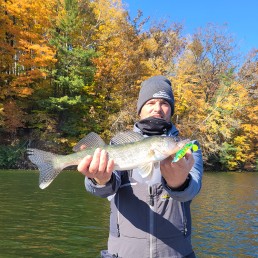
After the fall turnover, a few days chasing walleyes, bass, and pike are in order. We concentrate on two locations. Any green weeds or the sharpest, quickest drop-offs in the lake.
Fall fishing is the best. Fat fish putting on the feed bag, very few anglers, and incredible weather. Yes, snow flurries are pretty, especially when you are catching some fish.
For more insight and tips for fishing throughout the year, check out the articles in every issue of MidWest Outdoors, available by subscribing on our website.
MWO
SHARE THIS POST
Did you enjoy this post?
You can be among the first to get the latest info on where to go, what to use and how to use it!