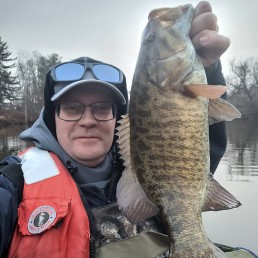
November River Smallmouths
Here in Wisconsin, we are blessed with high-quality smallmouth rivers and streams. Some are hundreds of yards wide in places, and some may be only 25 feet wide. They all have the same elements. Shallow water could mean 6 inches in some streams and 6 feet in others. Deep holes could be 6 feet in some streams and 25 feet in other rivers. But the common denominator is, whether it is 6 feet or its 25 feet, it’s the deepest water available.
Those deep holes, or deepest water available, is where all the smallmouths hang out for the winter. They start to migrate to these areas in October. It slowly comes together like a flashmob until all the beautiful smallies are stacked in these deep holes for winter. The colder the water gets, the more they migrate and school up in their winter homes. That’s why, when I see skim ice along the shore, I know it’s going to be a good day. And that’s why I love November (and sometimes December when Mother Nature allows) stream and river smallmouth fishing.
So, location is locked down. But it takes some special patience to catch smallmouth bass in 35- to 40-degree water. When I say slow, this is a new level of slow. Cast out and let the bait get to the bottom. Don’t move it. Literally don’t move the bait for 10 to 15 seconds. Now, just shake the slack line. If nothing happens, pick it up, move it two feet and repeat. Yes, it’s painful, but it’s deadly.
You don’t feel the tell-tale thump like you do when it’s summer. The line just gets heavy and slow; that’s the best I can describe a hit. It feels like you have hooked a small, springy branch. This time of the year, if you feel any resistance, just set the hook. Hooksets are free, and when the water is this cold, strikes aren’t what you are used to. When in doubt, set the hook.
I’m getting away with the lightest tackle I can at the end of the season: usually 5-pound braid with a 6-pound fluorocarbon leader on a medium-light rod. If you aren’t comfortable with the 5-pound braid, try 8-pound. I will get into this in a second, but 5-pound lets me cast tiny 1/16-ounce hair jigs with ease. There is very little water resistance with the 5- or 8-pound as well.
Let’s get into the meat of the issue: lures. I’m using 100% soft plastics and hair once the water gets below 40 degrees. Jerk baits, blade baits, and tail spinners work well in cold water. But in my observations, their effectiveness drops off once the water gets under 40 degrees.
Let’s start with the obvious. It’s become the G.O.A.T. for finesse bass fishing everywhere: the “Ned Rig.” It works well in cold water, and here is no exception. My one piece of advice is to cut them to two inches for late-season smallies. Black or watermelon have been my best colors.
Another standard is a tube. The one requirement here is that the tube should be 2.5 to 2.75 inches long. A small, bite-sized tube is deadly in cold water. This is probably the best bait for shaking in place on the bottom. A 1/8-ounce head allows current to sweep it a bit when you lift it. You can also squeeze scent into it, which is an added attraction in cold water.
You can be among the first to get the latest info on where to go, what to use and how to use it!
Some of my favorite cold-water river smallie baits are any aquatic insect baits. The most popular is a soft plastic hellgrammite. Keep it 3 inches or less. I like fishing a helgy on a 1/8-ounce football head so I can just slowly drag it along the bottom and “feel every rock.” Situations where it hangs up on a rock and then releases triggers strikes. Aquatic insects are always in the river, and always a great food source for river smallies.
Speaking of a food source that is always in a river, you can never count out a crawfish. Craws don’t hibernate! They go dormant at times, but they never hibernate. They are always around and are a high-protein food source for the stream. There are so many plastic craws out there that it’s hard to mention a specific model. But, like the helgy, keep it 3 inches or less. Baits from the Great Lakes Finesse company are great for late-season smallmouths.
Last, but not least, are marabou hair jigs. They are the “when all else fails,” tie on the hair. Black or olive are my best colors. Weights are as light as you can get away with.
A 1/16-, or even a 1/32-ounce is perfect when the water is cold. Unlike the other baits I have talked about that need to be on the bottom, never let a hair jig hit the bottom. Swim it slowly, as close to the bottom as you can without making bottom contact, and you will score with hair jigs.
With any of these baits, when the water is under 45 degrees, I really like adding scent. I have no evidence that this helps, but I feel like it can’t hurt. As described earlier, I will let a bait sit motionless for 15 seconds. When a bait sits still, I know a bass could be looking at it, and it doesn’t hurt if it smells good, too. Everyone has their favorites, and the water-soluble vs. oil-based debate will go on forever. I use both, and I wish I could tell you one shined over the other. I like Procure Sticky Gel (Smallmouth Crush or Goby) to add as I fish. I also marinate baits Old Salt “Old Time” scent (Wisconsin Company) which is more of a water-based scent. I think it helps when you are fishing as slowly as we are in November.
I know it’s cold. I know it may even be snowing, but if you can get out on one of our great smallmouth rivers or streams, you won’t be disappointed.
For more insight and tips for fishing throughout the year, check out the articles in every issue of MidWest Outdoors, available by subscribing on our website.
MWO
SHARE THIS POST
Did you enjoy this post?
You can be among the first to get the latest info on where to go, what to use and how to use it!