
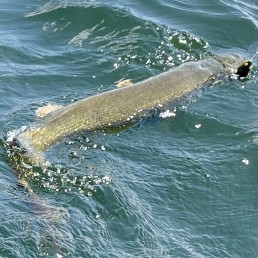
Winning in the Wind
The bite for virtually any gamefish can be darned good in darn big winds. Here are some strategies that may help make the best of it.
Before the blow
When facing fierce winds, a first consideration can be changing course. Big, open water, unless there’s an offshore gale with promising water near shore, isn’t likely the best option for most watercraft. If available in the area instead, and fortunately in the Midwest we usually have a lot of options, picking a smaller water or river can be a much better bet.
Another consideration is the layout of the lake or river section. For example, when a lake is mainly oriented east-west and you face a fierce westerly, it might be difficult to navigate and fish well. A north-south lake shape, and preferably not too wide a body of water, can bring a better day even if the fishery might not be as strong as your first choice.
Other factors can include the locations of boat launches, and shoreline configuration. An onshore gale can make busy public access sites so ridiculous that it’s tempting to pull up a chair, pop a cold beverage, and just enjoy the entertainment, instead of fishing. But a better option can be a different access site, if available, that offers some wind protection. Especially if the rest of the lake or river has a layout that provides a break from big winds, at least part of the time.
Go with the blow
You’ve made your choices on body of water and access; now it’s time to make the wind work for, not against you. As long as you can still safely present lures or baits well enough, better fishing is usually available in windy spots, which tend to have more aggressive fish in the reduced visibility, with more vulnerable forage. I’ve mostly struggled to understand the wily walleye, for example, but have still had my best days when these fish went from mysterious to reckless during a strong wind that pushed tons of forage onto the right structure, like a big, offshore bar.
Trolling is best accomplished using the wind to your advantage, so try drifting directly downwind, or angled downwind if the area can be covered well that way. Up to a point at least. Maybe it’s 20 mph winds for most vessels, with the motor angled upwind and trimmed to keep the bow down, catching less wind. Forward trolling downwind can still bring decent control. Much beyond that wind speed, though, it’s better to motor upwind. Move your boat well away from the area into calmer water, and make trolling passes at downwind angles.
Other spots, such as shallower areas with tight contours and weedy cover, making it tough to keep trolling baits clean, can warrant casting in a big wind instead. The same principle applies: Moving directly downwind, or at angles close to that, lets you both cast better and retrieve with less bow in your line from the blow. If not too awful to partially cast upwind, such as working specific cover like weedy patches as you pass them, use spinning tackle versus casting gear, which can result in limiting casting distance and hellish backlashes, even for experienced anglers.
Why fight it? Go with the blow as to gear selection. In some windy situations that don’t make it impossible to cast, get into a rhythm, throwing big bomb casts downwind with casting tackle, then casting back, when needed, at upwind angles with spinning tackle. With any type of tackle, keep your rod tip low so less line is exposed to the wind, which helps with feeling hits.
Speaking of strike detection, lures with substantial resistance, and therefore tighter lines during a retrieve or trolling pass, help with this. Larger and/or tandem blades on spinnerbaits, in-line spinners, and livebait rigs pull tightly, allow less bow in the line, as do crankbaits with lip designs that pull hard. Slim minnow baits and spoons, on the other hand, usually result in more slack in big breezes, allowing a striking fish to expel them more easily.
Skilled jigging anglers can still do well in heavy seas, however; heavier jigs are warranted. But there’s something to be said for other methods that may work better on a given day.
You can be among the first to get the latest info on where to go, what to use and how to use it!
Another underrated tactic in current times, which can be a big help in big winds, is anchoring. Yes, some of us still use a rope and chunk of heavy metal! Anchoring off the bow can be much better than using “power poles” off a low stern in rough seas. If you have the Spot-Lock feature on a bowmount trolling motor, that is a great option, too.
For manual anchoring, work down a windblown structure by pulling the anchor up occasionally as you progress; just disengaging it from the bottom a bit is enough to drift back in intervals. Then the boat swings around in each spot, allowing for thorough coverage and better focus on fishing presentation with less of a boat control battle.
Time to punt?
However, when the going gets too tough, the tough should not be too stupid. If you can’t fish safely or effectively where you want, even plenty of aggressive fish are more difficult to catch when execution is severely limited. In fierce gales blowing the tops off already big waves, boat control is a mess, especially when battling a fish. Lines blow around so wildly that even changing a lure is a challenge, let alone tying a simple knot.
If it gets that bad, it’s time to punt, such as carefully motoring to at least a somewhat protected area instead. Even if it has fewer fish than very windy spots, you can present lures or baits to them much more effectively, and have a better day. It’s not as if all gamefish flee to windy areas in these conditions. Promising structure and cover is still promising, but the fish there may be less aggressive. You can get sensible approaches into their strike zone more effectively, though, and better hook and boat them as well.
There are also ways to take advantage of a big wind’s benefits without a direct bass kicking in the process. Like a large shoreline point where you stay mostly downwind out of the worst of it, but bomb cast, or even troll a bit out into the current pushing by, into the big eddy that forms just past it. These spots can be as productive as the front of the point, but without fighting such huge waves.
Another example is a lake narrows, creating a river current effect even if wider than most rivers. Fishing the downwind sides of shoreline protections lets you present better and still reach gamefish fish turned on by the current and relative squeeze of forage through the narrower area.
Hopefully, these strategies help you the next time a big wind threatens your big fishing day or weekend.
Get better results from the time you spend fishing. Use information from the pros found in every issue of MidWest Outdoors, available by subscribing on our website.
MWO
SHARE THIS POST
Did you enjoy this post?
You can be among the first to get the latest info on where to go, what to use and how to use it!
