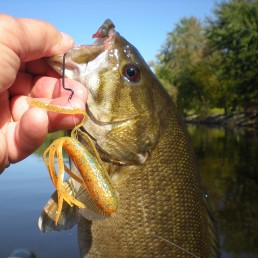
Tubes: Baits for All Seasons
I wasn’t the first person to fish a tube. They had probably been around for ten years before I discovered the delight of the tube jig.
Most anglers pick up a bait or two they have never used each year. Me, too. My Einstein moment came when weed line largemouths had me befuddled one summer evening. That’s when I spied the small package of tubes stuffed in my plastic box. So, I figured, what the hey? And tied one on—a baitfish imitation. After going two fishless hours prior, I quickly caught two nice bass. Unfortunately, no other takers that night. But I gave the bait ample room, for the future. And I’ve been fishing it ever since.
What I found out is that the tube works in all seasons and in all waters, whether lake or river. Fall became one of one of my favorite tube times, because they work. I remember one June evening when I stumbled into my first outing during the summer peak. I pulled up on a breakline, tossed my tube to the break… and had a fish running with the bait before I got the trolling motor locked down. And the action never stopped!
I don’t really think there are too many rules that govern the bait. It’s truly a bait for all seasons, as far as size, colors and retrieves.
Size comes into play based on season and subject: 2 1/2-, 3 1/2-, 4-, and 4 1/4-inch tubes are all part of the mix. Smallmouths are key subjects for the smaller end, especially when finesse is called for. A 3 1/2-inch is a normal smallmouth bait, but some 4-inchers are thinner and work well.
Usually, a jig head works good as an insert on smaller baits. Rigging a mid-size tube Texas-Style makes for a nice dragging rig. Or, rig it on a traditional head, which you can pop through the top of the tube after you insert it. That makes it easier to hop off bottom. This type of insert provides a perfect wounded minnow as it spirals back toward bottom after being snapped up. Largemouth lovers, take note.
A lumbering version of a tube as evidenced by Yum’s 4 1/4-inch ribbed tube is great for rigging Texas-style, where it can be both a weed line bait or go into the weeds when the fish are backed into cover. I am not sure if they are still made. But, if not, look for the most durable 4-inch tube you can find.
Color-wise, there are a lot. I like a black back/white bottom as a minnow imitator. Green pumpkin is a great basic color for largemouths, as are watermelon seed and black/blue fleck. Plain white has been used a bunch on fish that may still be bedding. It is easier for anglers to see (or not see) if the fish grabs it: The bait disappears!
You can be among the first to get the latest info on where to go, what to use and how to use it!
For smallmouths, everything from watermelon to green pumpkin works. As do crawfish orange and firetiger color patterns. A friend passed on a bubblegum, pinkish/orange tube that also worked good when fish were bedded.
So, it’s fall. Go check your favorite river as the days get colder. Save your fluorocarbon line for clear water spring and summer. Most rivers are off color and you can get by with your normal tackle: Medium-action rods and reels with 10- to 12-pound-test line. Tie a fluorocarbon leader to your mono or braid, though.
Once you’ve caught one, you know how hard upset smallmouths can fight. To be safe, I still like to have something heavy along. So, I have a baitcaster or two armed with 14-pound fluorocarbon. It helps me slow down bigger fish.
As October moves along, you can also start experimenting with long rods, lighter line, and smaller tubes. Berkley’s MaxScent offers small and large versions. These release scent, so you can actually pause them on bottom and let them come to you. If you have one of the Spot-Lock trolling motors that will hold your location, this is an ideal time to use them as a location holder. Cold-water smallmouths like very slow presentations, and those tactics can help make your offering more appealing.
If you are not currently fishing tubes, this might be the time to try. When you do, you’ll probably decide to have some rigged up for spring and summer action as well.
Looking for some new fishing techniques to try this season? You’ll find plenty of suggestions in every issue of MidWest Outdoors. Subscribe on our website.
MWO
SHARE THIS POST
Did you enjoy this post?
You can be among the first to get the latest info on where to go, what to use and how to use it!