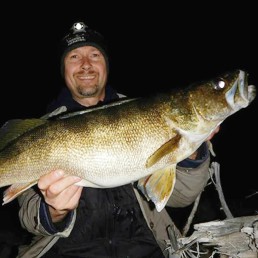
Holiday Hijinks on the River
The dazzling red, yellow, orange, and gold colors of early fall have long since departed from the trees lining the river, replaced by a dull brown of bare branches and carpet of dead, fallen leaves. So, too, have most anglers left the water, many to scratch their hunting itch during deer season. Silence reigns along the river’s course, other than occasional flocks of vocal waterfowl quacking, honking, and heading ever southward. An occasional shotgun burst breaks the eerie quiet, immediately replaced by a blanket of stillness.
Not yet full-on winter, but getting there, the terrestrial environment slows to a glacial pace as Thanksgiving approaches. But beneath the surface, feeding activity has yet to peak—at least for river walleyes seeking to put on additional fat prior to the icy gloom looming on the horizon.
Beneath the surface, waves of walleyes are arriving in the tailwaters areas below dam. Here, the combination of current and deeper water allow fish to spend the winter without fear of being locked in ice, as they might be in shallower areas farther downstream.
Tailwaters encompass more than the deep washout area immediately below the dam. A mile-or-more stretch of open water will likely be present throughout most of the winter, except in the harshest and cruelest of climates; where and when that occurs, much of the tailwaters, and perhaps even most of the washout hole, may skim over with ice for a few weeks to a month. But there’s still sufficient current flushing through beneath the ice to make the area a safe sanctuary during winter’s harshest freezes.
Even so, reduced winter current allows fish to move and feed throughout the washout hole. In general, if sauger are present, they claim the deepest portions of the hole, belly-to-the-bottom in 25 to as much as 50 feet of water, if available. Walleyes are likely to assume shallower positions along current breaks rimming the hole, perhaps in 12 to 18 feet of water during the day and moving shallower at night. Under cover of darkness, depths of 3 to 8 feet can draw walleyes shallow under the cover of darkness. Areas of reduced current—eddies, wing dams, retaining walls, points, bridge pilings, etc., become focal points of fish activity.
Most anglers simply flock to the hole area in late fall and vertically jig the bottom, using a 1/4- to 3/8-ounce jig tipped with a fathead minnow. Controlled drifting downstream at the same pace as the current allows the use of short, vertical lines that transmit every tick of the jig on-and-off bottom, as well as detecting light hits from wary walleyes and sauger. Medium spinning gear with 6- to 8-pound mono line matches nicely with fishing moderate-weight jigs in reduced current. If you need to fish deeper or in stronger current, chiefly for sauger, upsize to a 1/2-ounce jig head. If you find yourself missing short strikers, add a stinger hook to your jig to nip fish that barely wrap their lips around the tail of the jig.
You can be among the first to get the latest info on where to go, what to use and how to use it!
Often missed by anglers are the shallower, shoreline-related, current break areas mentioned earlier. In late afternoon or evening, anchor or hover your boat within casting distance of a wing dam, shoreline point, or eddy. Then cast out a 1/8- to 1/4-ounce jig, let it barely sink to bottom, and retrieve it back with a swimming or lift-drop retrieve that minimizes snagging rocks or pieces of wood lying on the bottom. Perhaps even consider a diving crankbait like a Shad Rap. Big walleyes moving shallow to feed during low-light periods will whack ‘em.
Remember that the first mile or so below a dam can display similar patterns. In fact, slightly downstream areas often tend to produce larger walleyes than the bananaland of the deep hole, which is more likely to produce numbers of smaller walleyes and sauger.
Finally, if you can safely walk down to the shore after dark and cast from the shoreline or riprap, give it a shot. This is your most likely opportunity to catch a whopper walleye of 10 pounds or more. Cast either a jig/soft plastic combo (shad or curly tail), or a neutrally buoyant minnow imitator like a sizeable Husky Jerk 12 (4 3/4 inches). Relatively few folks try it; they know what others are missing.
Around about Thanksgiving, don’t just set your sights on turkey and the trimmings. River walleyes and sauger are on the bite. Spend a day or two away from TV football, on a river near you. You might just spawn a new holiday tradition.
For more insight and tips for fishing throughout the year, check out the articles in every issue of MidWest Outdoors, available by subscribing on our website.
MWO
SHARE THIS POST
Did you enjoy this post?
You can be among the first to get the latest info on where to go, what to use and how to use it!