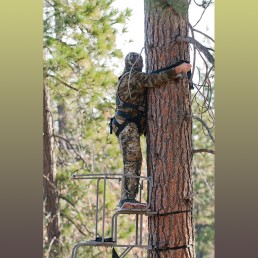
Not all Trees are Created Equal
Whether you hunt deer with a gun, muzzleloader, or bow, proper stand placement can play a big part in your hunting success.
There are many things to consider when choosing a stand site. Deer are edge dwellers that need both deep woods for cover and open areas where they can browse. The meeting of these two biomes is called an ecotone or edge. Match a cluster of edges up with water and food, and terrain features like a ridge or saddle that helps to further funnel the game, and you have a recipe for success. Areas such as clear cuts, old roadbeds, fences, power lines, field edges, swamps, rivers, planted pines, and mature hardwoods occur throughout the deer woods, and must meet each other at some point and become an edge. Spots like this will traditionally be good year after year… until they change. And that is the kicker; some hunters use the same spot that was successful for them long after the edge has moved to some other location, taking the deer with it.
There is no one spot that is perfect day-in, day-out. I hunt my stands sparingly and rotate which stand I hunt. Very seldom do I hunt the same stand more than three times in a year. I believe that the more you hunt the same stand, the less likely you are to continually see deer. While deer don’t have long memories, hunting the same stand day after day is a plan for failure.
The first and second time you hunt the stand provides the best opportunity at a quality buck. After that, deer get wise and change their movement patterns. Keep the element of surprise in your favor and hunt each stand only when conditions are best for each particular stand site. Of course, another prominent reason to have several locations selected is that another hunter might just take yours, and you will need to switch locations without any hesitation.
The tree you pick to climb can help you in many ways as well. Pines and cedars offer great concealment with their many branches and permanent needles. A split-trunk tree makes for a great permanent stand. This gives you concealment from two directions, and you have the option of changing the way you face if the wind changes, or if you want to hunt the same tree in the morning or afternoon.
The type of tree also determines the type of stand you use. Climbers do well on straight, branchless pines, but are next to impossible to use on scrub oak. A ladder stand, while bulkier, will probably give you the most options for tree selection. It also allows you to quickly change to another tree if conditions or deer movement warrant. Of course, a safety belt should always be used with a treestand.
Whatever type of stand you use, don’t let the tree pick your placement. Make sure the tree itself is safe. Look carefully for dead branches that can fall (see photo). Consider entrances and exits; the best tree is worthless if you cannot enter or leave it undetected. Plan your path using any concealment that you can find.
You can be among the first to get the latest info on where to go, what to use and how to use it!
Consider the sun when placing a stand. When possible, position the sun so that it will be behind you, and the deer will be looking into it, instead of the other way around. With the sun and tree at your back, you will be in the shaded part of the tree, which will help conceal you, and keep you a few degrees cooler.
Wind is also a big consideration for stand placement, but not a dependable one. Try to find the best wind advantage you can in relation to deer activity. It is better to have fewer deer that don’t detect you, than lots of deer that all catch your scent. You want to be facing into or quartering into the wind.
However, the prevailing wind on your windsock at home is usually all but meaningless at your hunting area. Trees, streams, hills, and valleys can do weird things to wind direction. Streams and valleys can act as funnels and drastically change the “prevailing” wind direction. Trees buildings and other tall structures can create a backdraft eddy that, within a large local area, is completely opposite the direction of the prevailing wind. Convection currents from open fields, water or even just different vegetation can change local winds.
On large hills, hot air will move uphill during the day, carrying your scent with it, and cool air will move downhill during the night. Hillside stands positioned so that you are shooting parallel to the slope, or slightly downhill, probably work better in the afternoon. Attach a small piece of marabou feather or light thread to your bow, and watch it while you’re going to your selected area. Make your final placement accordingly.
Finally, as stated earlier, don’t get tied to a particular spot because it “looks” good. Look for new spots every time you go out. Always be critical of your choice, and don’t be afraid to move to a new place.
For more insight and tips on how to make the most of the time you spend hunting, check out the articles in every issue of MidWest Outdoors, available by subscribing on our website.
MWO
SHARE THIS POST
Did you enjoy this post?
You can be among the first to get the latest info on where to go, what to use and how to use it!