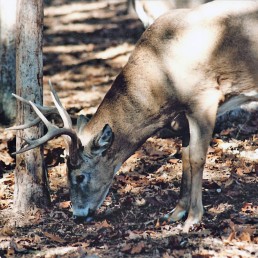
Bowhunting Lessons
The season for hunting white‑tailed deer is upon us, and archers are learning what they did not know about their sport. Bowhunting can be a humbling experience. In 40-plus years of hunting with this primitive weapon, I learn each year that taking a deer involves more than just shooting it. Take heart; there is still time to learn from your mistakes.
Lesson 1
A good map of the hunting area is a must. A topographic map is probably best, but a good county map will also do well. Mark off areas that are used for bedding and feeding, as well as sources of water. Deer need all, three and will travel on a regular basis between them.
By marking trials and indicating the time of the day the deer will be on them, plan hunting stands to intercept migrating deer. For instance, in the morning, deer travel from feeding areas along a ridge to a bedding area, or to water. A hunter who knows this pattern can set up along that ridge to intercept deer.
Lesson 2
Some hunters use too much scent. If a little works, then more is better, right? Wrong! Use cover scents sparingly. Some hunters use so much that it scares off deer. Cover scents are used to hide the hunter, not draw attention to him. Hunters should bathe and wash clothing in unscented soaps to erase as much scent as possible. Then, a small amount of cover scent is used to neutralize any scent left over. Do not smoke or use any scented products such as hair spray, deodorant, or cologne while hunting.
Lesson 3
Once at the stand, check your shooting lanes for twigs and branches that could deflect an arrow. They can be tied back with thread or removed if necessary. By looking carefully for even the smallest of twigs, you can prevent an arrow deflecting just a little, which could mean the difference between success and just another shot.
Lesson 4
Once in a stand, do not present a silhouette. Try to stay with a large object to your back. It could be a large tree trunk, brush pile, boulder, etc. Anything that will break your silhouette will help with concealment.
Lesson 5
Camo face makeup is often over-used. Just some marks on the face to break up the outline should be enough. Some hunters carry this to extremes by painting their whole face. It is not necessary.
Lesson 6
Knowing the habits of deer is probably the most important part of deer hunting. Deer in heavily-hunted areas avoid main trails and follow less-often-used ones paralleling them. In heavy forested areas, they feed in cutover areas, near lakes, in marshes, and along stream edges. Powerline rights of ways are good. Two other good areas are along forest roads and fire trails. Deer, although they feed in open fields, are creatures of the edges. They are uncomfortable out in the open, but like the vegetation. They feed on the edge only a few bounds from concealment.
Lesson 7
Pay close attention to the last animal in any group of deer. When they move about, does usually lead, followed by the young of the year. Older bucks trail along, and the big guys usually are off to the side and away from the herd.
You can be among the first to get the latest info on where to go, what to use and how to use it!
Trophy hunters learn early on to seek big bucks away from the herd, except during the rut.
Lesson 8
The final lessons are about equipment. Bowhunters need to know how their weapon performs. The important thing is that it be consistent and accurate. Bowhunters have a multitude of factors to consider, and equipment should be checked regularly during the season.
Lesson 9
Bent or damaged arrows do not fly where you intend. The only good-flying arrow is one that is straight from nose to tail. Check them for straightness after every trip into the field. A hunter can bump his bow quiver against a tree by accident and bend an arrow ever so slightly. That affects its accuracy. Arrows should be checked for lose nocks and points, as well as fletching. All of these can become loose without you being aware of it.
Lesson 10
Bowstrings do stretch. Strings used on a hunting trip should have been on the bow for at least a month prior to the trip. Each day, at the end of the hunt, check the string and cables for any frays or cuts that might cause it to fail at the moment of truth.
Lesson 11
Practice with the tackle to be used in the field both before and during the season. One thing about bowhunting is that you do not get a lot of shots. Spend a little time limbering up before taking to the field, as well as some time out for practice between trips.
Lesson 12
If you shoot with a bow sight, check the sight pins during practice to make sure they have not moved from accidental contact.
Bowhunting deer is a very complicated sport. It should be studied and restudied. It not only requires the ability to see deer, but also the necessary skill with your weapon to affect a clean, humane kill.
For more insight and tips on how to make the most of the time you spend hunting, check out the articles in every issue of MidWest Outdoors, available by subscribing on our website.
MWO
SHARE THIS POST
Did you enjoy this post?
You can be among the first to get the latest info on where to go, what to use and how to use it!