
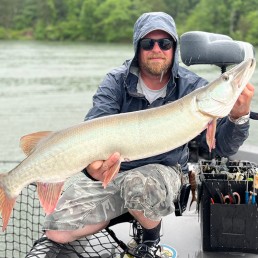
Spinnerbaits: Versatile Muskie Lures You’re Overlooking
Spinnerbaits may be the most versatile and overlooked tools in a muskie angler’s arsenal. But in the modern age of muskie tackle, with most anglers’ minds fixed on what’s new, many snub their nose at the lowly spinnerbait.
While a premium-quality muskie spinnerbait will not win awards at a trade show or stop customers dead in their tracks in the tackle store, I can assure you that it will do one thing: Catch muskies.
A top-quality muskie spinnerbait can solve problems when the bite gets tough or completely disappears. They can be fished high, low, fast, or slow, through cover, along edges, around wood, over rock, and even boatside with total control. When muskies refuse to chase other presentations, a spinnerbait can be stalled, pulsed, dropped, or crawled through cover and structure. As a guide, this timeless classic still gets me out of more jams than any other lure in my tackle arsenal, because it is the most versatile lure that a muskie angler can have.
That’s the part many muskie anglers miss. Spinnerbaits are not just beginner lures. They are not only for dirty water, thick weeds, or early-season fish. They are control tools. They let anglers manage depth, speed, vibration, and contact cover and structure with a level of precision that few lure categories can match.
The real strength of a spinnerbait is that it can be modified and controlled without changing the entire presentation. By adjusting rod angle, blade choice, and retrieval speed, the same basic lure can become a shallow-running bait; a slow-rolled, cold-front bait; a deep edge tool; a cast-back lure; or even a vertical presentation.
That flexibility matters, because muskies do not always do what we want them to. Some days, they change their lure size and profile preferences on a whim. Some days, they bury in cover. On others, they plant their bellies on the bottom, just out of reach of smaller presentations. When conditions are not in my favor, I always reach for a spinnerbait because it gives me nearly limitless options without forcing me to completely start over.
The things that matter for muskie spinnerbaits
Every spinnerbait is controlled by four main variables: head weight, blade selection, rod angle, and retrieve cadence.
Head weight is the foundation of the lure. Heavier heads provide stability, cleaner tracking at higher speeds, and better depth control in current. Lighter heads shine in shallow cover, slow-speed presentations, and situations where you need the lure to ride high above cover or work at the slowest speeds.
Blade selection controls lift, vibration, and running depth. Wider blades like Colorado blades create more lift and more thump. They are strong choices in vegetation, stained water, shallow cover, or when muskies need a slower-moving target. Narrower blades, especially willow-style blades, create less lift and allow a bait to run deeper with a tighter path of travel.
Rod angle is the most underused control system in spinnerbait fishing. Most anglers try to manage depth with reel speed alone. That is a mistake. A high rod tip brings the lure up. A low rod tip drives it deeper. Small rod angle adjustments during the cast can make the difference between riding cleanly over weed tops or burying in them, or between crawling over rock and digging into it.
Retrieve cadence gives a bait life. A spinnerbait can be reeled straight, slow-rolled, pulsed, ripped, stalled, lifted, dropped, or crawled. It does not have to move at one speed on one path from the beginning of the cast to the boat.
Selecting the right spinnerbait
Spinnerbait selection starts with weight and head design. A moderate-weight spinnerbait offers the most flexibility because weight can be added on the water, but it is hard to take weight away. The 1 1/2-ounce class is a strong middle-ground for many muskie situations.
You can be among the first to get the latest info on where to go, what to use and how to use it!
Head shape matters. A flatter head tends to run shallower and fall forward, which works well in vegetation and shallow cover. A drop-style head tends to run deeper and fall flatter, making it better for deeper edges, vertical work, current seams, or more controlled drop presentations.
Blade style should match the job. Willow blades run deeper and create less lift. Indiana blades balance vibration and lift. French blades add resistance and a different vibration signature that can be useful around pressured fish. Colorado blades provide maximum lift and allow very slow, shallow presentations.
One of the most important rules is: If the vibration is right, but the lure is running too high, add weight before changing blades. Anglers often find a blade combination that fish respond to, then abandon it because the bait is not running deep enough. In many cases, the better answer is to keep the vibration and solve the depth problem.
Core retrieves
The straight retrieve is the baseline, but it should not be mindless. Even on a straight retrieve, you should control running depth with rod angle and speed. Run the spinnerbait just over vegetation, along the outside edge, or across shallow cover. Let it make occasional contact, but do not let it bury.
The slow-roll is one of the best, tough-bite spinnerbait retrieves. Maintain just enough speed to keep the blade turning while keeping the lure close to weeds, rock, bottom, or a breakline. This is a premier, cold-front and post-front retrieve. Add small stutters or half-pauses to change the blade rhythm without moving the bait too far forward.
The lift-and-drop retrieve is excellent around weed edges, holes in vegetation, timber, and steep breaks. Lift the bait under tension, then lower it on a controlled fall. Do not throw total slack at it. A spinnerbait falling under control can helicopter, flare, and keep the blade working. Many bites happen on the fall, or on the first handle turn after the fall.
The pulse retrieve is a simple way to mix up a straight retrieve. Use short rod pumps or brief speed bursts without advancing the lure too far. This makes the bait surge, flare, and settle while staying in the strike zone.
A spinnerbait is not just something to reel through weeds. It is one of the best speed, depth, and cover-control tools in muskie fishing.
When the bite is tough, when fish are buried, when follows will not convert, or when other lures stop producing, do not overlook the old classic. A well-fished spinnerbait can still get you out of jams.
Looking for more ways to increase your catch rate? You’ll find plenty of suggestions in every issue of MidWest Outdoors. Subscribe on our website.
MWO
SHARE THIS POST
Did you enjoy this post?
You can be among the first to get the latest info on where to go, what to use and how to use it!
